Quick Answer
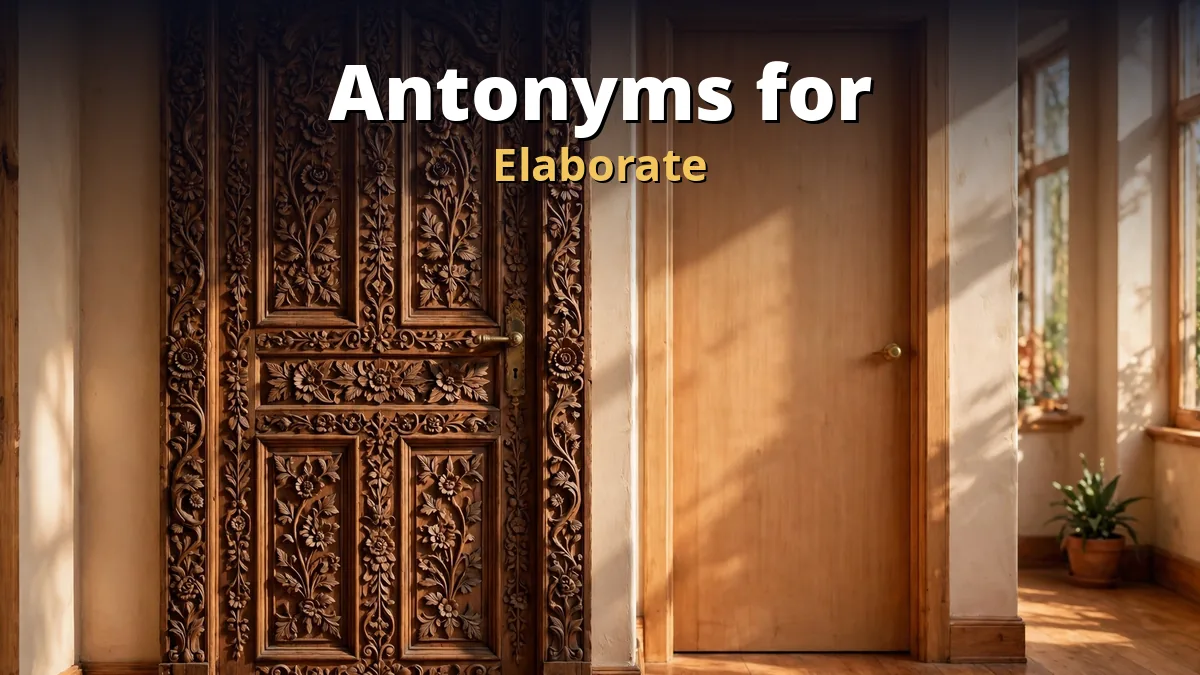
The clearest opposite of elaborate is simple. Something elaborate is built up with many details, parts or steps; something simple has few of them and is easy to take in at once. For decoration and style, the everyday opposite is plain.
Quick Comparison
| Word | Type | Meaning | Example |
|---|---|---|---|
| Simple | True opposite | Having few parts or steps; easy to understand or do | She gave a simple explanation that everyone followed. |
| Plain | True opposite (style) | Without decoration or extra features | He wore a plain black suit to the interview. |
| Uncomplicated | True opposite | Not involving many stages or difficulties | The repair turned out to be uncomplicated. |
| Basic | Contextual opposite | Covering only what is necessary, nothing extra | The cabin had basic furniture and little else. |
What Elaborate Means
To start with the word itself: elaborate (adjective) means made with great care and many details worked out fully, part by part. An elaborate plan covers every step; an elaborate carving is covered in fine work; an elaborate excuse has a story built into it.
Elaborate is also a verb (pronounced slightly differently, with the stress at the end): to elaborate is to add detail to something “Could you elaborate on that point?” Both uses point the same way, towards more: more parts, more detail, more work. Its opposites all point towards less, fewer parts, plainer surfaces, shorter explanations. Note that elaborate is neutral or approving in careful contexts (an elaborate safety system is a good thing), so its opposites are not automatically praise either: a simple plan can be exactly right or not detailed enough.
Core Antonyms
1. Simple
Meaning: Having few parts, steps or details; easy to understand, use or follow.
Example: Instead of the elaborate five-course menu she had planned, they served a simple meal of soup, bread and salad.
Best context: Plans, explanations, designs, systems, meals, language the widest everyday opposite.
Nuance: Simple is the head-on reversal: where elaborate adds, simple leaves out. It can be a compliment (clear, honest) or a criticism (too simple for the task), so let the sentence show which you mean.
2. Plain
Meaning: Without decoration, pattern or extra features; ordinary to look at.
Example: The elaborate wedding dress stayed in the shop window; she chose a plain one she could wear again.
Best context: Clothes, food, rooms, packaging, language (“in plain English”).
Nuance: Plain is about surfaces and style, where simple is about structure. A plain cake may still be made by an elaborate recipe; plain tells you how it looks and tastes, not how it was built.
3. Uncomplicated
Meaning: Not involving many stages, rules or difficulties; straightforward to deal with.
Example: What looked like an elaborate application process was actually uncomplicated one form, ten minutes.
Best context: Procedures, repairs, journeys, arrangements, medical or legal matters described reassuringly.
Nuance: Uncomplicated removes difficulty rather than detail. An uncomplicated design can still be beautifully made; it just asks little of the person using it. Of the three, it carries the most relief.
4. Basic
Meaning: Covering only the necessary parts; the simplest level of a thing, with nothing added.
Example: The elaborate hotel suite was booked out, so they took a basic room with a bed, a desk and a kettle.
Best context: Equipment, skills, versions, models, accommodation, knowledge (“basic first aid”).
Nuance: Basic is a contextual opposite: it means the floor level of something, which sometimes carries a hint of “not enough.” Use simple when you mean the opposite kindly, basic when the missing extras are the point.
Opposites by Context
When elaborate is a verb (to elaborate = add detail): the opposite is to summarise or be brief. “She elaborated for ten minutes” reverses as “She summarised it in one sentence” detail removed rather than added.
When elaborate describes a trick, excuse or scheme: straightforward and honest. An elaborate excuse is reversed by a straightforward answer, not by a simple object.
When elaborate describes decoration: plain and unadorned. This is also where the connection to meticulous work shows: elaborate things are often made meticulously, and their opposites are made or look with far less fuss.
Words That Are Not Antonyms
- Detailed, intricate, complex, ornate: near-synonyms of elaborate, not opposites. An intricate design is an elaborate one seen up close.
- Cheap: about price, not detail. An elaborate handmade chair can be cheap, and a simple one can cost a fortune.
- Boring: a judgement, not a reversal. Plenty of plain, simple things are interesting, and plenty of elaborate ones are dull.
- Unelaborate: you will meet it occasionally, but it is rare and awkward. Simple and plain do the job in natural English.
Example Sentences
- Elaborate: The students built an elaborate model of the solar system, with every planet labelled.
- Simple: Her instructions were simple: boil, stir, serve.
- Plain: He prefers plain food, rice, lentils and vegetables, nothing fancy.
- Uncomplicated: Moving in was uncomplicated; the flat was empty and the keys were ready.
- Basic: The basic model has no camera, but it makes calls and lasts a week on one charge.
Common Mistakes
1. Elaborate as a noun
Incorrect: He gave an elaborate of the plan.
Correct: He elaborated on the plan.
Why? Elaborate is an adjective or a verb, never a noun. For the noun, use “an explanation” or “the details.”
2. Confusing elaborate and elabourate spellings in the verb
Incorrect: Please elaborate the report.
Correct: Please elaborate on the report.
Why? The verb takes “on” or “upon” before its topic: elaborate on a point, elaborate upon a theme.
3. Using simple when you mean simplistic
Incorrect: His simple argument ignored half the evidence.
Correct: His simplistic argument ignored half the evidence.
Why? Simple is neutral or positive; simplistic means so simple that it leaves out things that matter. The mistake matters because one praises and the other criticises.
Mini Quiz
1. Which is the best opposite for “an elaborate ceremony”?
Answer: a simple ceremony, few parts, little fuss; plain would describe how it looked.
2. “Could you ___ on that idea?” Elaborate or summarise, if the speaker wants more detail?
Answer: elaborate, the verb means to add detail; summarise does the reverse.
3. A phone with only calls and texts, nothing extra, is best described as ___.
Answer: basic, it covers the necessary level only.
Short Q&A
What is the best opposite of elaborate?
Simple. It reverses both halves of the word few parts instead of many, easy to grasp instead of worked out in detail. For looks and decoration, plain is the choice.
Is elaborate a positive word?
It depends on the subject. An elaborate security system sounds thorough; an elaborate excuse sounds invented. English leaves the judgement to the context, and so do its opposites.
What is the opposite of the verb elaborate?
Summarise, or be brief. To elaborate adds detail; to summarise strips an account down to its main points.
Elaborate or complicated: which opposite set?
They overlap but differ: complicated means hard to understand, so its opposite is straightforward or easy. Elaborate means rich in detail, so its opposites are simple and plain. A thing can be elaborate yet easy to follow.
Key Takeaways
- The core opposite of elaborate is simple: fewer parts, less detail, easier to take in.
- Plain reverses its decoration and style; uncomplicated reverses its difficulty; basic marks the necessary-only level.
- As a verb, elaborate reverses to summarise or be brief.
- Detailed, intricate and ornate are elaborate’s family, not its opposites.

I’m Leo Jackson, an English writer with a soft spot for the peculiarities of language and vocabulary. He specializes in exploring the nuances of English synonyms, antonyms, helping students, writers, and professionals choose the right word with confidence. My guides combine careful research with clear, practical explanations.