Quick Answer
A scythe has no true antonym. It is the name of a hand tool, a long curved blade on a long handle, used for cutting grass and grain. Tools do not have opposites in the way qualities like hot and cold do. What readers usually want instead is one of two things: the scythe’s smaller relative, the sickle, or the machines that replaced it, the mower and the combine harvester. Neither is an opposite; both are explained honestly below.
Quick Comparison
| Word | What it really is | Why it is not an antonym |
|---|---|---|
| Sickle | A smaller, one handed cutting tool | A relative of the scythe, not its reverse |
| Mower | A machine that cuts grass | The scythe’s successor, not its opposite |
| Combine harvester | A machine that cuts and gathers grain | A modern replacement for hand reaping |
| Blade | The cutting part of the scythe | A part of the tool, not a contrast |
What a Scythe Is
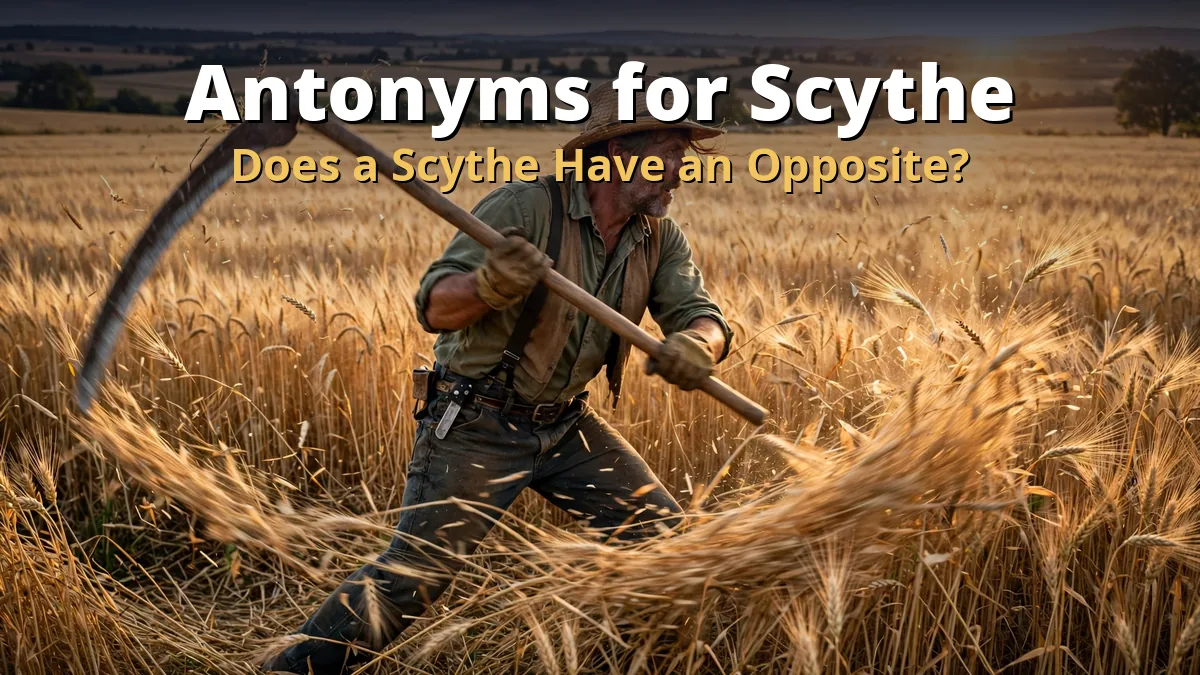
A scythe is a farm tool with a long, gently curved blade fixed to a long bent handle, often called a snath. The worker holds it with both hands and swings it in a wide arc, cutting grass, hay or grain while standing upright. For centuries it was the standard tool of the harvest, and it is still used on small plots and steep ground where machines cannot go. Its shape is so familiar that the figure of Death, the Grim Reaper, is drawn carrying one.
Why There Is No Antonym
Antonyms reverse a quality or a direction: hot and cold, rise and fall, join and separate. A scythe is not a quality or a direction. It is an object, and objects have parts, relatives and replacements, but not opposites. A hammer has no opposite, and neither does a spade. Asking for the antonym of scythe is like asking for the opposite of a chair. The honest answer is that English does not have one, and any list that offers one is inventing it.
The Words Readers Actually Need
Sickle
Meaning: A short tool with a curved blade and a short handle, held in one hand.
Example: She cut the wheat with a sickle, gathering the stalks with her free hand.
Best context: When you want the scythe’s smaller cousin, used close to the ground.
Nuance: The sickle does the same job as the scythe, only smaller and slower. Same family, not an opposite.
Mower
Meaning: A machine, pushed or ridden, that cuts grass with spinning blades.
Example: A mower did in one hour what a scythe once took a morning to finish.
Best context: Lawns, fields and modern farming talk.
Nuance: The mower replaced the scythe; it did not reverse it. A successor is not an antonym.
Combine harvester
Meaning: A large machine that cuts grain, separates it and collects it in one pass.
Example: The combine harvester crossed the field where reapers with scythes once worked in lines.
Best context: Modern grain farming.
Nuance: It answers the question of what took over the scythe’s work at harvest, nothing more.
Words That Are Not Antonyms
Sickle is the most common wrong answer. It is a relative of the scythe, smaller and held in one hand.
Hoe and rake are fellow farm tools. Working alongside a tool does not make a word its opposite.
Seed and sowing belong to the start of the growing season, while the scythe belongs to the end of it. Opposite ends of a process are not antonyms either.
Example Sentences
- The old farmer still cut his hay with a scythe.
- A scythe needs a sharp blade and a steady swing.
- The sickle is smaller than a scythe and is used with one hand.
- Mowers and harvesters have replaced the scythe on most farms.
- In old pictures, the reaper carries a scythe over his shoulder.
Common Mistakes
Incorrect: The sickle is the antonym of the scythe.
Correct: The sickle is a smaller relative of the scythe, not its opposite.
Why: Both tools cut crops in the same way. Words for tools in the same family are relatives, not reversals.
Incorrect: Every English word has an antonym, so scythe must have one.
Correct: Many nouns, especially names of objects, have no antonym at all.
Why: Antonyms reverse qualities and directions. An object like a scythe has neither.
Incorrect: The mower is the modern opposite of the scythe.
Correct: The mower is the modern replacement for the scythe.
Why: A replacement does the same job faster. An opposite would undo the meaning, and cutting tools all share the same meaning of cutting.
Mini Quiz
- True or false: a scythe has a dictionary antonym.
Answer: False. It names a tool, and tools have no opposites. - Which tool is the scythe’s smaller relative: the sickle or the rake?
Answer: The sickle, a one handed tool with a short curved blade. - What machine took over the scythe’s work on most farms?
Answer: The mower for grass, and the combine harvester for grain.
Short Q&A
What is the opposite of a scythe?
There is none. English has no antonym for the names of tools, and scythe is a tool’s name.
What is the difference between a scythe and a sickle?
Size and grip. A scythe has a long blade and a long handle, is swung with both hands, and cuts while the worker stands. A sickle is short, is held in one hand, and cuts close to the ground.
What replaced the scythe?
Machines. Mowers took over grass cutting, and combine harvesters took over the grain harvest.
Why does the Grim Reaper carry a scythe?
Because reapers harvested grain with scythes, and the harvest became a picture of lives being gathered in. It is symbolism, not a clue about antonyms.
Key Takeaways
- A scythe has no true antonym, because it names a tool, and tools do not reverse.
- The sickle is its smaller relative, not its opposite.
- The mower and the combine harvester are its replacements, not its opposites.
- If a list gives you an antonym for scythe, it is inventing one.

Hi, I’m Amna Akhtar. I write about word meanings, opposites, and the small distinctions that make English tricky. I don’t come at language purely from instinct, either. I have a peer-reviewed academic paper “Determinants of Jobs Satisfaction of Female Teachers: An Evidence from District Hafizabad, Pakistan,” published in education economics, and that research background shapes how I think about language content, I want it to actually help people learn, not just look correct on a page. Whether you’re a student, a writer, or just someone who wants to use the right word at the right moment, my goal is to make that easier for you.