Featured Snippet
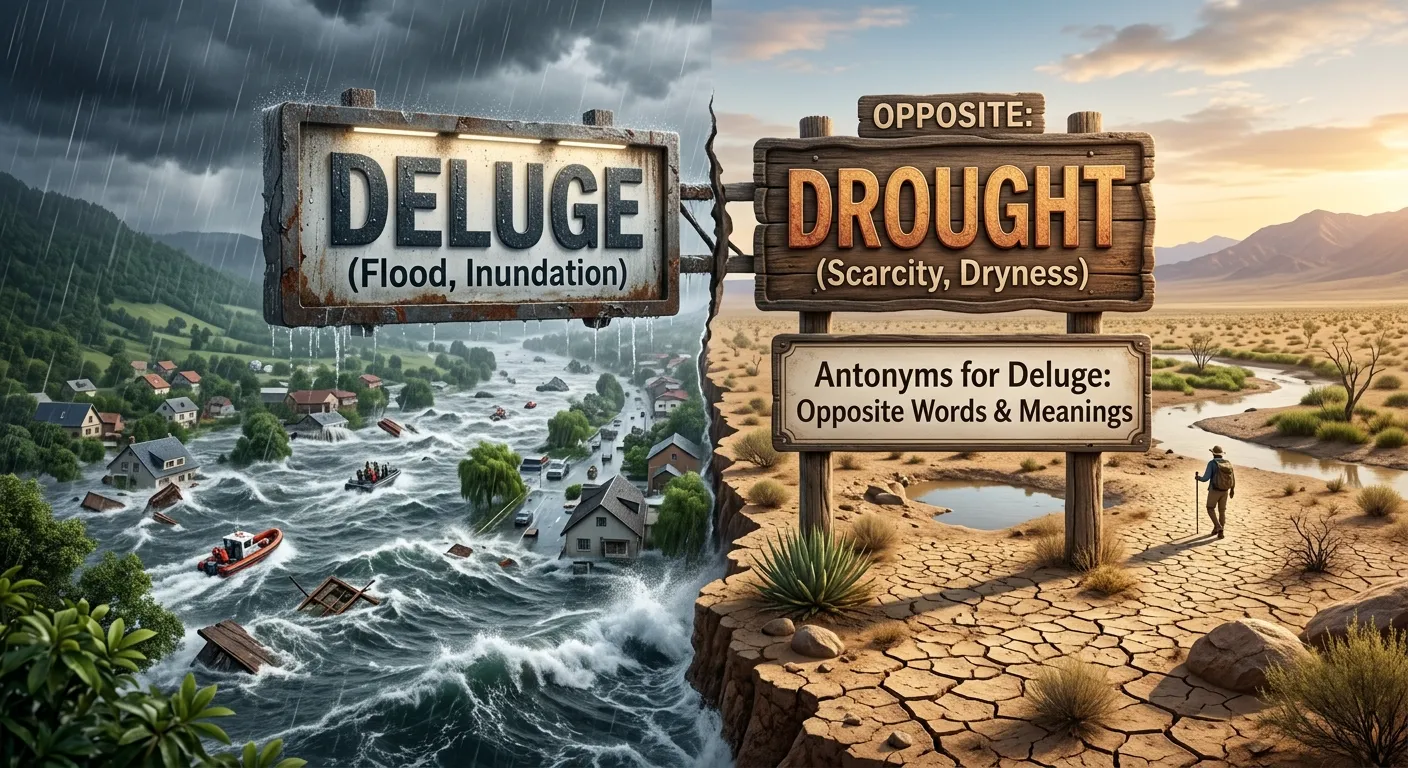
The main antonym of deluge is drought when deluge refers to an overwhelming amount of water or heavy flooding. When deluge means a large amount of something, scarcity, shortage, or trickle can express the opposite idea, depending on the context.
Quick Answer
Drought is the strongest opposite of deluge when talking about extreme amounts of water. For figurative uses, such as a deluge of emails, questions, or information, scarcity, shortage, or lack may be more appropriate.
When deluge is used as a verb meaning “to overwhelm with a large amount,” verbs such as limit, restrict, or withhold can create a contextual contrast, but they are not direct antonyms in every situation.
Quick Comparison
| Word | Meaning | Example |
| Deluge | An overwhelming amount of water or something else | The region experienced a deluge of rain. |
| Drought | A prolonged period with unusually little or no rain | The region suffered through a severe drought. |
| Scarcity | A state in which something is difficult to find or obtain | Water scarcity affected the village. |
| Shortage | A situation in which there is less of something than needed | The city faced a water shortage. |
| Trickle | A small, slow flow or amount | Only a trickle of water came from the pipe. |
Definition
Deluge: An overwhelming amount of water or something arriving in a very large quantity.
Main antonym: Drought a prolonged period of unusually low rainfall or water availability.
Learning Outcomes
After reading this guide, you will know:
- The strongest antonyms of deluge
- How drought, scarcity, shortage, and trickle differ
- Which opposites work for literal and figurative uses
- How to use these words naturally in sentences
Core Antonyms for Deluge
1. Drought
Drought is the clearest opposite of deluge when both words relate to water.
A deluge involves an excessive amount of water, while a drought involves an unusually prolonged lack of rainfall or water.
Example:
The area went from a devastating deluge one year to a severe drought the next.
Best context: rainfall, weather, agriculture, rivers, and water supplies.
2. Scarcity
Scarcity means that something is available only in a small amount compared with what is needed.
It works particularly well as an opposite of deluge when deluge is used figuratively.
Example:
The website received a deluge of information, while another project suffered from a scarcity of reliable data.
Best context: resources, information, food, money, opportunities, and supplies.
3. Shortage
Shortage means there is not enough of something to meet demand or need.
It contrasts naturally with deluge when the target word describes an excessive quantity.
Example:
The store experienced a deluge of orders rather than a shortage of customers.
Best context: products, supplies, workers, food, money, and demand.
4. Trickle
Trickle means a small, slow flow or a very small amount of something.
It is a particularly useful contrast when deluge refers to a large flow of water or information.
Example:
After the heavy rain, the stream became only a trickle.
Best context: water, traffic, visitors, information, money, and other flows.
Deluge: a huge flow
Trickle: a tiny flow
5. Drizzle
Drizzle means light rain falling in very small drops.
It can contrast with deluge when both words describe rainfall, although drought is the stronger antonym because drizzle is still rain.
Example:
The forecast changed from a deluge to a light drizzle.
Best context: weather and rainfall.
Important: Drizzle is a contrast, not a perfect antonym. Both a drizzle and a deluge involve precipitation.
6. Lack
Lack means the absence or insufficient amount of something that is needed.
It can provide a broad figurative contrast with deluge.
Example:
The team faced a lack of information rather than a deluge of data.
Best context: information, resources, money, time, support, and supplies.
7. Deficiency
Deficiency refers to an insufficient amount of something necessary or desirable.
It is more formal than lack and is useful in academic, technical, and professional writing.
Example:
The report identified a deficiency of reliable evidence instead of a deluge of useful data.
Best context: research, nutrition, resources, finance, and formal writing.
8. Moderation
Moderation means keeping something within reasonable or controlled limits.
It can contrast with deluge when the emphasis is on excess versus a controlled amount.
Example:
The website maintained a steady flow of comments instead of receiving a deluge.
This is a contextual opposite, rather than a direct dictionary antonym.
Contextual Antonyms of Deluge
When Deluge Means “A Large Amount of Water”
Use:
- drought: prolonged lack of rain or water
- trickle: very small flow
- drizzle: light rain
- dryness: absence of moisture
Example:
The region suffered a deluge of rain.
Depending on the intended contrast:
The region suffered a severe drought.
or:
Only a trickle of water reached the fields.
Drought gives the strongest contrast in terms of overall water conditions, while trickle focuses on the amount of flowing water.
When Deluge Means “A Large Amount of Something”
Use:
- scarcity
- shortage
- lack
- deficiency
- trickle
Example:
The journalist received a deluge of emails.
Possible contrasts include:
The journalist received only a trickle of emails.
or:
The journalist faced a shortage of responses.
The best choice depends on whether you are contrasting quantity, availability, or flow.
When Deluge Is a Verb
As a verb, deluge can mean to overwhelm someone or something with a large amount of something.
The company was deluged with complaints.
There is no single perfect verb antonym. Contextual contrasts include:
- limit
- restrict
- reduce
- withhold
Example:
The company was deluged with requests.
A contrasting situation could be:
The company received very few requests.
This is usually more natural than forcing a single-word antonym.
Antonym Meaning & Usage
Drought vs. Scarcity
These words are not interchangeable.
Drought specifically describes a prolonged period of unusually low rainfall or water availability.
Farmers struggled during the drought.
Scarcity is much broader. It describes insufficient availability of almost anything.
Water scarcity affected several communities.
So, use drought for a climatic or water-related condition and scarcity for a general shortage of resources.
Shortage vs. Scarcity
Shortage usually describes a situation where supply is insufficient for demand.
There is a shortage of fuel.
Scarcity emphasizes limited availability.
Water scarcity is a major concern.
Both can contrast with a deluge of something, but they emphasize different aspects of insufficient quantity.
Trickle vs. Deluge
These words create one of the clearest quantity contrasts.
Deluge suggests an overwhelming flow or amount.
Trickle suggests a small, slow flow.
A deluge of visitors arrived.
Only a trickle of visitors arrived.
Unlike drought, trickle can be used for both literal and figurative flows.
Drizzle vs. Deluge
Drizzle and deluge can both describe rain, but they represent very different intensities.
A light drizzle continued throughout the morning.
A sudden deluge flooded the streets.
Because drizzle is still precipitation, it is better described as a contrast in intensity rather than a strict antonym.
Example Sentences
- Deluge → Drought
The region experienced a devastating deluge followed by several months of drought. - Deluge → Trickle
Instead of a deluge of visitors, the museum saw only a trickle of guests. - Deluge → Scarcity
The organization moved from a deluge of applications to a scarcity of qualified candidates. - Deluge → Shortage
The market went from a deluge of cheap products to a shortage of essential supplies. - Deluge → Drizzle
The forecast predicted a light drizzle rather than another deluge. - Deluge → Lack
The researcher struggled with a lack of data instead of a deluge of information. - Deluge → Deficiency
The study revealed a deficiency of evidence rather than an overwhelming amount of supporting data. - Deluge as a verb
The customer-service team was deluged with complaints.
Contrast:
The team received very few complaints.
Grammar & Word Class
Deluge can function as both a noun and a verb.
Deluge as a noun
As a noun, deluge means an overwhelming amount or flood.
A deluge of rain damaged the roads.
We received a deluge of messages.
The noun commonly appears in the structure:
a deluge of + plural or uncountable noun
Examples:
- a deluge of rain
- a deluge of emails
- a deluge of questions
- a deluge of complaints
Deluge as a verb
As a verb, deluge means to overwhelm with a large amount.
The company was deluged with requests.
A common structure is:
be deluged with + noun
For example:
The office was deluged with applications.
Common Mistakes
Mistake 1: Calling “drizzle” a perfect antonym
❌ Drizzle is the exact opposite of deluge.
✅ Drizzle is a contrast in rainfall intensity, while drought is a stronger antonym for an extreme lack of rain or water.
A drizzle is still rain, so it is not the complete opposite of a deluge.
Mistake 2: Using “drought” for every figurative meaning
❌ The company experienced a drought of emails after receiving too many messages.
✅ The company experienced a scarcity of emails after receiving a deluge of messages.
Drought is normally associated with prolonged lack of rainfall or water. For non-water contexts, scarcity, shortage, or lack is usually more appropriate.
Mistake 3: Treating “shortage” and “trickle” as identical
❌ Shortage and trickle always mean the same thing.
✅ Shortage describes insufficient supply, while trickle describes a small flow or amount.
A shortage of workers.
A trickle of visitors.
Expert Tip
When choosing an antonym for deluge, first identify whether you are contrasting water, quantity, or flow.
- Water: drought
- Quantity: scarcity, shortage, lack
- Flow: trickle
- Rain intensity: drizzle
This makes your choice much more precise.
Synonyms for Deluge
The best synonym for deluge depends on whether it is used as a noun or a verb.
Synonyms for Deluge as a Noun
| Synonym | Meaning | Example |
| Flood | A large amount of water covering normally dry land | Heavy rain caused a flood. |
| Torrent | A powerful, fast-moving flow of water or something figuratively overwhelming | A torrent of messages filled her inbox. |
| Downpour | A sudden heavy fall of rain | A sudden downpour flooded the street. |
| Inundation | An overwhelming flood or excessive amount | The city faced an inundation of water. |
| Outpouring | A large amount expressed or produced at once | There was an outpouring of public support. |
| Avalanche | A sudden overwhelming amount, especially figuratively | An avalanche of questions followed the announcement. |
Synonyms for Deluge as a Verb
When deluge means “to overwhelm with a large amount,” useful synonyms include:
- overwhelm
- flood
- inundate
- swamp
- bombard
Example:
Customers deluged the company with complaints.
Similar:
Customers bombarded the company with complaints.
These synonyms are not interchangeable in every context. Bombard often suggests repeated or aggressive delivery, while inundate emphasizes being overwhelmed by a very large amount.
Mini Quiz
Choose the best antonym
The drought-stricken region finally received a ______ of rain.
A. trickle
B. deluge
C. scarcity
Answer: B. deluge
A deluge means an extremely large amount of water or heavy rainfall. A trickle is a small flow, while scarcity means insufficient availability.
Choose the most precise opposite
The website received only a small flow of visitors rather than a ______.
A. deluge
B. drought
C. deficiency
Answer: A. deluge
A deluge of visitors means an overwhelming number of visitors, making deluge the natural contrast with a small flow.
Short Questions & Answers
Q: What is the opposite of deluge?
A: The strongest antonym of deluge is drought when talking about water or rainfall. For figurative meanings, scarcity, shortage, lack, or trickle may be more appropriate.
Q: Is drought the exact opposite of deluge?
A: Drought is the strongest contextual opposite when deluge refers to an overwhelming amount of water. However, it is not an antonym for every figurative use of deluge.
Q: What is the opposite of a deluge of rain?
A: Depending on the intended contrast, drought, drizzle, or a trickle can work. Drought describes a prolonged lack of rainfall, while drizzle describes light rain.
Q: What is the opposite of a deluge of information?
A: Scarcity, lack, or a trickle can express the opposite idea. Scarcity emphasizes limited availability, while a trickle emphasizes a small flow of information.
Q: What are some synonyms for deluge?
A: Common synonyms include flood, torrent, downpour, inundation, overwhelm, inundate, swamp, and bombard, depending on whether deluge is being used as a noun or verb.
Conclusion
Deluge describes an overwhelming amount, especially of water, but it can also describe an excessive amount of information, requests, visitors, or other things.
- Drought is the strongest water-related antonym.
- Scarcity and shortage work well for insufficient quantities.
- Trickle contrasts with a deluge in terms of flow or amount.
- Drizzle contrasts with a deluge in rainfall intensity but is not a perfect antonym.
- Lack and deficiency are useful in broader or formal contexts.
The right antonym depends on whether deluge refers to excessive water, excessive quantity, or an overwhelming flow.
Antonyms for Record: 10 Opposite Words to Know

I am Clara Stephen, passionate about making English simple and easy to understand through clear synonym, antonyms, word comparisons, vocabulary guides, and language tips. Through thoughtful, reliable content, I aim to be a trusted guide for anyone looking to expand their English vocabulary.