Quick Answer
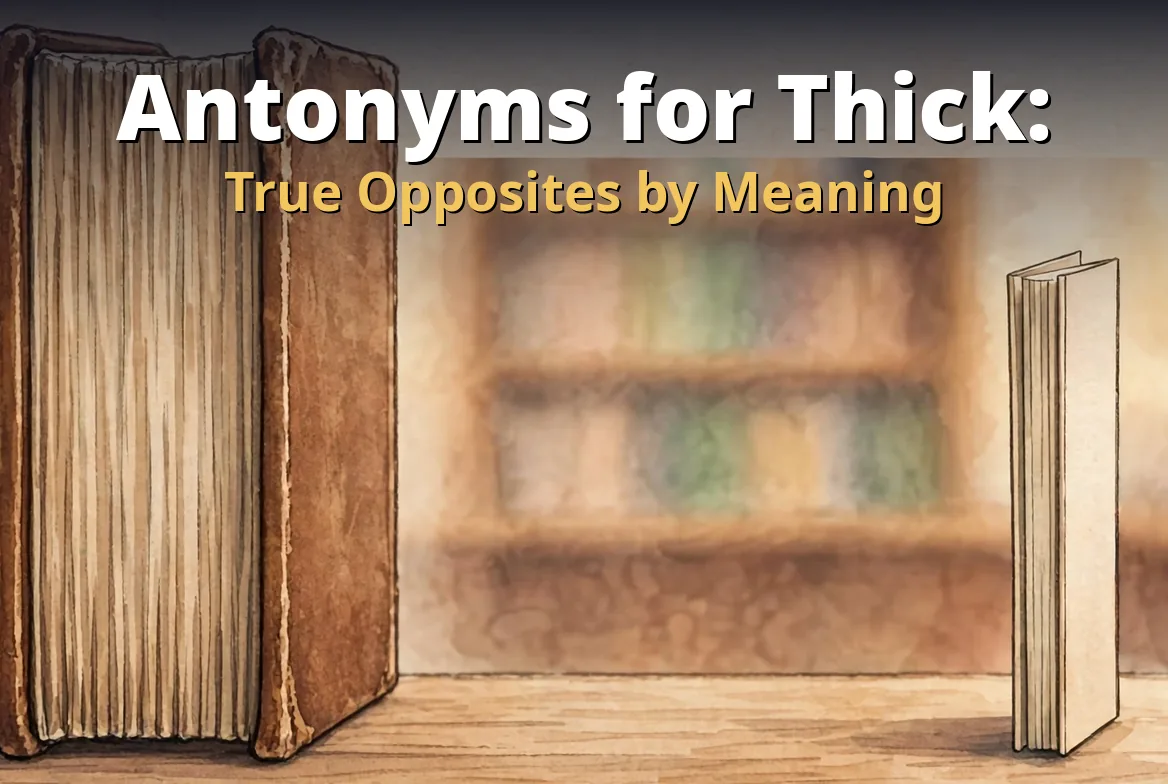
Thick does not have one opposite that fits everywhere, because the word itself works in several senses. Thin is the true, general antonym: a thick book becomes a thin book, and thick soup becomes thin soup. The other senses need their own words. Where thick means densely packed or growing close together, the opposite is sparse. In the informal sense of slow to understand (“a bit thick”), the opposite is bright. And where thick describes a strong accent, the contrast is a matter of degree, so slight works as a shade opposite rather than an exact pair.
Five opposites cover the main senses: thin, watery, sparse, bright and slight: one for each job, used consistently throughout this page.
Quick Comparison
| Opposite | Sense of “thick” it reverses | Example |
|---|---|---|
| Thin | Size, depth and consistency | She cut a thin slice from the thick loaf. |
| Watery | Consistency of liquids (a shade of thin) | The gravy was thick yesterday but watery today. |
| Sparse | Dense growth or crowding | The wood thinned out into sparse trees near the summit. |
| Bright | Informal: slow to understand | He acts a bit thick, but she is bright and quick. |
| Slight | Strength of an accent (a shade contrast) | Her accent was thick; his was only slight. |
Core Opposites
Size, Depth and Consistency
Thin
Meaning: Having little distance between opposite sides, or a loose, flowing consistency: the direct reverse of thick in both its physical senses.
Example: The carpenter planed the thick board down to a thin panel.
Nuance: Thin is the one true pair for thick and the answer most people need. It works for objects (a thin book, thin ice, a thin slice) and for substances (thin paint, thin soup). Do not confuse it with narrow: thin measures the gap between two surfaces, while narrow measures width from side to side. A sheet of paper can be thin without being narrow.
Watery
Meaning: Containing too much water; lacking body or thickness, said of a liquid.
Example: The sauce had simmered into a thick coating, but the second batch stayed watery.
Nuance: Watery is best treated as a labelled shade of thin, not a separate core opposite: thin already covers liquids (thin soup is perfectly natural English). Watery earns its place because it adds a judgement thin does not: it suggests the liquid has been diluted or has failed to thicken, and it often sounds like a complaint. Its close relative runny (runny eggs, runny batter) belongs to the same shade and is covered by this entry rather than listed twice.
Dense Growth and Crowding
Sparse
Meaning: Scattered, thinly spread, present in small numbers with gaps between.
Example: Beyond the thick forest, the hillside carried only sparse pines.
Nuance: When thick describes how closely things are packed: a thick forest, thick hair, a thick crowd: the opposite is not thin but sparse. Thin hair can mean hair that is fine in texture; sparse hair means there is less of it, spread out. Keep the two apart: thin describes each item, sparse describes the distribution.
Informal: Slow to Understand
Bright
Meaning: Quick to learn and understand; clever.
Example: Do not be fooled by his act: he pretends to be a bit thick, but he is bright enough to follow every word.
Nuance: This sense of thick is informal British English (“I’m being a bit thick today”) and slightly self-mocking. Its opposites work at phrase level: bright, clever and sharp all fit, with bright the most natural single choice. Because the sense is informal, the contrast is looser than the physical pair thick/thin: nobody would pair them in a dictionary table, but in conversation they reverse each other cleanly.
Strength of an Accent
Slight
Meaning: Small in degree; barely present.
Example: She speaks with a thick regional accent, while her brother’s is so slight that strangers rarely notice it.
Nuance: A thick accent is a strongly marked one, and accent strength runs along a scale rather than flipping between two poles, so there is no exact antonym. Slight (with mild as a near-equivalent) is a shade contrast: it places the accent at the weak end of that scale. Treat it as the honest answer for this sense, not as a strict pair like thick/thin.
A note on voices: A voice can also be “thick with emotion”: husky and unsteady. That shade has no single-word opposite either; the natural contrast is phrasal, as in “she spoke in a clear, steady voice.”
Example Sentences
- The novel was so thick that she swapped it for a thin paperback for the flight.
- Cook the custard until it coats the spoon; if it stays watery, it needs more heat.
- The crowd was thick at the entrance but sparse near the exits.
- Sorry, I’m being a bit thick: explain it once more, slowly.
- His thick accent softened over the years until only a slight trace remained.
Common Mistakes
Using thin for every sense. Thin is right for size and consistency, but the opposite of a thick crowd is not a “thin crowd” in the same mechanical way: sparse is the natural word for things spread out with gaps between them.
Confusing thin with narrow. Thin is about the distance between two faces of an object; narrow is about width across. A thin road is not a standard phrase: roads are narrow, books are thin.
Treating watery and runny as extra core opposites. They are shades within the liquid sense, already covered by thin. Listing thin, watery and runny as three equal antonyms inflates the count without adding a new meaning.
Forgetting the informal sense is informal. Calling someone thick to mean unintelligent is British and colloquial; in neutral or formal writing, choose a direct word such as slow or dense: and an equally direct opposite such as bright or sharp.
Mini Quiz
1. What is the opposite of a thick slice of bread?
A. A sparse slice
B. A thin slice
C. A slight slice
Answer: B. Size and depth reverse with thin.
2. A forest is thick at the valley floor. Which word best describes it where the trees grow far apart near the top?
A. Watery
B. Bright
C. Sparse
Answer: C. Sparse reverses dense growth and crowding.
3. In “Don’t mind me, I’m being a bit thick today,” which word reverses the meaning?
A. Bright
B. Thin
C. Runny
Answer: A. In the informal sense of slow to understand, the opposite is bright (or clever, sharp).
Short Q&A
What is the main antonym of thick?
Thin. It is the true pair for the world’s main senses: physical thickness and consistency: and the correct answer in most sentences.
What is the opposite of thick hair?
It depends on what you mean. Sparse hair means there is less of it, spread thinly; thin or fine hair describes the strands themselves. If the hair is dense and full, sparse is the real opposite.
Is watery an antonym of thick?
Only within the liquid sense, and as a shade of thin rather than a separate core opposite. Watery adds the idea of dilution: a liquid that has too much water in it: which thin alone does not say.
What is the opposite of a thick accent?
There is no exact pair, because accent strength is a scale. A slight or mild accent sits at the weak end of that scale and is the honest contrast.
Can thick describe a person?
Yes, informally in British English: “a bit thick” means slow to understand something. The opposite in the same register is bright, clever or sharp.
Key Takeaways
- Thin is the true antonym of thick for size, depth and consistency: the pair to reach for first.
- Sparse is the genuine opposite when thick means densely packed or growing close together.
- Watery is a labelled shade for liquids, covered by thin; it adds a sense of dilution.
- Bright reverses the informal “slow to understand” sense, and slight gives a shade contrast for a thick accent, where no exact opposite exists.
- Match the opposite to the sense: five words, each doing one job, beat a long list of near-duplicates.

I’m Leo Jackson, an English writer with a soft spot for the peculiarities of language and vocabulary. He specializes in exploring the nuances of English synonyms, antonyms, helping students, writers, and professionals choose the right word with confidence. My guides combine careful research with clear, practical explanations.