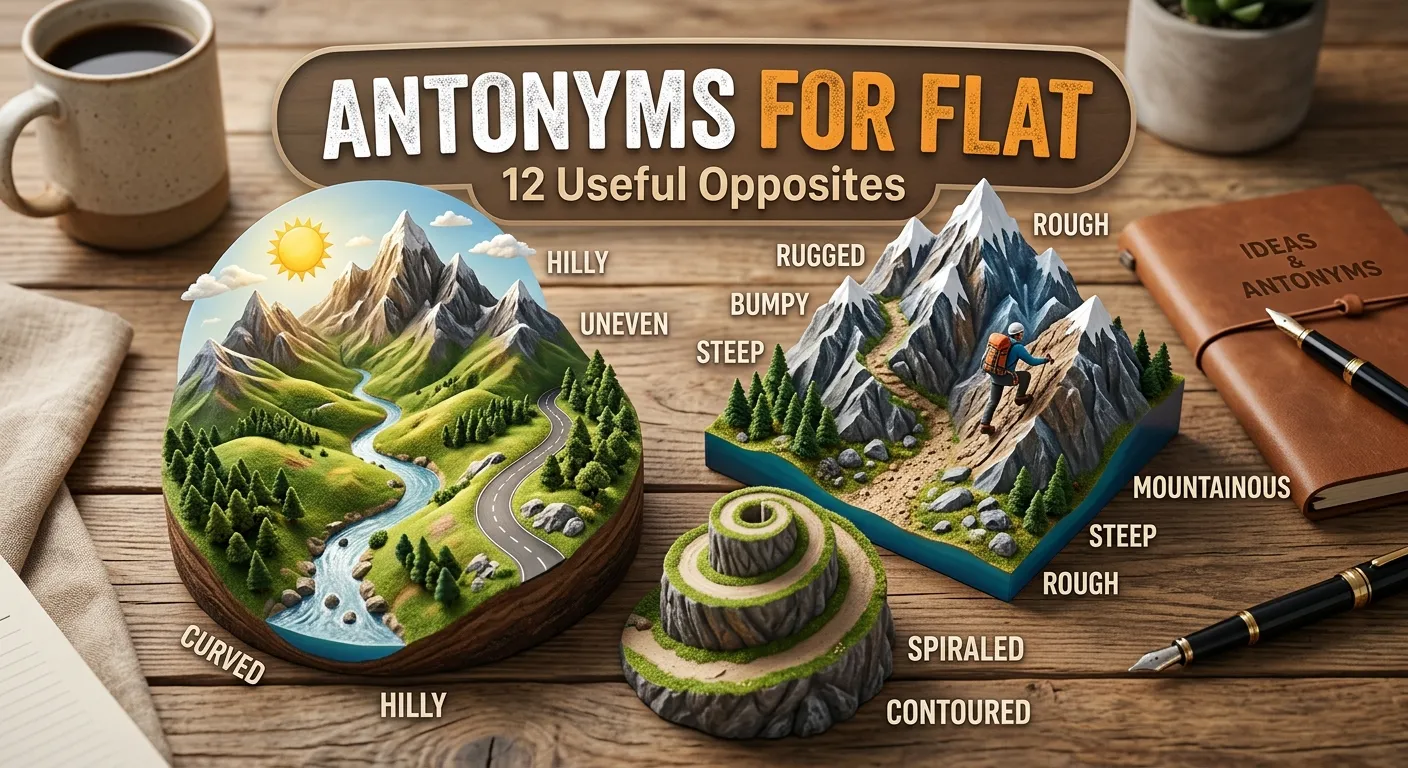
What Is the Opposite of Flat?
The most common antonyms for flat are raised, uneven, inflated, lively, and sharp, depending on the meaning. Flat can describe a surface, a tire, a sound, an emotional style, or a musical note, so the correct opposite changes with context.
The Short Answer
There is no single antonym for flat in every situation. Raised or elevated works for a surface with height, uneven or rough describes a surface that is not smooth and level, inflated contrasts with a flat tire, lively contrasts with a flat performance, and sharp is the musical opposite of a flat note.
Flat vs. Its Opposite
| Meaning of flat | Useful opposite | Example |
| Level and without raised areas | Raised | The design has raised patterns. |
| Smooth and level | Uneven | The path became uneven near the hill. |
| Deflated | Inflated | The bicycle tire is fully inflated. |
| Dull or lacking energy | Lively | The second performance was much more lively. |
| Lacking emotional expression | Expressive | Her expressive voice made the story engaging. |
| A musical note below the correct pitch | Sharp | The note sounded sharp rather than flat. |
Definition
Flat: Level, smooth, without much height or variation; it can also mean deflated, dull, lacking expression, or lower than the correct musical pitch.
Main antonyms: raised, uneven, inflated, lively, expressive, sharp depending on the meaning.
What You’ll Learn
- The main contextual opposites of flat
- Why raised is not always the right antonym
- The difference between flat, uneven, and rough
- The opposite of a flat tire
- Why sharp is the musical opposite of flat
- How to choose the right antonym in a sentence
Main Antonyms for Flat
1. Raised
Raised is a strong opposite when flat means having no noticeable height or projection.
Example:
The artist added raised lettering to the sign.
Here, raised means extending above the surrounding surface.
2. Elevated
Elevated means positioned higher than the surrounding area.
Example:
The house stands on an elevated platform.
It is especially useful when the contrast involves height or position, rather than surface texture.
3. Uneven
Uneven describes a surface that is not level or regular.
Example:
Be careful because the ground is uneven.
This is often a better opposite than raised when flat means level and even.
4. Rough
Rough describes a surface that is not smooth.
Example:
The rough stone felt uncomfortable under her hand.
However, rough is not a perfect opposite of every meaning of flat. A surface can be flat and rough at the same time.
For example:
The flat stone had a rough texture.
So rough contrasts with the smooth sense of flat, not necessarily its level sense.
5. Inflated
Inflated is the natural opposite of flat when flat means deflated, especially for tires, balls, or other objects filled with air.
Example:
The mechanic checked whether the tires were properly inflated.
Compare:
- flat tire → lacking enough air
- inflated tire → filled with air
6. Full
Full can contrast with flat when an object is flat because it has lost its contents or pressure.
Example:
The balloon was full again after they inflated it.
This is more context-dependent than inflated, which is the more precise term for an air-filled object.
7. Lively
Lively is a useful opposite when flat means dull, boring, or lacking energy.
Example:
The conversation became lively after everyone arrived.
Here, lively refers to energy and activity rather than physical shape.
8. Expressive
Expressive can contrast with flat when flat describes a voice, delivery, face, or performance that shows little emotion.
Example:
The actor gave an expressive performance.
Compare:
- flat delivery → little emotion or variation
- expressive delivery → clear emotion and variation
9. Animated
Animated means showing energy, excitement, or strong expression.
Example:
She became animated while describing her trip.
It can be a natural opposite of flat when talking about someone’s manner, voice, or conversation.
10. Dynamic
Dynamic describes something energetic, active, or constantly changing.
Example:
The speaker gave a dynamic presentation.
It can contrast with a flat presentation when flat means dull or lacking energy.
11. Sharp
Sharp is the standard musical opposite of flat.
In music, a flat note is lower in pitch than the intended note, while a sharp note is higher.
Example:
The singer was slightly sharp on the final note.
This is a specialized meaning, so sharp should not be used as the general antonym of flat.
12. Convex
Convex can provide a technical geometric contrast when flat is being discussed in terms of surface shape.
A convex surface curves outward.
Example:
The lens has a convex surface.
This is a specialized term rather than an everyday antonym of flat. In ordinary conversation, raised, curved, or uneven may be more natural depending on the intended meaning.
Different Meanings, Different Opposites
The word flat has several important meanings. Choosing its antonym requires identifying the sense first.
When “flat” means level
Use:
- raised
- elevated
- uneven
- sloped
- inclined
Example:
The road is flat.
→ The road is sloped.
When “flat” means smooth and without texture
Use:
- rough
- textured
- uneven
Example:
The surface is flat and smooth.
→ The surface is rough and textured.
Notice that uneven is not exactly the same as rough. Unevenness concerns regularity or levelness; roughness concerns surface texture.
When “flat” means deflated
Use:
- inflated
- full
Example:
My bicycle tire is flat.
→ My bicycle tire is inflated.
When “flat” means dull or lacking energy
Use:
- lively
- energetic
- dynamic
- animated
Example:
The presentation felt flat.
→ The presentation felt lively.
When “flat” means lacking emotional expression
Use:
- expressive
- animated
- emotional
Example:
His voice sounded flat.
→ His voice sounded expressive.
When “flat” describes musical pitch
Use:
- sharp
Example:
The note was flat.
→ The note was sharp.
How These Antonyms Differ
Not all opposites of flat are interchangeable.
Raised vs. uneven:
A raised surface has parts that project upward. An uneven surface is irregular or not level. A surface can be raised but still perfectly even.
Uneven vs. rough:
An uneven floor may have bumps or different levels. A rough surface may be completely level but have a coarse texture.
Inflated vs. full:
For a tire or balloon, inflated is more precise. Full is broader and can refer to something containing air or another substance.
Lively vs. expressive:
Lively focuses on energy and animation. Expressive focuses on showing feelings or ideas clearly.
Sharp vs. flat:
These are opposites specifically in the context of musical pitch. They are not general physical opposites.
Examples in Context
- The tabletop is completely flat.
- The sculpture has raised details along its surface.
- The old road became uneven after the storm.
- The tire went flat during the journey.
- We need to make sure all four tires are properly inflated.
- The meeting was surprisingly lively.
- His flat delivery made the speech difficult to follow.
- The actress gave a highly expressive performance.
- The children became animated when they heard the news.
- The singer’s final note was slightly sharp.
- The stone was flat but rough.
- The building sits on an elevated section of land.
What Part of Speech Is It?
Flat can function as an adjective, adverb, noun, or verb, depending on the sentence.
In antonym questions, the adjective is usually the most important form:
- flat → adjective
- raised → adjective
- uneven → adjective
- inflated → adjective
- lively → adjective
- expressive → adjective
- sharp → adjective
Examples:
- The surface is flat.
- The surface is uneven.
- The tire is flat.
- The tire is inflated.
The word flat also has other grammatical uses, but they do not always have the same antonyms.
Common Errors to Avoid
Using “rough” as the opposite in every context
❌ The opposite of a flat tire is a rough tire.
✅ The opposite of a flat tire is an inflated tire.
Rough relates to surface texture, not tire pressure.
Using “sharp” as the general opposite
❌ The opposite of a flat road is a sharp road.
✅ The opposite of a flat musical note is a sharp note.
Sharp is the relevant opposite only in particular contexts, especially music.
Assuming “raised” and “uneven” mean the same thing
❌ The raised floor and uneven floor mean exactly the same thing.
✅ The raised platform is higher, while the uneven floor is irregular or not level.
A Useful Language Tip
When you see flat, ask one question: “Flat in what sense?”
If it describes a surface, think raised, elevated, uneven, or sloped.
And if it describes a tire, think inflated.
If it describes a performance or voice, think lively or expressive.
If it describes a musical note, think sharp.
This simple check helps you choose a precise antonym instead of a merely possible one.
Quick Practice
1. Choose the best antonym
The bicycle tire is flat.
A. Rough
B. Inflated
C. Sharp
Answer: B. Inflated
The sentence refers to a tire that has lost air.
2. Choose the best antonym
The speaker’s delivery was flat.
A. Lively
B. Uneven
C. Elevated
Answer: A. Lively
Here, flat means dull or lacking energy.
3. Choose the best antonym
The singer’s note was flat.
A. Raised
B. Sharp
C. Rough
Answer: B. Sharp
In music, sharp means higher in pitch, while flat means lower.
Frequently Asked Questions
What is the most common antonym of flat?
There is no single antonym that works in every context. Raised or uneven can contrast with a flat surface, inflated with a flat tire, lively with a flat performance, and sharp with a flat musical note.
What is the opposite of flat when talking about a tire?
The usual opposite is inflated. A flat tire has lost air or pressure, while an inflated tire contains the required amount of air.
What is the opposite of flat in music?
The opposite is sharp. A flat note is lower than the intended pitch, while a sharp note is higher than the intended pitch.
Is “rough” the opposite of flat?
Only in some contexts. Rough contrasts with flat when flat is being used to suggest a smooth surface, but a surface can be both flat and rough. For levelness, uneven is often a better contrast.
What to Remember
Flat has several meanings, so its antonym depends on context:
- Flat surface → raised, elevated, uneven
- Flat tire → inflated
- Flat performance → lively, dynamic
- Flat voice → expressive, animated
- Flat musical note → sharp
The safest approach is to identify the meaning of flat first and then choose the antonym that expresses the exact opposite.
Antonyms for Circumference: Opposite Concepts Explained

I am Clara Stephen, passionate about making English simple and easy to understand through clear synonym, antonyms, word comparisons, vocabulary guides, and language tips. Through thoughtful, reliable content, I aim to be a trusted guide for anyone looking to expand their English vocabulary.