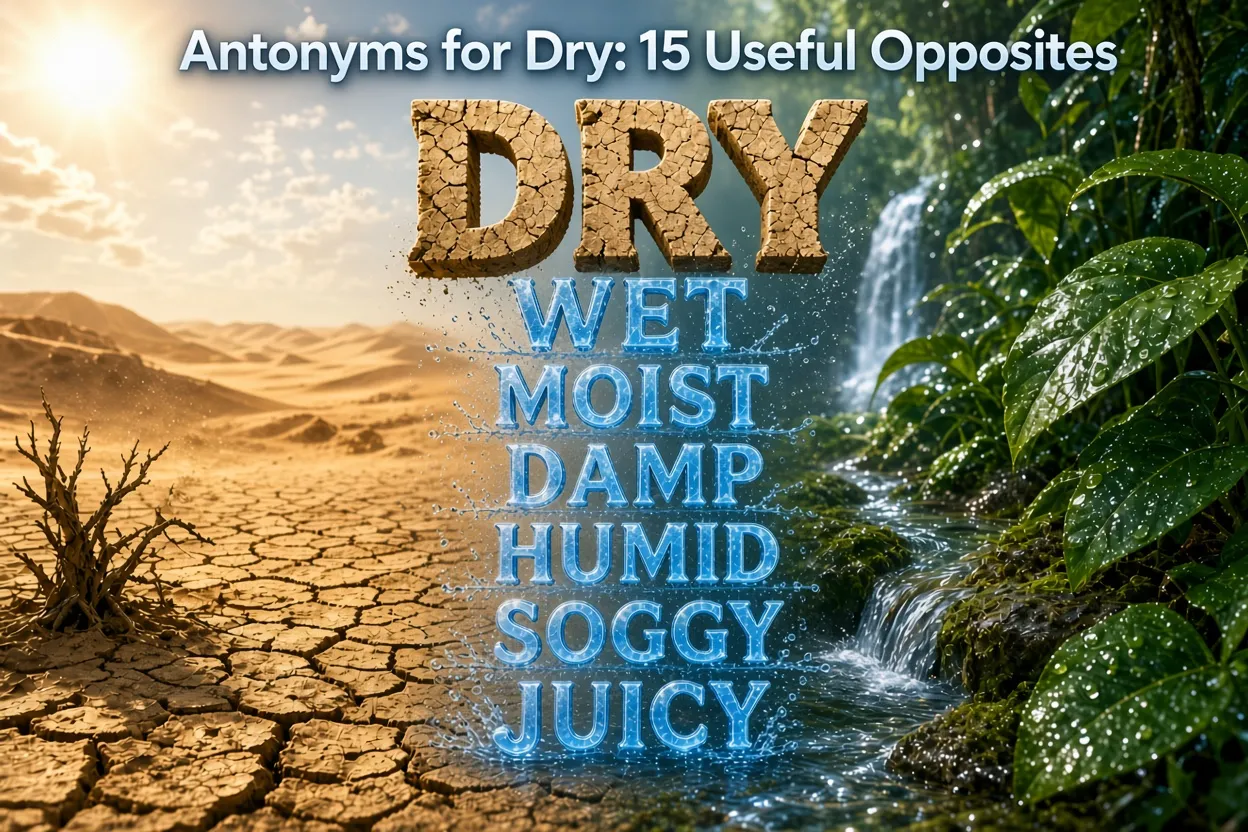
Dry and Its Main Antonym
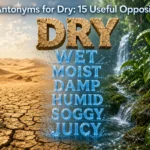
The most common antonym for dry is wet. Dry means having little or no moisture, while wet means covered or saturated with water or another liquid. Depending on the context, useful opposites include moist, damp, humid, hydrated, juicy, and fresh.
Quick Answer
The main antonym of dry is wet.
- Dry means having little or no moisture or liquid.
- Wet means containing, covered with, or saturated with liquid.
- Moist describes something slightly wet, especially in a pleasant or desirable way.
- Damp means slightly wet, often in an unpleasant or cool way.
- Humid describes air containing a high amount of moisture.
Because dry has several meanings, its opposite changes with context.
Side by Side by Comparison
| Word | Meaning | Example |
| Dry | Having little or no moisture | The towel is dry. |
| Wet | Covered or saturated with liquid | The towel is wet. |
| Moist | Slightly wet | The cake is moist. |
| Damp | Slightly wet, often unpleasantly | The basement feels damp. |
| Humid | Containing a lot of moisture in the air | The weather is humid. |
Definition
Dry: Having little or no moisture, liquid, or water.
Main antonym: Wet covered with or containing a noticeable amount of liquid.
What Are the Antonyms for Dry?
Here are the most useful opposites of dry, depending on the meaning:
- Wet: covered or saturated with water or another liquid.
- Moist: slightly wet or containing some moisture.
- Damp: slightly wet, usually in an unpleasant way.
- Humid: containing a high level of moisture in the air.
- Hydrated: containing enough water or moisture.
- Juicy: containing plenty of liquid, especially when describing food or fruit.
- Fresh: containing natural moisture or recently prepared, depending on context.
- Saturated: holding as much liquid as possible.
- Soaked: extremely wet because a large amount of liquid has been absorbed.
- Dripping: so wet that liquid is falling or running from it.
- Waterlogged: filled or saturated with too much water.
- Oily: containing or covered with oil rather than being dry.
- Lubricated: covered with a substance that reduces friction.
- Hydrated/moisturized: containing or supplied with sufficient moisture, especially for skin.
- Rainy: wet because of rain, when describing weather or conditions.
Not all of these are direct dictionary antonyms in every context. Some are contextual opposites that work naturally for particular meanings of dry.
Dry vs. Wet: The Direct Opposites
Wet is the clearest and most general opposite of dry.
The clothes are dry after being left outside.
The clothes are wet after the rain.
This contrast works for objects, surfaces, materials, and many everyday situations.
More examples
- Dry ground → wet ground
- Dry clothes → wet clothes
- Dry hair → wet hair
- Dry floor → wet floor
- Dry paint → wet paint
When you need one straightforward antonym for dry, wet is usually the best choice.
Dry vs. Moist
Moist is a softer opposite of dry. It means containing some moisture but not being very wet.
For example:
The bread was dry.
can contrast with:
The bread was moist.
Moist is especially common when describing food, soil, skin, and other materials where a moderate amount of moisture is desirable.
Examples
- Keep the soil moist rather than dry.
- The cake is soft and moist.
- Apply the cream to moist skin.
Important: Moist does not usually mean completely wet. It describes a moderate level of moisture.
Dry vs. Damp
Damp means slightly wet, often with an unpleasant or unwanted feeling.
The room was dry.
can contrast with:
The room was damp.
The word damp is common when talking about walls, clothes, rooms, basements, soil, and weather.
Examples
- The basement was damp after the heavy rain.
- Hang the towel outside before it becomes damp again.
- The walls felt damp.
Moist vs. Damp
These two words are close, but they are not interchangeable in every situation.
Moist often sounds neutral or positive:
The cake is moist.
Damp often suggests unwanted wetness:
The basement is damp.
So, if you want to describe something pleasantly containing moisture, moist may be more suitable. If the moisture is unwanted, damp is often more natural.
Dry vs. Humid
When dry describes air or weather, humid can be a natural contextual opposite.
- Dry air contains little moisture.
- Humid air contains a high level of moisture.
Examples
The air is very dry today.
The air is very humid today.
However, humid is mainly used for air and weather, so it cannot replace wet in sentences such as:
The floor is wet.
You would not normally say:
The floor is humid.
Dry vs. Hydrated
When dry describes the body, skin, or something that needs water, hydrated can provide a useful contextual contrast.
Examples
- Drink enough water to stay hydrated.
- The lotion helps keep your skin hydrated.
- Dehydrated skin can feel dry.
This is a contextual relationship rather than a universal opposite. Hydrated does not work as a replacement for wet when describing an ordinary object.
Dry vs. Juicy
For food, especially fruit, juicy can contrast naturally with dry.
The chicken was dry.
The chicken was juicy.
Similarly:
This orange is dry.
This orange is juicy.
Juicy emphasizes the presence of abundant liquid rather than simply the absence of dryness.
Stronger Words for Very Wet Conditions
Sometimes the opposite of dry needs to show a very high degree of wetness.
Soaked
Soaked means extremely wet because something has absorbed a lot of liquid.
My clothes were soaked after walking home in the rain.
Saturated
Saturated means containing as much liquid as something can hold.
The soil was saturated after several hours of rain.
Dripping
Dripping describes something so wet that liquid is falling or running from it.
His jacket was dripping wet.
These words are useful when wet is not strong enough to express the intended degree.
Contextual Antonyms of Dry
Because dry has several meanings, its opposite depends on what you are describing.
| Meaning of Dry | Natural Opposite | Example |
| Without water or liquid | Wet | The floor is dry/wet. |
| Slightly lacking moisture | Moist | The cake is dry/moist. |
| Unpleasantly lacking moisture | Damp | The room is dry/damp. |
| Lacking atmospheric moisture | Humid | The air is dry/humid. |
| Lacking enough water | Hydrated | The skin is dry/hydrated. |
| Lacking liquid in food | Juicy | The meat is dry/juicy. |
| Completely without moisture | Soaked / saturated | The ground is dry/saturated. |
This is why there is no single replacement that works as the opposite of dry in every sentence.
See the Antonyms in Action
Here are natural examples showing how different opposites work:
- The towel was dry, but the one beside it was wet.
- The cake was moist rather than dry.
- The basement became damp after the storm.
- The summer air was hot and humid, not dry.
- Drinking enough water helps keep your body hydrated.
- The grilled chicken was surprisingly juicy instead of dry.
- We found the soil completely saturated after the rainfall.
- She arrived home with soaked clothes.
- The freshly washed floor was wet, while the kitchen counter was already dry.
Grammatical Forms of Dry
Dry can function in several grammatical roles.
As an adjective
It describes something that lacks moisture.
The clothes are dry.
As a verb
It means to remove moisture or become free of moisture.
Please dry the dishes.
The clothes will dry soon.
As a noun
In some contexts, dry can be used as a noun, such as when referring to a period or condition without rain, although this use is less common in everyday vocabulary.
The most common antonym relationship in ordinary vocabulary questions is the adjective dry → adjective wet relationship.
Common Mistakes
1. Using “humid” as the opposite of every use of dry
❌ The floor is humid.
✅ The floor is wet.
Humid normally describes air or weather conditions, not a wet physical surface.
2. Treating “moist” and “wet” as exact synonyms
❌ The two words always mean exactly the same thing.
✅ Moist usually suggests a moderate amount of moisture, while wet can describe something with much more liquid.
3. Assuming “damp” is always a positive opposite
Damp often carries an unpleasant or undesirable meaning.
The cake is moist. ✅
The cake is damp. ⚠️
For food, moist is usually more natural when you mean pleasantly soft and containing some moisture.
A Useful Language Tip
Think about what is missing from the dry thing before choosing an antonym. If it is missing water, use wet; if it needs a little moisture, moist may fit; if the air lacks moisture, use humid as the contextual contrast; and if food lacks liquid, juicy may be more precise.
Short Questions & Answers
Q: What is the main antonym of dry?
The main antonym of dry is wet. Dry means having little or no moisture, while wet means covered with or containing liquid.
Q: Is moist the opposite of dry?
Yes, moist can be a contextual opposite of dry. It describes something containing some moisture, but it does not usually mean completely wet.
Q: What is the opposite of dry weather?
For weather, humid or rainy may provide a contextual contrast, depending on what you mean. Humid refers specifically to moisture in the air, while rainy refers to weather with rain.
Q: What is the opposite of dry skin?
Depending on the intended meaning, hydrated or moisturized can contrast with dry skin.
Q: Is damp the same as wet?
No. Damp generally means slightly wet and often suggests unwanted moisture, while wet is the broader term for containing or being covered with liquid.
Final Verdict
The most direct antonym of dry is wet. Other opposites become more appropriate when the context changes:
- Wet → the general opposite
- Moist → slightly and often pleasantly wet
- Damp → slightly wet, often unpleasantly
- Humid → moist air or weather
- Hydrated → adequately supplied with water or moisture
- Juicy → containing plenty of liquid, especially food
- Soaked / saturated → extremely or completely wet
The best antonym is therefore determined by what “dry” means in the sentence.
Antonyms for Dark: Opposite Words & Example

I’m Leo Jackson, an English writer with a soft spot for the peculiarities of language and vocabulary. Specializes in exploring the nuances of English synonyms, antonyms, helping students, writers, and professionals choose the right word with confidence. My guides combine careful research with clear, practical explanations.