Quick Answer
No: dilemma has no true dictionary antonym. A dilemma is a situation: one that forces you to choose between two options, usually both unwelcome. Antonyms reverse qualities and states: hot/cold, easy/difficult. A situation is not a quality, so there is no word that “reverses” one, just as there is no antonym for meeting or journey.
What a dilemma does have is three honest contrasts, each labelled for what it is:
- A win-win situation: the pleasant mirror image: a choice where both options turn out well.
- An obvious choice (informal: a no-brainer): a choice with one plainly right answer, where the difficulty a dilemma is built on is simply absent.
- A solution / a resolution: not a contrast of the situation at all, but its ending: the point where the dilemma dissolves.
Longer lists usually pad these out with words like certainty, clarity, choice and ease. Those are not opposites of dilemma: see “Words That Are Not Antonyms” below for why.
Quick Comparison
| Contrast | Kind of contrast | Example |
|---|---|---|
| A win-win situation | Counterpart situation (phrase): both options good instead of both costly | Offered two jobs she liked, in two cities she loved, Amara was in a win-win situation. |
| An obvious choice (“a no-brainer”) | Difficulty absent: one answer plainly right | With the bridge closed, taking the train was a no-brainer. |
| A solution / a resolution | The ending: the dilemma dissolved, not reversed | After weeks of deadlock, the committee finally reached a resolution. |
What a Dilemma Is
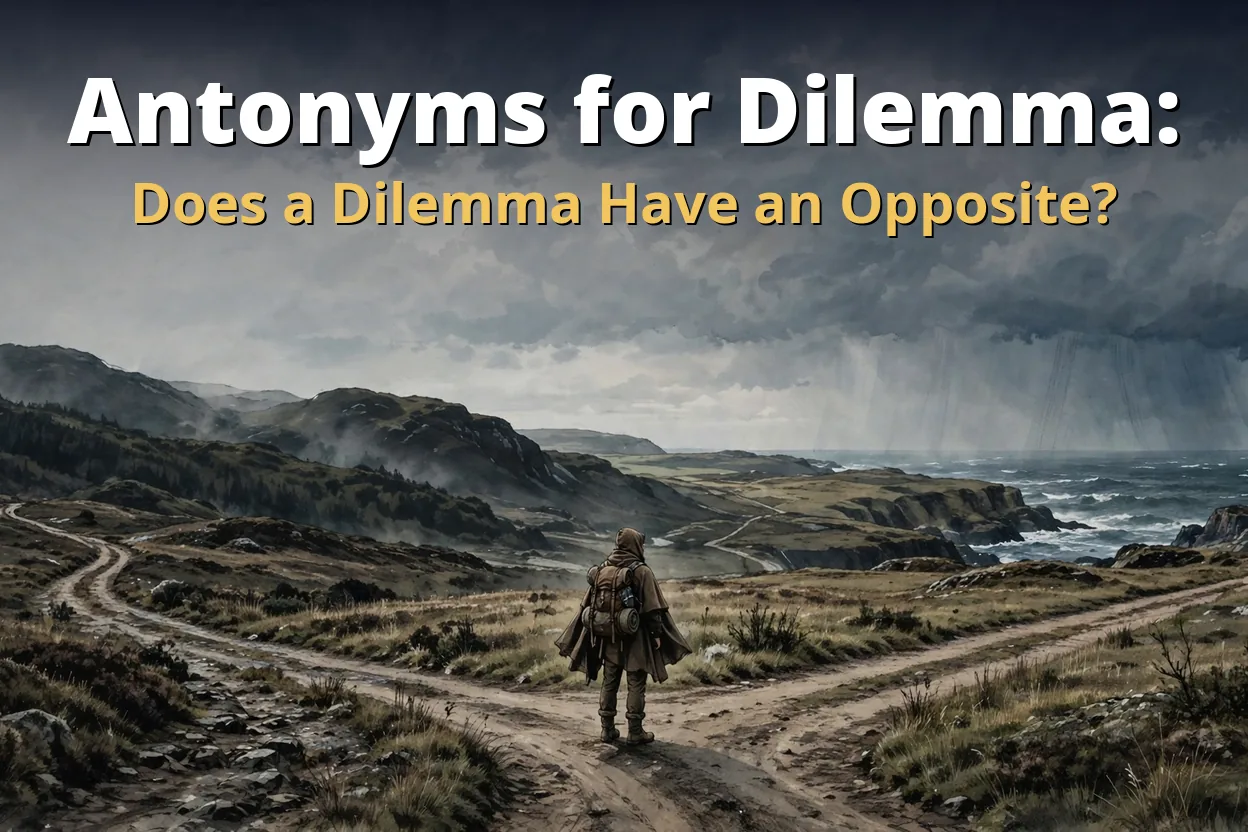
In its strict sense, a dilemma is a choice between two alternatives that are both unwelcome: whichever you pick, you lose something. The classic picture is being caught between the horns of a bull: a picture preserved in the phrase on the horns of a dilemma, which simply means facing exactly that kind of costly either/or choice. In logic and ethics, this strict sense still rules: an ethical dilemma is not just a hard decision, but one where every available option involves some wrong or harm.
In everyday use, the word has loosened: many people call any difficult choice a dilemma, even when the options are attractive (“My dilemma is whether to holiday in Italy or Greece”). Teachers and careful writers still prefer the strict sense: a dilemma hurts because both horns are sharp. The distinction matters here: reverse the strict sense and you want a choice that costs nothing; reverse the loose sense and you want a choice that is simply easy. The contrasts below cover both. The common patterns are face a dilemma and be in a dilemma.
The Genuine Contrasts
1. A win-win situation: the pleasant mirror image
A dilemma’s pain comes from the fact that every option costs you something. A win-win situation flips precisely that feature: the outcome is good whichever option is picked: two rival departments both gain from a deal; a job candidate chooses between two offers she would be glad to accept.
Label it honestly: win-win situation is a phrase, and a fairly informal one, naming the counterpart situation: not a dictionary antonym of the noun dilemma. But as a mirror image it is exact: same structure (a forced choice between two), opposite arithmetic (gain either way instead of loss either way). Reach for it when you mean “a choice with nothing painful about it.”
2. An obvious choice: the difficulty absent
A dilemma is hard because neither option is plainly right: that is the whole of the difficulty. Remove that one feature and the dilemma evaporates: one answer is obviously correct, and choosing takes seconds. English expresses this with phrases: an obvious choice, a clear-cut decision, and, informally, a no-brainer.
Notice what the chooser feels here: certainty. That is where certainty legitimately belongs: as the state of mind an obvious choice produces and a dilemma destroys. It is not itself an opposite of dilemma: certainty is something a person feels, while a dilemma is a situation a person is in: and someone can feel quite certain how to handle a dilemma (“I’ll take the smaller loss”) while the dilemma itself stays exactly as painful.
3. A solution or resolution: the ending, not the opposite
A solution is an answer or way out that dissolves a dilemma: a third option appears, new information removes one horn, or a compromise lets both sides keep what matters. A resolution is the decision or settlement that formally brings the matter to an end, often after discussion or dispute.
These are genuinely useful words: but label them correctly: they name the dilemma’s outcome or ending, not its reverse, the way an answer completes a question rather than opposing it. A plain decision works the same way: every dilemma that ends, ends in one, so decision cannot be its opposite either.
Words That Are Not Antonyms
- Choice: a component of the target word, not its opposite. A dilemma is a kind of choice: a hard one, between unwelcome options: and a part cannot oppose the whole it belongs to. (Only the qualified phrase an easy choice contrasts: see contrast 2.)
- Certainty, clarity: states of mind, not situations. New facts can bring clarity and end a dilemma, but the absence of confusion is not a counterpart choice-situation. Certainty is covered under contrast 2.
- Agreement, harmony: these describe how people relate to each other, not the structure of a choice. A committee in perfect harmony can still face a genuine dilemma together when money runs short.
- Simplicity, ease: general qualities of tasks. A task done with ease may never have involved a choice at all; easiness is too broad to reverse anything specific about dilemma.
Example Sentences
- The hospital faced a dilemma: fund the new ward or repair the old one, with money for only one and patients who needed both.
- Whichever supplier they chose, the terms improved for both firms: a genuinely win-win situation.
- Once the test results came back, the treatment was a no-brainer.
- The talks ended in a resolution that neither side loved but both could accept.
- Caught on the horns of a dilemma, he could tell the truth and break a promise, or keep the promise and mislead his friend.
Common Mistakes
Mistake 1: Calling “solution” the exact dictionary antonym of dilemma
A solution ends a dilemma; it does not reverse it. Treat solution and resolution as the outcome words: the right choice when your sentence is about escaping the situation, not about contrasting it.
Mistake 2: Listing “choice” as the opposite
A dilemma is itself a choice: a difficult, costly one. Choice only contrasts when you qualify it: an easy choice, a straightforward choice, an obvious choice.
Mistake 3: Using “dilemma” for any problem at all
A burst pipe is a problem, not a dilemma, because no choice between alternatives is involved. In careful writing, keep dilemma for situations where you must pick one of two options, and prefer the strict sense: both options unwelcome: especially in essays and examinations.
Mistake 4: Expecting every noun to have an antonym
Nouns that name situations, events and objects often have none. Dilemma has counterparts (a win-win situation), absences (an obvious choice) and endings (a solution): three different relations that padded lists blur into one false “antonyms” heading.
Mini Quiz
1. Which statement about the word dilemma is correct?
A. Its dictionary antonym is certainty
B. It has no true dictionary antonym, only contrasts of different kinds
C. Its opposite is choice
Answer: B. Dilemma names a situation, and situations take counterparts and outcomes, not antonyms. Certainty is a state of mind, and a dilemma is itself a kind of choice.
2. “Two publishers have offered for her novel, both with terms she loves.” What is she in?
A. A win-win situation
B. A dilemma in the strict sense
C. On the horns of a dilemma
Answer: A. Both options are good, so nothing hurts either way: the mirror image of a dilemma, where both options cost something.
3. Which word names the ENDING of a dilemma rather than a contrast to it?
A. Resolution
B. Win-win
C. No-brainer
Answer: A. A resolution settles the matter and dissolves the dilemma. The other two describe choices that are pleasant or easy while they are being made.
Short Q&A
Q: What is the closest opposite of dilemma?
A: There is no single opposite, because there is no true antonym. The closest contrasts are a win-win situation (a choice where both options are good) and an obvious choice (one plainly right answer). If you mean the way out, the word is solution.
Q: Is “solution” an antonym of dilemma?
A: Not in the dictionary sense. A solution is what ends a dilemma: an outcome, not a reverse. The two words are a pair like question and answer: completing, not opposing.
Q: What does “on the horns of a dilemma” mean?
A: It means trapped between two equally unwelcome alternatives: whichever way you move, a horn gets you. It is just a vivid way of saying in a dilemma, in the strict sense of the word.
Q: Is every hard choice a dilemma?
A: In everyday speech, people use it that way. In the strict sense teachers prefer, no: a dilemma is a choice between two options that are both unwelcome. A hard choice between two good things is a win-win situation or, if one answer is plain, no dilemma at all.
Q: What should I write when I want the opposite idea in a sentence?
A: Decide which feature you are reversing. Both options painful → a win-win situation. No option plainly right → an obvious choice or, informally, a no-brainer. Still unresolved → a solution or a resolution.
Key Takeaways
- Dilemma has no true dictionary antonym: it names a situation: a forced choice between two options, in the strict sense both unwelcome: and situations do not reverse.
- The counterpart situation is a win-win situation: same forced choice, but both options turn out well (a phrase, honestly labelled).
- The difficulty-absent contrast is an obvious choice: a no-brainer informally: where one answer is plainly right and the chooser feels certainty.
- A solution or resolution is the dilemma’s ending, not its opposite: useful words, wrongly labelled on padded lists.
- Choice is a component of a dilemma, and certainty, clarity, agreement and ease name feelings, relations and qualities around one: none of them is an antonym.

I am Calara Stephen, passionate about making English simple and easy to understand through clear synonym, antonyms, word comparisons, vocabulary guides, and language tips. Through thoughtful, reliable content, I aim to be a trusted guide for anyone looking to expand their English vocabulary.