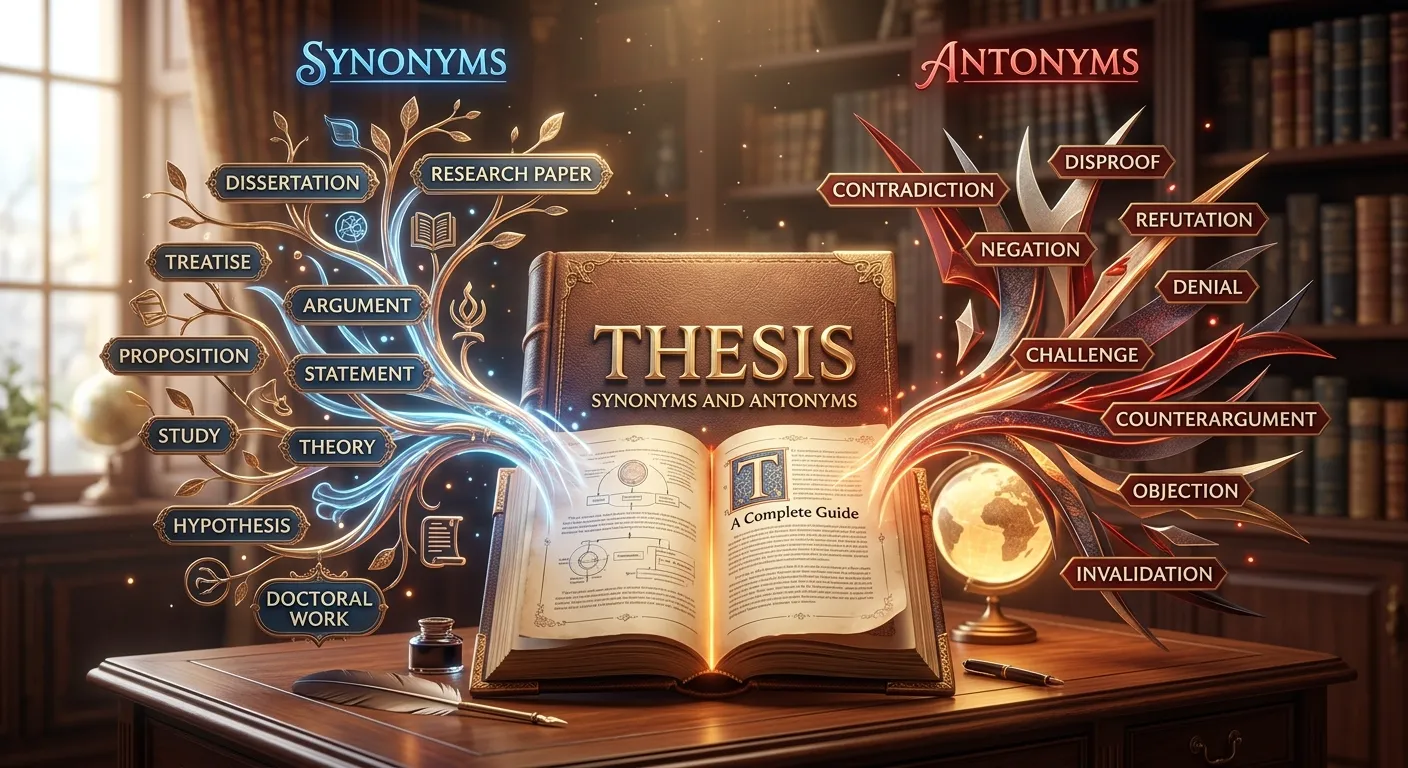
A thesis is a statement, idea, or argument that a writer or researcher develops and supports with evidence. Common synonyms include argument, proposition, claim, and hypothesis, while true antonyms are less direct because thesis names a concept rather than a quality. Context matters.
Quick Answer
Synonyms for thesis
Depending on context, useful synonyms include:
- Argument: a reasoned position supported by evidence
- Claim: a statement presented as true
- Proposition: a suggested idea or statement for consideration
- Assertion: a confident statement
- Contention: a position that someone argues for
- Premise: an idea or statement used as the basis for reasoning
- Hypothesis: a testable proposed explanation
- Theory: a well-supported explanation or system of ideas
- Position: a particular view or standpoint
- Central idea: the main idea being developed
Antonyms for thesis
There is no single exact antonym for thesis. Depending on what you mean, useful contrasting terms include:
- Antithesis: a directly contrasting idea or position
- Counterargument: an argument opposing another argument
- Rebuttal: a response intended to challenge or disprove an argument
- Refutation: evidence or reasoning that disproves a claim
- Contradiction: a statement or idea that conflicts with another
Quick Comparison Table
| Word | Meaning | Example |
| Thesis | A central argument or proposition | Her thesis argues that technology improves learning. |
| Argument | A reasoned position supported by evidence | His argument relies on recent research. |
| Claim | A statement presented as true | The paper makes a strong claim about education. |
| Antithesis | A contrasting or opposite idea | The author presents poverty as the antithesis of prosperity. |
| Counterargument | An opposing argument | The essay addresses the main counterargument. |
One-Line Definition
Thesis: A central idea, argument, or proposition that a writer or researcher develops and supports.
Main contrasting term: Antithesis an idea or position that directly contrasts with another.
Learning Outcomes
After reading this guide, you will know:
- The most useful synonyms for thesis
- Why thesis does not have one universal antonym
- The difference between antithesis, counterargument, and refutation
- How to choose the right word for academic writing
Synonyms for Thesis
The best synonym depends on how thesis is being used.
1. Argument
Argument is one of the closest alternatives when thesis refers to the central position a writer is defending.
Example:
The author’s argument is supported by several studies.
Best for: essays, research papers, debates, and academic writing.
2. Claim
A claim is a statement that someone presents as true and may need evidence to support.
Example:
The study makes the claim that regular reading improves vocabulary.
Difference: A thesis is usually broader and more central to an entire paper, while a claim can be one individual assertion within that paper.
3. Proposition
A proposition is a statement or idea put forward for consideration, discussion, or proof.
Example:
The researcher tested the proposition that social media influences purchasing decisions.
Best for: formal and academic contexts.
4. Assertion
An assertion is a confident statement that something is true.
Example:
The author’s assertion requires stronger evidence.
Difference: Assertion emphasizes the act of stating something confidently rather than the overall argument of a paper.
5. Contention
Contention refers to a position or argument that someone maintains or defends.
Example:
The central contention of the article is that education reduces inequality.
Best for: formal academic and argumentative writing.
6. Premise
A premise is a statement or idea that forms the basis for a logical argument.
Example:
The conclusion depends on the validity of its main premise.
Important: Premise is related to thesis but is not always interchangeable with it. A premise supports an argument; a thesis generally expresses its central position.
7. Hypothesis
A hypothesis is a proposed explanation or prediction that can be tested.
Example:
The researchers developed a hypothesis before conducting the experiment.
Important: In scientific writing, hypothesis and thesis have different meanings. A thesis is not automatically a hypothesis.
8. Position
Position means a particular opinion, viewpoint, or stance on an issue.
Example:
The paper clearly explains the author’s position on climate policy.
Best for: argumentative and academic writing.
9. Central Idea
Central idea refers to the main point around which a piece of writing is organized.
Example:
The central idea of the essay is that education should be accessible to everyone.
This is especially useful when explaining thesis to English learners.
10. Theory
Theory can sometimes be related to thesis when the word refers broadly to an organized explanation or system of ideas.
Example:
The paper examines a theory about how children acquire language.
Important: Theory is not a direct synonym for thesis. In academic contexts, they usually have distinct meanings.
Antonyms for Thesis
Unlike adjectives such as easy/hard or verbs such as accept/reject, thesis is a noun naming an idea or argument. Therefore, English does not have one simple opposite that works in every situation.
The strongest contrasts are contextual.
1. Antithesis
Antithesis is the closest lexical opposite when you mean an idea or position that directly contrasts with another.
Example:
Individualism is often presented as the antithesis of collectivism.
It can also describe a person or thing that represents the complete opposite of another.
Example:
His cautious approach was the antithesis of her adventurous style.
Why it is the strongest opposite
The prefix anti- means “against” or “opposite to,” while thesis refers to a proposition or position. Thus, antithesis specifically expresses a contrasting position.
However, in academic essays, antithesis does not always mean the formal opposite of a thesis statement. It can also refer more broadly to a strong contrast.
2. Counterargument
A counterargument is an argument that challenges or opposes another argument.
Example:
The researcher acknowledges the counterargument before defending the thesis.
This is often more useful than antithesis when discussing argumentative essays.
Thesis:
Online learning improves access to education.
Counterargument:
Online learning can create barriers for students without reliable internet access.
3. Rebuttal
A rebuttal is a response that challenges an opposing argument.
Example:
The author provides a detailed rebuttal to the criticism.
A rebuttal is therefore not simply an opposite thesis; it is a response to an argument.
4. Refutation
A refutation is an argument, evidence, or reasoning that shows that another claim is wrong or false.
Example:
The new evidence provides a strong refutation of the earlier claim.
This is appropriate when the goal is to disprove an argument rather than merely present an opposing position.
5. Contradiction
A contradiction is a statement or idea that conflicts with another statement or idea.
Example:
The second conclusion appears to be a contradiction of the original argument.
This is a broader term and is not necessarily a formal academic antonym of thesis.
Contextual Antonyms: Which Opposite Should You Use?
The appropriate opposite changes according to what thesis means in your sentence.
| If you mean… | Best contrasting term | Why |
| A directly opposing idea | Antithesis | Expresses strong conceptual contrast |
| An opposing argument | Counterargument | Challenges the original argument |
| A response to an argument | Rebuttal | Answers or challenges an opposing position |
| Something that disproves a claim | Refutation | Shows why a claim is wrong |
| An incompatible statement | Contradiction | Conflicts with another statement |
Meaning & Usage: Thesis vs. Antithesis
The most important distinction is between thesis and antithesis.
- Thesis → a central proposition or position
- Antithesis → a contrasting or opposing proposition or position
Example:
Thesis: Strict school uniforms improve student discipline.
Antithesis: Strict school uniforms unnecessarily limit student freedom.
The second statement directly challenges the idea expressed by the first.
However, if the second statement is presented specifically as an argument against the first, counterargument may be the more natural term.
Thesis in Academic Writing
In academic writing, thesis has a particularly important meaning.
A thesis statement normally expresses the central argument or position of an essay, research paper, or other academic work.
Example:
This essay argues that public libraries remain essential despite the growth of digital media.
Here, the sentence functions as the thesis statement.
You could describe it as the paper’s:
- central argument
- main claim
- central position
- principal proposition
But these alternatives are not perfectly interchangeable in every academic context.
Grammar & Word Class
Thesis is a noun.
Its plural form is:
thesis → theses
The plural theses is pronounced differently from the singular.
- thesis: /ˈθiːsɪs/
- theses: /ˈθiːsiːz/
Many of its related words are also nouns:
| Word | Word class |
| Thesis | Noun |
| Argument | Noun |
| Claim | Noun |
| Proposition | Noun |
| Hypothesis | Noun |
| Antithesis | Noun |
| Counterargument | Noun |
| Rebuttal | Noun |
| Refutation | Noun |
Common Mistakes
Mistake 1: Treating antithesis as a synonym
❌ The antithesis of my paper is the main idea I support.
✅ The thesis of my paper is the main idea I support.
Antithesis refers to a contrasting or opposing idea, not the central idea itself.
Mistake 2: Assuming hypothesis means thesis
❌ The thesis was tested in the laboratory.
This may be incorrect if you mean a testable prediction or proposed explanation.
✅ The hypothesis was tested in the laboratory.
A thesis and a hypothesis can both appear in academic research, but they perform different roles.
Mistake 3: Calling every opposing idea an antithesis
An opposing argument is often better called a counterargument.
The essay presents a thesis and then responds to several counterarguments.
This is more precise than automatically using antithesis.
Expert Tip
When writing an academic article, use thesis for the central position you are developing, counterargument for an opposing argument, and refutation when you specifically show why an opposing claim is wrong. This distinction makes academic writing more precise.
Mini Quiz
Choose the best word
The essay presents a central argument and then responds to an opposing ______.
A. thesis
B. counterargument
C. hypothesis
Answer: B. counterargument
A counterargument directly refers to an argument that challenges another argument.
Fill in the blank
The researcher tested the ______ that sleep affects memory.
Answer: hypothesis
A hypothesis is a proposed explanation or prediction that can be tested.
Short Questions & Answers
Q: What is the closest synonym for thesis?
Argument is one of the closest synonyms when thesis means the central position or argument of an academic paper. Other context-dependent alternatives include claim, proposition, contention, and position.
Q: What is the opposite of thesis?
There is no single universal antonym for thesis. Antithesis is the closest lexical contrast when referring to a directly opposing idea, while counterargument is often better when referring to an opposing argument in academic writing.
Q: Is antithesis the opposite of thesis?
Antithesis can represent a contrasting or opposing idea, making it the closest direct lexical contrast to thesis. However, it is not always the best term for an opposing academic argument; counterargument may be more precise in that context.
Q: Is counterargument a synonym for antithesis?
No. A counterargument is an argument that challenges another argument. Antithesis is a broader term for a strong contrast or opposing idea, and it can be used outside formal argumentation.
Q: What is the difference between thesis and hypothesis?
A thesis is a central argument or proposition, particularly in academic writing. A hypothesis is a proposed explanation or prediction that can be tested. A research paper may contain both.
Key Takeaways
- Thesis means a central idea, argument, or proposition.
- Argument, claim, proposition, contention, and position are useful synonyms depending on context.
- Antithesis is the closest lexical opposite when you mean a contrasting idea.
- Counterargument is usually the better term for an opposing argument in academic writing.
- Rebuttal responds to an opposing argument, while refutation aims to disprove a claim.
- Hypothesis is related to academic research but is not a direct synonym for thesis.
Antonyms for Restriction: 15 Useful Opposites

Hi, I’m Amna Akhtar. I write about word their meanings, opposites, and the small distinctions that make English tricky. I don’t come at language purely from instinct, either. I have a peer-reviewed academic paper “Determinants of Jobs Satisfaction of Female Teachers: An Evidence from District Hafizabad, Pakistan,” published in education economics, and that research background shapes how I think about language content, I want it to actually help people learn, not just look correct on a page. Whether you’re a student, a writer, or just someone who wants to use the right word at the right moment, my goal is to make that easier for you.