Featured Snippet Block
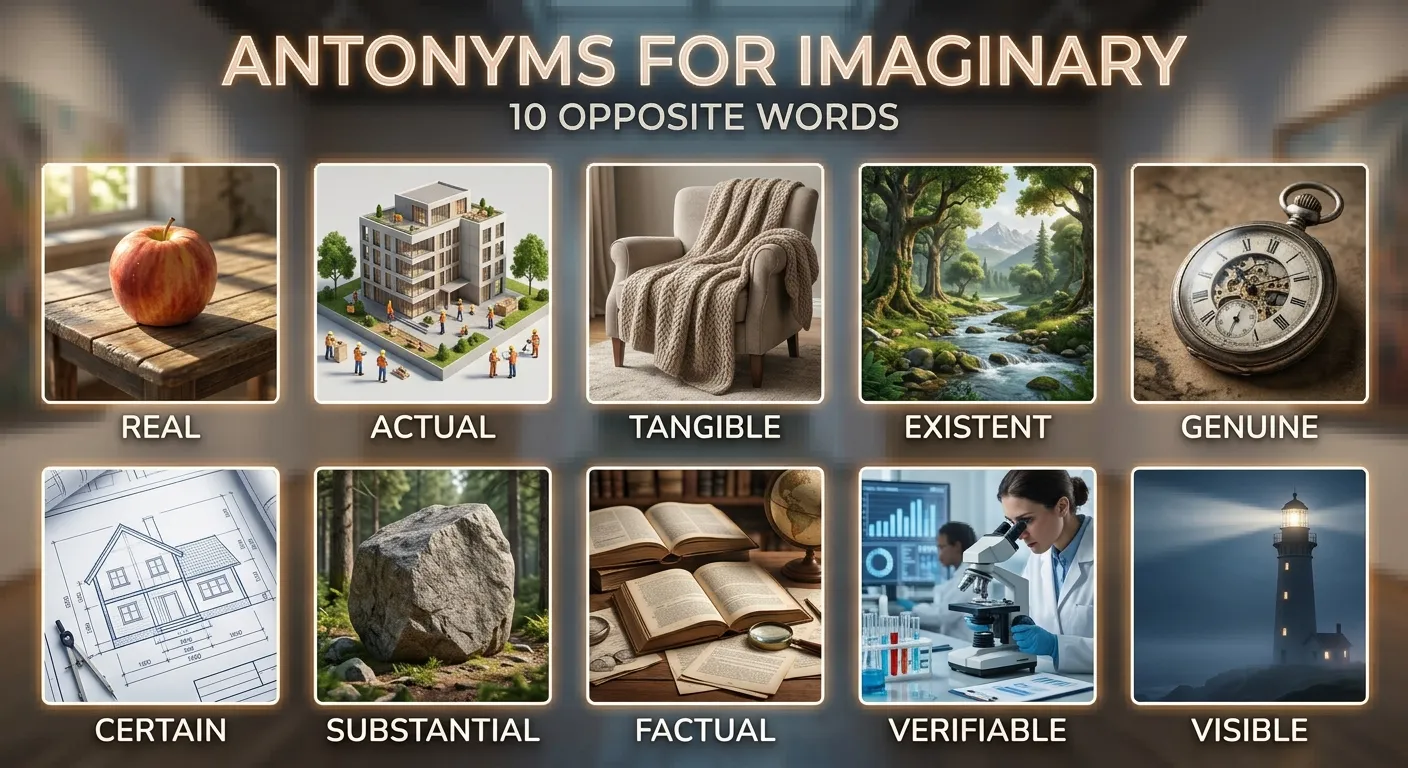
The most common antonym for imaginary is real, meaning something that exists in reality rather than only in the mind or imagination. Depending on context, other opposites include actual, existent, factual, concrete, and nonfictional. The best antonym depends on what “imaginary” describes.
Quick Answer
The main antonym of imaginary is real.
- Imaginary means existing only in the imagination or not existing in reality.
- Real means actually existing or occurring in reality.
- Actual emphasizes what truly exists or happened.
- Factual describes information based on facts rather than invention.
- Concrete emphasizes something definite or tangible rather than abstract or imagined.
- Nonfictional is useful when discussing stories, characters, or writing.
So, if you need one general opposite of imaginary, choose real.
Quick Comparison Table
| Word | Meaning | Example |
| Imaginary | Existing only in the mind or imagination | The child had an imaginary friend. |
| Real | Actually existing in reality | The danger was real. |
| Actual | Existing or happening in fact | We finally saw the actual building. |
| Factual | Based on facts and truth | The report contains factual information. |
| Existent | Actually existing | Evidence of the existent problem was found. |
| Concrete | Definite, specific, or tangible | We need a concrete plan. |
| Tangible | Real enough to be touched or clearly experienced | The project produced tangible results. |
| Nonfictional | Based on real people, events, or facts | The book is a nonfictional account. |
One-Line Definition
Imaginary: Existing only in the mind or imagination rather than in physical or actual reality.
Main antonym: Real Actually existing or happening in reality.
Learning Outcomes
After reading this guide, you will know:
- The strongest antonym of imaginary
- Other useful opposites and their meanings
- Why real and actual are not always interchangeable
- Which antonyms work in different contexts
- How to use these words naturally in sentences
Core Antonyms for Imaginary
1. Real
Real is the clearest and most common antonym of imaginary. It refers to something that actually exists, happens, or is genuine.
Example:
The monster in the movie was imaginary, but the fear it caused was real.
Best for: General everyday use.
2. Actual
Actual means existing or happening in fact. It often contrasts with something imagined, assumed, predicted, or described inaccurately.
Example:
The actual cost was much higher than the imaginary figure in his estimate.
Usage note:
Actual is closely related to real, but it often emphasizes the true or factual situation rather than simply existence.
3. Existent
Existent means actually existing. It is a more formal word and is particularly useful in academic, philosophical, or technical writing.
Example:
The researchers investigated whether the supposed problem was existent or merely imaginary.
Usage note:
Although grammatically correct, existent is much less common in everyday English than real or actual.
4. Factual
Factual means based on facts or information that can be verified as true. It can contrast with imaginary or invented material.
Example:
The article separates factual information from imaginary stories.
Usage note:
Factual is not a universal antonym for imaginary. It is most appropriate when discussing information, statements, reports, or descriptions.
5. Concrete
Concrete can contrast with imaginary when the meaning is “definite, specific, or clearly existing.”
Example:
Instead of an imaginary solution, the team needs a concrete plan.
Usage note:
Concrete does not simply mean “real.” It often means something definite, practical, or specific, especially when contrasted with an idea that is vague or theoretical.
6. Tangible
Tangible describes something real and perceptible, especially something that can be touched or whose effects can be clearly experienced.
Example:
The new policy produced tangible benefits for employees.
Usage note:
Tangible is useful when the contrast involves something that can be physically perceived or clearly demonstrated.
7. Nonfictional
Nonfictional means based on real people, events, or facts rather than being invented as fiction.
Example:
The documentary tells a nonfictional story about the explorer’s journey.
Usage note:
This is especially useful when discussing books, stories, characters, films, or other creative works.
8. Genuine
Genuine means real, authentic, or sincere rather than fake, artificial, or invented.
Example:
Her concern was genuine, not imaginary.
Usage note:
Genuine is particularly natural when talking about feelings, intentions, objects, or authenticity.
9. Authentic
Authentic means genuine, original, or truly what something claims to be.
Example:
The museum displayed an authentic historical document rather than an imaginary reconstruction.
Usage note:
Authentic is stronger than real in contexts involving originality or authenticity.
10. Verifiable
Verifiable means capable of being checked or confirmed as true.
Example:
The journalist used verifiable evidence instead of imaginary claims.
Usage note:
Verifiable is useful when the contrast concerns claims, evidence, information, or statements. It is not a direct antonym of imaginary in every situation.
Contextual Antonyms of Imaginary
Not every opposite of imaginary works in every situation. The best choice depends on what the word describes.
When “imaginary” means “not real”
Use:
- real
- actual
- existent
- genuine
Example:
The imaginary threat → The real threat
Example:
The imaginary problem → The actual problem
When “imaginary” describes invented information
Use:
- factual
- verifiable
- real
- authentic
Example:
Imaginary facts → Factual information
Example:
Imaginary evidence → Verifiable evidence
Here, factual is more precise than simply using real.
When “imaginary” describes fiction or invented stories
Use:
- nonfictional
- real
- historical, when referring specifically to documented events
Example:
An imaginary character → A real person
Example:
An imaginary story → A nonfictional account
When “imaginary” contrasts with something definite or practical
Use:
- concrete
- tangible
- actual
Example:
An imaginary solution → A concrete solution
Example:
Imaginary benefits → Tangible benefits
These words are contextual opposites rather than exact dictionary antonyms.
Imaginary vs. Real: The Main Contrast
The most important distinction is between imaginary and real.
Imaginary refers to something created by the mind, invented, or perceived in imagination.
Real refers to something that actually exists or happens.
Compare:
- The dragon is imaginary.
- The castle is real.
- She imagined an imaginary conversation.
- She had a real conversation with her manager.
The pair works naturally across many everyday contexts, which is why real is the best general antonym.
Imaginary vs. Actual
Imaginary and actual are closely related opposites, but their emphasis differs.
- Imaginary = created or existing in the imagination
- Actual = existing or happening in fact
Example:
The predicted number was different from the actual number.
You would normally use actual when correcting an assumption, estimate, expectation, or imagined version of something.
Imaginary vs. Factual
These words contrast most naturally when discussing information.
- Imaginary = invented or imagined
- Factual = based on facts
Example:
The teacher asked students to distinguish factual information from imaginary details.
However, factual is not the correct antonym in every sentence. For example, the natural opposite of an imaginary friend is a real friend, not a factual friend.
Example Sentences
Here are natural examples showing different contexts:
- The creature in the story is imaginary.
- The danger they faced was real.
- We need to know the actual cause of the problem.
- The report contains factual information.
- The company needs a concrete plan before moving forward.
- The charity achieved tangible results.
- The documentary presents a nonfictional account of the event.
- Her concern was genuine, not imaginary.
- The museum confirmed that the painting was authentic.
- The claim must be verifiable before it is published.
Grammar & Word Class
Imaginary is an adjective.
It describes a noun:
- imaginary character
- imaginary friend
- imaginary problem
- imaginary world
- imaginary creature
Most of its useful general antonyms are also adjectives:
- real
- actual
- existent
- factual
- concrete
- tangible
- genuine
- authentic
- nonfictional
- verifiable
Example
Imaginary: She created an imaginary world.
Real: She visited a real country.
Because both imaginary and real are adjectives, they can occupy the same grammatical position in many sentences.
Common Mistakes
Mistake 1: Treating “factual” as the universal opposite
❌ The opposite of an imaginary friend is a factual friend.
✅ The opposite of an imaginary friend is a real friend.
Why?
Factual relates primarily to information and facts, while real can describe people, objects, situations, experiences, and events.
Mistake 2: Using “concrete” when “real” is intended
❌ My sister is concrete.
✅ My sister is real.
Why?
Concrete does not normally mean simply “real.” It often means definite, specific, or tangible.
Mistake 3: Assuming “actual” and “real” are identical in every context
Although they overlap, they have different shades of meaning.
- real problem = a problem that genuinely exists
- actual problem = the true problem, especially compared with an assumed or expected one
Both can be correct, but the context determines which sounds more natural.
Expert Tip
When you are unsure which antonym to use, choose real. It is the broadest and most natural opposite of imaginary. Use more specific alternatives such as factual, nonfictional, concrete, or verifiable only when the context calls for that particular meaning.
Mini Quiz
Choose the best antonym
The child had an imaginary friend, but her brother was ______.
A. factual
B. real
C. concrete
Answer: B. real
Explanation: A person can be real, but factual usually describes information and concrete describes something definite, specific, or tangible.
Fill in the blank
The journalist used ______ evidence instead of invented information.
A. imaginary
B. factual
C. imaginary
Answer: B. factual
Explanation: Factual means based on facts, making it the appropriate choice for evidence or information.
Synonyms for Imaginary
Imaginary can have several synonyms depending on whether something is invented, imagined, or unreal.
| Synonym | Meaning | Example |
| Fictional | Created for a story rather than existing in reality | Sherlock Holmes is a fictional character. |
| Fanciful | Imaginative, unusual, or unlikely to be real | She described a fanciful world filled with magical creatures. |
| Fictitious | Invented or made up rather than real | The company used a fictitious name in the document. |
| Unreal | Not real or not existing in reality | The scene seemed completely unreal. |
| Imagined | Created in the mind rather than experienced as reality | The danger was imagined rather than real. |
| Invented | Created or made up, especially a story, fact, or explanation | He gave an invented explanation for his absence. |
| Hypothetical | Based on an assumed situation rather than an actual one | The teacher presented a hypothetical situation to the class. |
Which synonym is closest to “imaginary”?
Fictional and unreal are often close to imaginary, but they are not interchangeable in every context. Fictional is especially common for characters, stories, and events created for fiction, while unreal emphasizes something that does not exist or seems impossible or strange.
Short Questions & Answers
Q: What is the main antonym of imaginary?
A: The main antonym of imaginary is real. Imaginary describes something created by the mind or not existing in reality, while real describes something that actually exists or happens.
Q: What is a stronger opposite of imaginary?
A: There is no single “stronger” antonym in every context. Real is the strongest general opposite, while actual, factual, authentic, or verifiable may be more precise in particular contexts.
Q: Is “actual” an antonym of “imaginary”?
A: Yes, actual can function as a contextual antonym of imaginary. It means existing or happening in fact. However, real is usually the more natural general antonym.
Q: Is “factual” the opposite of imaginary?
A: Factual can be an opposite of imaginary when discussing information, statements, evidence, or descriptions. It is not a universal antonym because it does not naturally describe every noun that imaginary can modify.
Q: What is the opposite of an imaginary person?
A: The most natural opposite is a real person someone who actually exists rather than someone invented or imagined.
Key Takeaways
The best general antonym for imaginary is real.
Other useful opposites depend on context:
- Real: actually existing
- Actual: existing or happening in fact
- Factual: based on facts
- Existent: actually existing; more formal
- Concrete: definite or specific
- Tangible: perceptible or clearly real
- Nonfictional: based on real people, events, or facts
- Genuine: real or sincere
- Authentic: genuine or original
- Verifiable capable of being confirmed as true
The key lesson is simple: use “real” for the general opposite, and choose a more specific word when the context requires a particular kind of contrast.
Antonyms for Analogy: 5 Clear Opposites & Examples

I’m Leo Jackson, an English writer with a soft spot for the peculiarities of language and vocabulary. Specializes in exploring the nuances of English synonyms, antonyms, helping students, writers, and professionals choose the right word with confidence. My guides combine careful research with clear, practical explanations.