Quick Answer
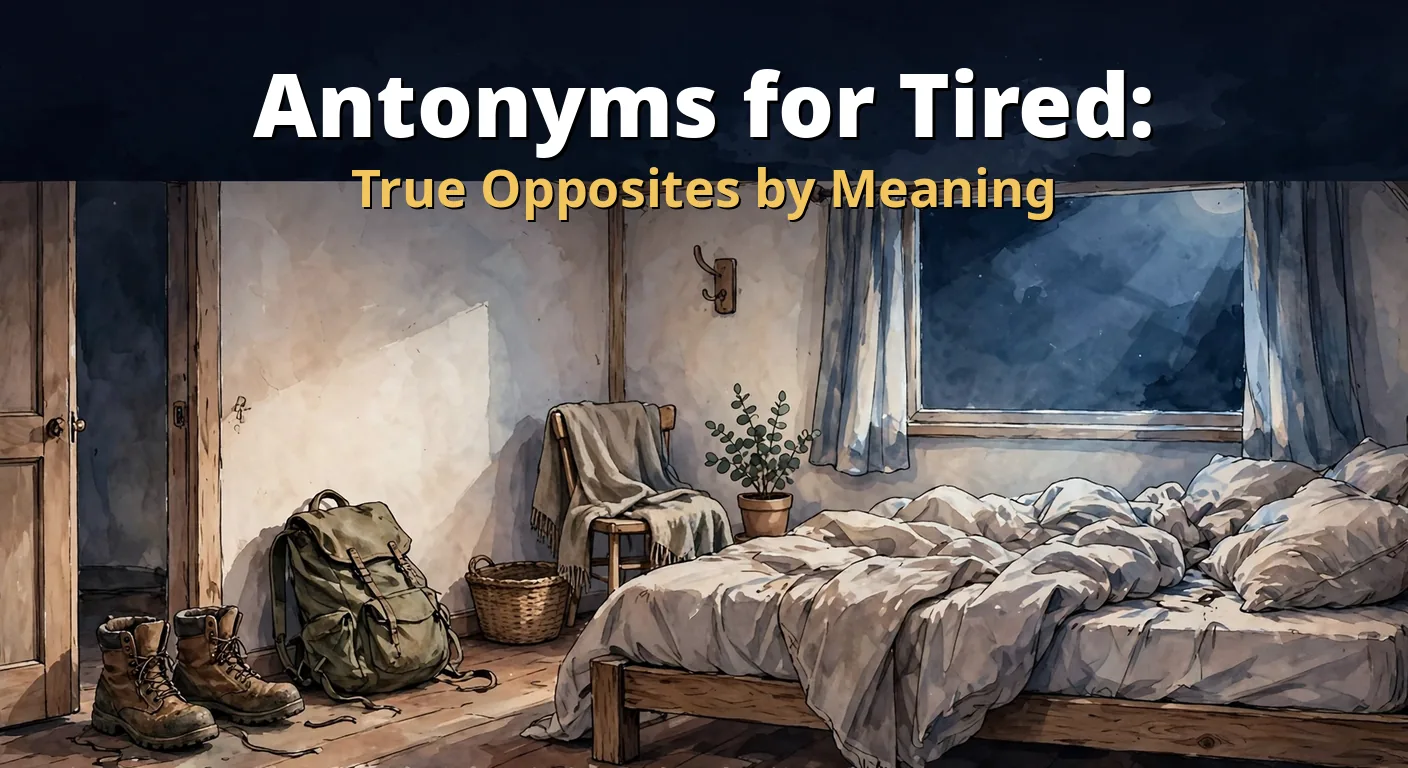
Tired has no single opposite, because it works in three different senses: and each sense reverses differently.
- Needing rest (your body or mind is used up): rested, refreshed and energetic describe recovery and energy; alert covers the mental side; awake marks only the boundary (see its entry).
- Tired of something (bored or impatient with it): interested and engaged.
- Overused (a tired joke, a tired cliché): fresh and original.
Nine opposites follow: one list, each word once, grouped by the sense it actually reverses.
Quick Comparison
| Opposite | Sense | Example |
|---|---|---|
| Rested | Needing rest | After eight hours of sleep, she felt completely rested. |
| Refreshed | Needing rest | A short walk left him refreshed and ready to work again. |
| Energetic | Needing rest | The energetic children played outside all afternoon. |
| Alert | Needing rest (mental) | She stayed alert through the long night drive. |
| Awake | Needing rest (boundary) | He was awake, but far too tired to drive safely. |
| Interested | Tired of something | Far from tired of the subject, she grew more interested each week. |
| Engaged | Tired of something | The engaged audience stayed to the very end. |
| Fresh | Overused | A fresh joke replaced the tired old one. |
| Original | Overused | His original metaphors stood out from the tired clichés around them. |
Core Opposites for Tired
Sense 1: Needing Rest
When tired means your body or mind has run low: after work, exercise or a long day: the opposites describe rest taken, recovery felt and energy present.
1. Rested
Meaning: No longer tired, because you have had enough rest or sleep.
Example: After a full night’s sleep, he felt rested and ready for the journey.
Nuance: The plain recovery word. Rested looks backwards: the tiredness existed, and rest has removed it. It says nothing about how much energy you now have: only that the debt is paid.
2. Refreshed
Meaning: Feeling rested and restored, as if made new again.
Example: She felt refreshed after a swim and a short nap.
Nuance: Refreshed adds renewal to recovery. It often follows something shorter or more pleasant than a full night’s sleep: a break, a shower, fresh air, a holiday: and it describes how you feel, not just what you did.
3. Energetic
Meaning: Full of energy and activity; lively and ready to act.
Example: Despite the early start, the energetic hikers reached the summit by noon.
Nuance: The strongest reversal on this page. Rested and refreshed mean the tiredness is gone; energetic means energy is present in abundance. The variant energised belongs here too: it means given energy: by excitement, coffee, good news: so it describes energy arriving from a cause, where energetic describes the state itself. One idea, one entry.
4. Alert
Meaning: Mentally sharp, watchful and quick to notice and react.
Example: A short rest left the driver alert again.
Nuance: The mental shade of this sense. Tiredness dulls the mind before it stops the body: slow reactions, wandering attention: and alert reverses exactly that dullness. A person can be physically tired yet alert, or rested yet mentally sluggish; the words measure different things.
5. Awake (a boundary word, not an exact opposite)
Meaning: Not asleep.
Example: He was wide awake at dawn: and tired again by ten.
Nuance: Handle with care. Awake strictly opposes asleep, not tired: you can be fully awake and completely exhausted, and the drowsy edge of tiredness is where the two scales meet. On the sleepiness end of tired (“too tired to keep my eyes open”), awake and wide awake are the natural contrasts: which is why the word earns a labelled place here rather than a false claim to exactness.
Sense 2: Tired Of Something
Tired of means bored, impatient or fed up: tired of waiting, tired of the same excuses. Nothing here needs sleep: the opposites are about attention and willingness, and they work at phrase level, inside the tired of pattern.
6. Interested
Meaning: Wanting to know, learn or hear more about something.
Example: She never grew tired of the stories; she stayed interested to the last one.
Nuance: The direct reversal of the boredom in tired of. Where tired of says “no more of this,” interested says “more, please.”
7. Engaged
Meaning: Fully involved and absorbed in something; giving it your attention.
Example: The speaker kept the audience engaged for two hours: nobody was tired of listening.
Nuance: Stronger and more active than interested: interest can be passive, but engagement means participating. It is the opposite to reach for when tired of describes people switching off during a task, lesson or meeting.
Sense 3: Overused
A tired joke, phrase or idea is one worn out by repetition: stale, predictable, no longer effective. People cannot be tired in this sense; only things and ideas can.
8. Fresh
Meaning: New, different and lively; not yet worn out by use.
Example: The comedian opened with fresh material instead of his tired routines.
Nuance: The everyday opposite for this sense. Fresh promises novelty and life: a fresh angle, a fresh example: without claiming the thing has never existed before.
9. Original
Meaning: New and inventive; not copied or repeated from something else.
Example: Her original metaphors made the tired topic feel new.
Nuance: Stronger than fresh: original claims the thing was created, not merely new to the audience. A fresh joke might be an old one you have not heard; an original joke is one nobody has told before.
Example Sentences
- After the holiday she came back rested, refreshed and noticeably more energetic.
- The night nurse stayed alert through the quiet hours.
- He was awake, but too tired to read another page.
- Far from being tired of the project, the team grew more engaged every week.
- The editor cut the tired introduction and wrote a fresh one.
Common Mistakes
Mistake 1: Padding the page by printing one list three times
A three-word answer does not become richer when the same three words appear in a comparison table, a second identical table and a “which fits best” recap. One list, each word once: this page’s nine entries are counted that way.
Mistake 2: Treating “exhausted” as an opposite
❌ He was not tired at all: in fact, he was exhausted.
✅ He was not tired at all: in fact, he was energetic.
Exhausted is a stronger synonym of tired, not its opposite. The sentence above claims a man with no energy had none left at all.
Mistake 3: Using “awake” as the exact opposite of tired
❌ She slept badly but woke up awake, so she was not tired.
✅ She woke up awake but still tired, so she rested before driving.
Awake opposes asleep. Sleep and tiredness are related but different scales, and confusing them produces nonsense: and, in the driving case, unsafe nonsense.
Mistake 4: Mixing the senses
❌ After ten hours of meetings, I am very interested and not tired at all.
✅ After ten hours of meetings, I am tired, though the last speaker kept me interested.
Interested and engaged reverse tired of, not physical or mental tiredness. A person can be exhausted and interested at the same time: the senses are independent.
Mini Quiz
1. “After nine hours of sleep, Daniel woke feeling __ and ready for the day.”
A. Rested
B. Drained
C. Weary
Answer: A. Rested: the rest is complete and the tiredness gone. Drained and weary are synonyms of tired, not opposites.
2. Which word best opposes tired when the problem is a dull, slow-reacting mind?
A. Original
B. Alert
C. Awake
Answer: B. Alert: mental sharpness is what tiredness dulls. Awake only says he is not asleep, and original belongs to the overused sense.
3. “Critics dismissed the sequel’s plot as tired.” Which opposite fits that sense?
A. Rested
B. Energetic
C. Fresh
Answer: C. Fresh: a tired plot is overused and stale, so its opposite is fresh (or original). People feel rested and energetic; plots do not.
Short Q&A
Q: What is the main antonym of tired?
A: It depends on the shade you mean. Energetic is the strongest general opposite: energy present, not just tiredness absent. For the state after sleep or rest, rested is the natural choice, and refreshed when the recovery feels like renewal.
Q: What is the difference between rested and refreshed?
A: Rested means the rest happened and the tiredness is gone: it points back to the sleep or break. Refreshed describes the feeling of being made new, and often follows something shorter or more pleasant than sleep: a walk, a shower, a week away.
Q: Is awake the opposite of tired?
A: Not exactly. Awake opposes asleep, and a person can be wide awake and exhausted. It is a boundary word: it contrasts with tired only at the drowsy end, where tiredness shades into sleep.
Q: What is the opposite of being tired of something?
A: Interested or engaged. Tired of means bored or fed up, so its opposites are about attention returning: wanting more of the thing, or being absorbed in it.
Q: What is the opposite of a tired joke or a tired cliché?
A: Fresh for the everyday contrast: new and lively rather than worn out: and original when the point is that it was newly created, not copied or repeated.
Key Takeaways
- Tired has three senses, and each takes its own opposites: needing rest, being tired of something, and being overused.
- For needing rest: rested (rest completed), refreshed (restored, feeling new), energetic (energy in abundance: with energised as its variant), and alert for the mental side.
- Awake is a boundary word, not an exact opposite: it opposes asleep, and a person can be awake and exhausted at once.
- For tired of, the opposites are interested and engaged; for tired ideas, fresh and original.
- Nine opposites in total, each listed once: and exhausted is a stronger synonym of tired, never an antonym.

Hi, I’m Amna Akhtar. I write about word meanings, opposites, and the small distinctions that make English tricky. I don’t come at language purely from instinct, either. I have a peer-reviewed academic paper “Determinants of Jobs Satisfaction of Female Teachers: An Evidence from District Hafizabad, Pakistan,” published in education economics, and that research background shapes how I think about language content, I want it to actually help people learn, not just look correct on a page. Whether you’re a student, a writer, or just someone who wants to use the right word at the right moment, my goal is to make that easier for you.