Quick Answer
Gait has no true dictionary antonym, and the reason is built into the word itself. Gait names a manner: the way a person or animal walks: the rhythm, length and pattern of their steps. A manner cannot be reversed. Every way of walking: striding, shuffling, limping: is a gait, so there is no “opposite way of walking” left for an antonym to name.
That leaves two honest kinds of contrast:
- The absence of gait: not walking at all: stillness and immobility. What remains when walking stops: not a reverse of it.
- Opposite descriptions of a gait: genuine word pairs that reverse one quality of a walk: steady/unsteady, even/uneven, smooth/awkward, brisk/slow, confident/hesitant. These words oppose each other, not the word gait: and they are what most searchers actually need.
Quick Comparison
| Contrast pair | What it describes | Example |
|---|---|---|
| Walking / stillness | Movement against no movement at all: the absence of gait | The deer froze in stillness, then walked off. |
| Steady / unsteady | Balance and regularity of the steps | Steady on the flat, unsteady on the stairs. |
| Even / uneven | Whether the steps fall in an equal rhythm | A limp: one step shorter than the other. |
| Smooth / awkward | How flowing or stiff the movement looks | Dancers train for a smooth gait; new boots made his awkward. |
| Brisk / slow | The speed of the walk | Brisk on the way out, slow coming home. |
| Confident / hesitant | How assured the steps are | He crossed the ice with a hesitant gait. |
What Gait Is
A gait is the pattern of steps a person or animal makes when walking: the rhythm, the length of stride, how the feet land and how the body moves over them. You can often recognise someone at a distance by gait alone.
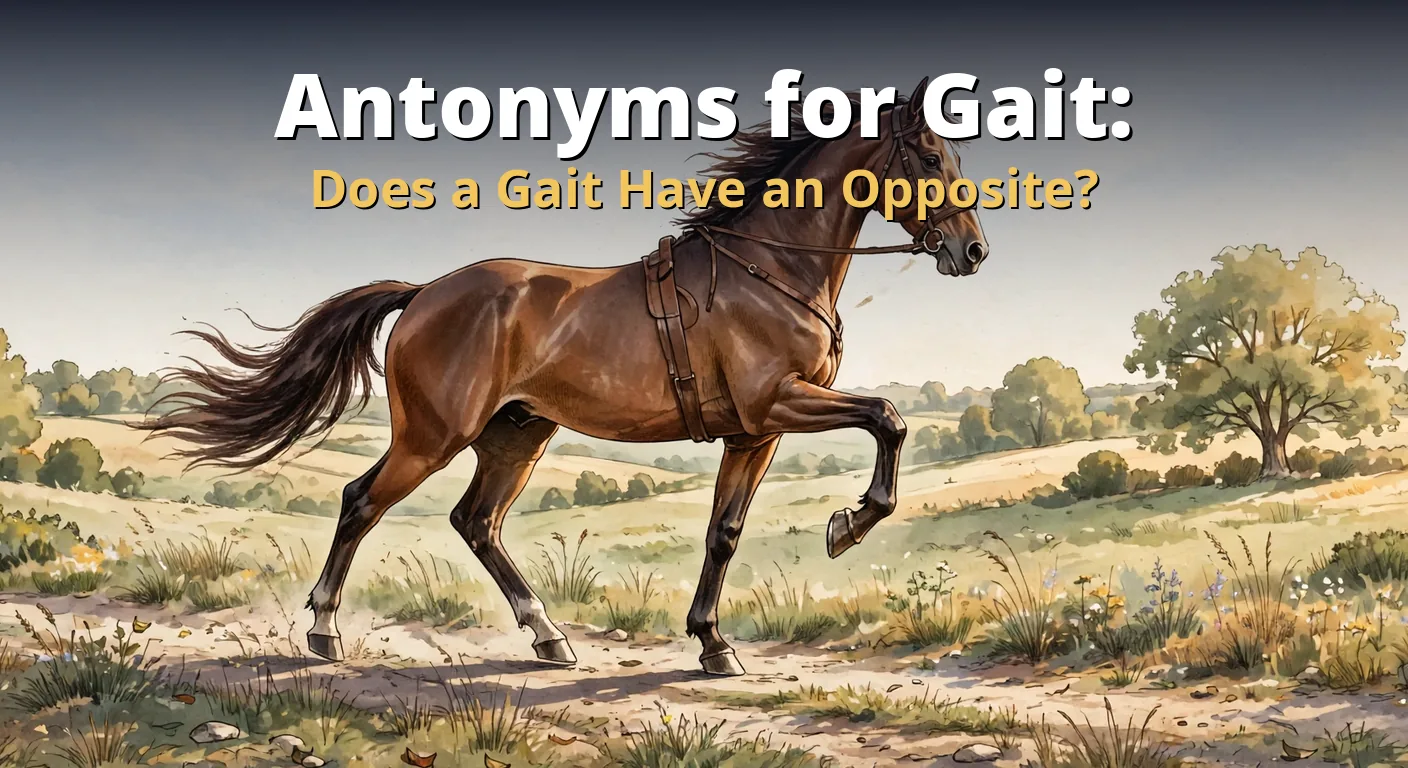
For animals, gait is also the technical word: a horse’s walk, trot, canter and gallop are its four natural gaits: different patterns, none the opposite of another.
The Only Noun-Level Contrast: Not Walking at All
At noun level, the only contrast is the absence of walking: and two words do that job, not interchangeably.
Stillness
Stillness is a complete lack of movement. It contrasts with walking as silence contrasts with sound: an absence, not a reverse. The deer standing in stillness has not adopted an “opposite gait”: it has stopped, and has no gait at all.
Immobility
Immobility is being unable to move: through injury, illness or restraint. It is stronger than stillness: the patient with a broken leg is immobile, full stop. It names gait’s absence through inability, not choice.
Opposites That Describe a Gait
Here is the useful turn: while gait has no opposite, the adjectives that describe one form real opposite pairs: each reversing a single quality, each side still a gait.
Steady / unsteady
A steady gait is balanced and regular; an unsteady gait wobbles, steps varying, the walker liable to fall. Unsteady is the word clinicians watch for: it can signal illness or injury.
Even / uneven
An even gait keeps an equal rhythm, step matching step. An uneven gait breaks it: usually a limp, one step shorter or lighter to spare a painful leg.
Smooth / awkward
A smooth gait flows: no jerks, no wasted movement. An awkward gait is stiff and ungainly: the walk of someone in stiff new boots or carrying an unbalanced load.
Brisk / slow
A brisk gait is quick and energetic; a slow gait is unhurried, each step placed deliberately or tiredly. This pair reverses the pace: and both extremes are still gaits, which is exactly why gait itself has no opposite.
Confident / hesitant
A confident gait is assured and purposeful. A hesitant gait is cautious and halting: short, testing steps, as on ice or in the dark.
A Short Note on Clinical and Animal Use
Doctors, physiotherapists and vets assess gait. The standard clinical pair is normal gait / abnormal gait: “gait abnormality” is the medical term for a way of walking that departs from the healthy pattern, and gait analysis is its formal examination. Named patterns exist: an antalgic gait avoids pain, an ataxic one is unsteady through poor coordination. But abnormal opposes normal, not gait: the judgement is what reverses, never the walking.
Words That Are Not Antonyms of Gait
Rest and inactivity
A rest is a pause in activity; inactivity is a general state of not being active. Neither targets walking: you can rest mid-walk with your gait intact, and an inactive person has a gait the moment they cross the room.
Pace, speed and stride
Pace and speed measure how fast a gait moves, and a stride is a single step within it. A measurement and a part: neither can oppose the whole: a fast gait and a slow gait are both gaits.
Invented words: “ungait”, “anti-gait”
No prefix reverses a manner noun, and none is needed: the absence words and adjective pairs above cover every honest contrast.
Example Sentences
- The horse moved from a walk to a trot: a different gait, not an opposite one.
- After the accident, his gait was unsteady: a noted gait abnormality.
- She recognised her father’s confident gait from far down the road.
- In the clearing there was total stillness: no animal walked at all.
Common Mistakes
Mistake 1: Calling stillness the antonym of gait
Stillness is the absence of movement in general: of a room, a pond, a held breath. It does not reverse a manner of walking; it means no walking is happening.
Mistake 2: Mixing up the absence words
Use stillness for a voluntary or neutral stop, and immobility only when movement is impossible. “His immobility at the bus stop” wrongly suggests the waiting passenger cannot move.
Mistake 3: Treating gait as speed
“The opposite of his fast gait is a slow gait”: no. Brisk and slow oppose each other as descriptions; the gait is present at both speeds. A trot is not the opposite of a gallop either: different patterns are alternatives, not opposites.
Mini Quiz
1. Does gait have a true dictionary antonym?
A. Yes: stillness
B. No: it names a manner of walking, and a manner cannot be reversed
C. Yes: immobility
Answer: B. Stillness and immobility name the absence of walking, not a reverse manner of walking.
2. “Within a week of the operation, her steps were balanced and regular again.” Which pair describes her recovery?
A. Her gait went from brisk to slow
B. Her gait went from unsteady to steady
C. Her gait went from confident to hesitant
Answer: B. Steady/unsteady is the pair about balance and regularity of steps.
3. A report says a patient has a “gait abnormality.” What does it mean?
A. The patient has no gait
B. The patient’s speed is abnormal
C. The patient’s way of walking departs from the normal pattern
Answer: C. In clinical use, abnormal opposes normal: the pattern is judged, and a patient who walks still has a gait.
Short Q&A
Q: What is the opposite of gait?
A: Strictly, there isn’t one. Gait means a manner of walking, and manners do not reverse: every way of walking is a gait. The closest contrasts are its absence (stillness, immobility) and opposite descriptions of it.
Q: Is stillness an antonym of gait?
A: No: it is a contrast of absence. Stillness means no movement at all, in anything; gait is a way of moving, and stillness describes no reversed way of walking.
Q: What is the opposite of a steady gait?
A: An unsteady gait: the adjectives oppose each other, and both phrases describe a gait.
Q: What is the difference between gait and pace?
A: Gait is the pattern of walking; pace is how fast it moves. The same person keeps a recognisable gait, brisk or slow.
Q: What does “abnormal gait” mean?
A: A way of walking that departs from the healthy pattern: the standard clinical phrase, assessed through gait analysis.
Key Takeaways
- Gait has no true dictionary antonym: it names a manner of walking, and every manner of walking: fast, slow, smooth, limping: is equally a gait.
- The only noun-level contrast is absence: stillness (no movement) and immobility (unable to move) describe gait stopping, not gait reversed.
- Real opposites exist one level down, in the descriptions: steady/unsteady, even/uneven, smooth/awkward, brisk/slow, confident/hesitant: pairs that oppose each other, not the word gait.
- In clinical use the honest pair is normal/abnormal gait; rest, inactivity, pace and stride are neighbours of the idea, not antonyms of it.

I am Calara Stephen, passionate about making English simple and easy to understand through clear synonym, antonyms, word comparisons, vocabulary guides, and language tips. Through thoughtful, reliable content, I aim to be a trusted guide for anyone looking to expand their English vocabulary.