Featured Snippet
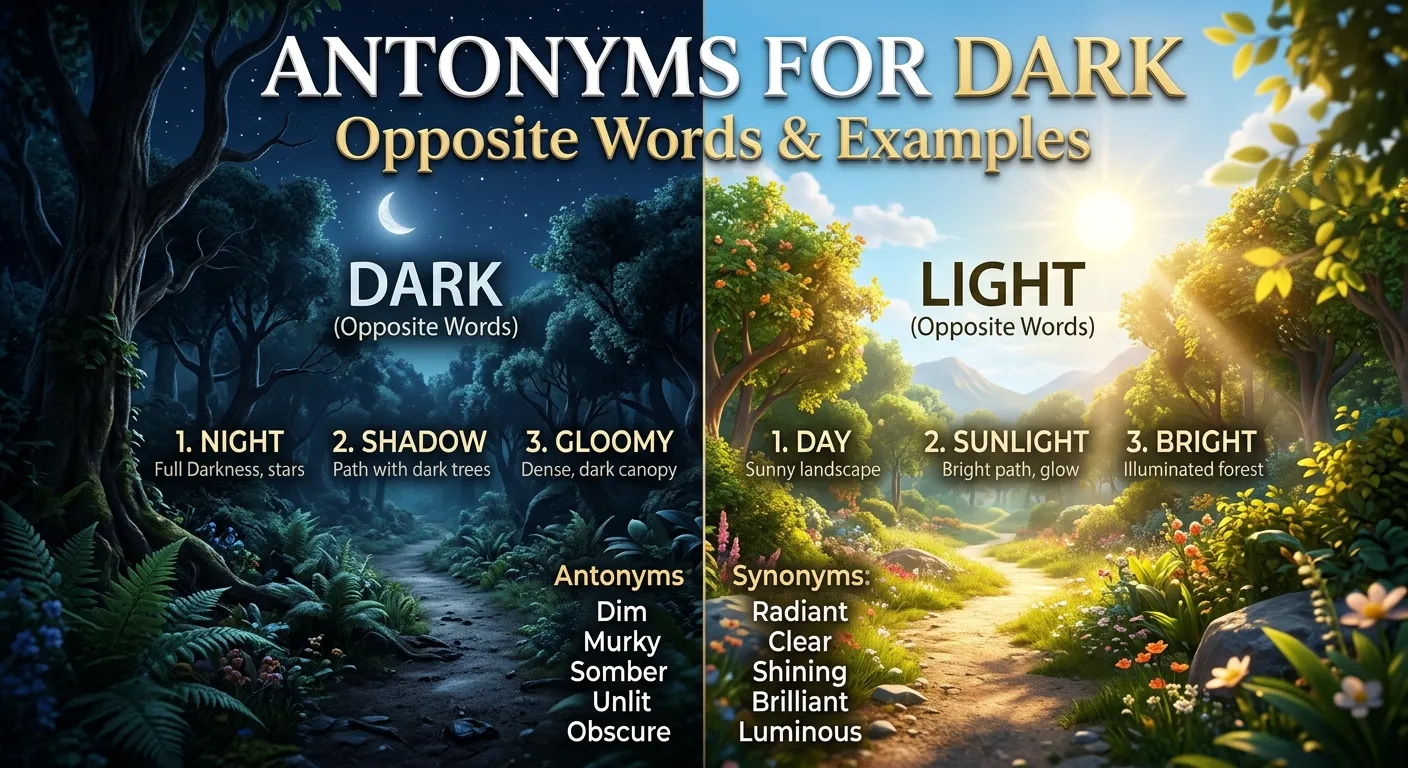
The most common antonym for dark is light. Dark can mean having little or no light, a deep color, something gloomy, or something mysterious or evil. Depending on the context, other opposites include bright, pale, cheerful, clear, innocent, and known.
Quick Answer
Light is the strongest and most common antonym of dark when dark refers to a lack of illumination.
However, dark has several meanings, so its opposite changes with context:
- Light / bright → opposite of darkness or low illumination
- Pale → opposite of a dark color or shade
- Cheerful / joyful → opposite of a dark or gloomy mood
- Clear / understandable → opposite of a dark or obscure idea
- Innocent / good → opposite of dark in a moral or sinister sense
- Known / revealed → opposite of something dark or mysterious
Quick Comparison Table
| Dark means… | Best antonym | Example |
| Little or no light | Light | The room was dark, but the hallway was light. |
| Low brightness | Bright | The dark screen became bright. |
| Deep color | Pale / light | She chose a pale blue instead of dark blue. |
| Gloomy mood | Cheerful | His dark mood became cheerful after the good news. |
| Difficult to understand | Clear | The explanation was dark and confusing rather than clear. |
| Evil or sinister | Good / innocent | The story contrasts dark forces with good characters. |
| Mysterious or unknown | Known / revealed | The truth was no longer dark or hidden. |
Definition
Dark: Having little or no light; also describing a deep color, gloomy mood, difficult idea, or sinister quality.
Main antonym: Light having or producing a substantial amount of illumination.
Learning Outcomes
After reading this guide, you will know:
- The main antonym of dark
- Context-specific opposites such as bright, pale, cheerful, and clear
- Why light is not always the best opposite
- How to use different antonyms naturally
Core Antonyms for Dark
1. Light
Light is the direct and most common antonym of dark when discussing illumination.
The room was dark at night but light during the day.
It can also describe a color that is not deep or intense.
She wore a light blue dress rather than a dark blue one.
Best for: rooms, places, nighttime, shadows, and colors.
2. Bright
Bright means giving off or reflecting a lot of light. It can also describe a vivid color.
The kitchen was dark before we switched on the lights.
Afterward, it was bright.
Bright is often a stronger and more specific contrast than light when you are emphasizing high illumination.
3. Pale
Pale is a useful antonym when dark describes the intensity of a color.
She painted the walls a pale green instead of dark green.
However, pale does not mean the opposite of darkness in general. It is primarily useful for color intensity or appearance.
4. Cheerful
Cheerful can contrast with dark when dark describes a gloomy, depressing, or emotionally heavy mood.
The novel has a dark tone, while the children’s story is more cheerful.
Other useful emotional contrasts include happy, joyful, positive, and upbeat, depending on the sentence.
5. Clear
Clear can contrast with dark when dark means difficult to understand, obscure, or confusing.
The instructions were clear, not dark or obscure.
In this context, clear is much more natural than light.
6. Good
When dark describes something evil, sinister, or morally troubling, good can provide the conceptual opposite.
The story explores the struggle between dark and good forces.
Depending on the sentence, evil and good are often better treated as moral opposites rather than direct dictionary antonyms of every sense of dark.
7. Innocent
Innocent can contrast with dark when the word suggests sinister intentions, disturbing themes, or moral corruption.
The character initially appeared innocent, but the story revealed his darker side.
This is a contextual antonym, not an opposite for physical darkness.
8. Revealed
When dark is used figuratively to suggest something hidden or unknown, revealed can provide a useful contrast.
The investigation brought the truth into the open and revealed what had previously remained hidden.
In this sense, hidden is actually closer to dark than dark itself is to revealed, so this is best understood as a contextual contrast rather than a strict antonym.
Contextual Antonyms of Dark
Because dark is highly polysemous, context matters.
When dark means “without light”
Use:
- light
- bright
- illuminated
The basement was dark, but the upstairs room was bright.
Here, light is the clearest opposite.
When dark describes a color
Use:
- light
- pale
- bright
He chose light gray instead of dark gray.
Pale works particularly well when the color is muted or lacking intensity.
When dark means “gloomy or depressing”
Use:
- cheerful
- happy
- joyful
- upbeat
The movie has a dark tone, while the sequel is more upbeat.
When dark means “evil or sinister”
Use:
- good
- kind
- innocent
- benevolent
The novel contrasts dark forces with benevolent characters.
The most appropriate word depends on whether you are discussing morality, personality, intentions, or atmosphere.
When dark means “obscure or difficult to understand”
Use:
- clear
- obvious
- understandable
- transparent
The author’s explanation was clear, not obscure.
Here, clear is generally the most natural choice.
When dark means “unknown or hidden”
Use:
- known
- revealed
- exposed
- disclosed
The investigation revealed information that had previously remained unknown.
These are contextual opposites rather than direct antonyms in the physical-light sense.
Antonym Meaning & Usage
Dark vs. Light
This is the fundamental contrast.
a dark room → a light room
dark blue → light blue
Light is the safest answer when someone asks simply, “What is the opposite of dark?”
Dark vs. Bright
These overlap but are not identical.
- Light can simply mean the presence of illumination.
- Bright emphasizes a high level of illumination or vividness.
The room is light.
The room is extremely bright.
Dark vs. Pale
Use pale mainly for colors and complexion.
dark pink → pale pink
dark skin → pale skin
But pale is not the opposite of dark in every context.
Dark vs. Cheerful
This contrast applies to mood, tone, atmosphere, or subject matter.
a dark story → a cheerful story
You would not normally use cheerful as the opposite of a physically dark room.
Dark vs. Clear
This works when dark has a figurative sense related to obscurity or difficulty of understanding.
a dark explanation → a clear explanation
For a physical room, however, clear does not mean the opposite of dark.
Example Sentences
- The room was dark, so I switched on the lamp.
- The hallway became bright after the lights were repaired.
- She replaced the dark curtains with light ones.
- He prefers pale colors to dark shades.
- The film has a dark and serious tone.
- The children’s program is much more cheerful.
- The instructions were clear and easy to follow.
- The novel contrasts good characters with sinister forces.
- Her explanation made the previously obscure issue clear.
- The investigation revealed information that had remained hidden.
Grammar & Word Class
Dark is most commonly an adjective.
a dark room
a dark color
a dark story
It can also function as a noun:
The cat disappeared into the dark.
And it appears in common expressions such as:
- in the dark: unaware or uninformed
- darken: become or make dark
- darkness: the state or condition of being dark
- darkly: in a dark or gloomy manner
Its most common adjective antonyms, such as light, bright, pale, cheerful, and clear, are also adjectives, although their meanings differ by context.
Common Mistakes
Mistake 1: Assuming “bright” is always the opposite
❌ The opposite of dark in every context is bright.
✅ Bright is an appropriate opposite when dark refers to low illumination or a lack of brightness.
For a gloomy mood, cheerful is more appropriate.
Mistake 2: Using “pale” for physical darkness
❌ The room was pale because there was no light.
✅ The room was dark because there was no light.
Pale mainly describes weak or light coloration, not the absence of illumination.
Mistake 3: Treating “light” as a universal opposite
❌ Light is the opposite of dark in every sentence.
✅ Light is the direct opposite when dark refers to illumination or color; other senses require different contextual opposites.
Mistake 4: Confusing “dark” with “black”
Black is a color, while dark can describe low illumination, deep color, mood, subject matter, or moral qualities.
a dark room
a black shirt
A room can be dark even when nothing in it is black.
Expert Tip
When someone asks for the antonym of dark without giving a sentence, answer light first. If dark appears in a specific sentence, identify its meaning before choosing an opposite. This prevents you from using light where cheerful, clear, pale, or another contextual opposite would be more natural.
Mini Quiz
Choose the best antonym
The basement was dark, but the living room was ______.
A. pale
B. bright
C. cheerful
Answer: B. bright
The sentence is about illumination, so bright provides the natural contrast.
Choose the best contextual antonym
The novel has a dark and depressing tone, unlike the ______ children’s story.
A. cheerful
B. illuminated
C. pale
Answer: A. cheerful
Here, dark refers to mood and tone, not physical lighting.
Short Questions & Answers
Q: What is the main antonym of dark?
A: Light is the main antonym of dark when it refers to a lack of illumination. For other meanings, words such as bright, pale, cheerful, clear, or good may provide better contextual opposites.
Q: What is the opposite of dark in color?
A: The most common opposites are light and pale, depending on the color. For example, dark blue contrasts naturally with light blue or pale blue.
Q: What is the opposite of dark in mood?
A: Cheerful, happy, joyful, and upbeat can contrast with dark when it describes a gloomy or depressing mood, tone, or atmosphere.
Q: What is the opposite of dark in a moral sense?
A: Depending on the context, good, innocent, kind, or benevolent can contrast with dark when it describes something evil or sinister.
Q: Is bright the same as light?
A: Not exactly. Light generally indicates illumination or a lack of darkness, while bright emphasizes a high level of light or vividness. They overlap, but they are not interchangeable in every context.
Q: Is black the opposite of dark?
A: No. Black is a color, while dark has several meanings. Black can be a dark color, but something can be dark without being black, such as a dark room or a dark mood.
Coclusion
The best antonym for dark depends on its meaning:
- Light → lack of darkness or illumination
- Bright → strong illumination or vivid color
- Pale → weak or light color
- Cheerful / joyful → gloomy mood or tone
- Clear → obscure or difficult-to-understand ideas
- Good / innocent → sinister or morally dark meanings
- Known / revealed → hidden or unknown information
For a general vocabulary question, light is the safest and most direct answer.
Antonyms for Circumference: Opposite Concepts Explained

Hi, I’m Amna Akhtar. I write about word their meanings, opposites, and the small distinctions that make English tricky. I don’t come at language purely from instinct, either. I have a peer-reviewed academic paper “Determinants of Jobs Satisfaction of Female Teachers: An Evidence from District Hafizabad, Pakistan,” published in education economics, and that research background shapes how I think about language content, I want it to actually help people learn, not just look correct on a page. Whether you’re a student, a writer, or just someone who wants to use the right word at the right moment, my goal is to make that easier for you.