Quick Answer
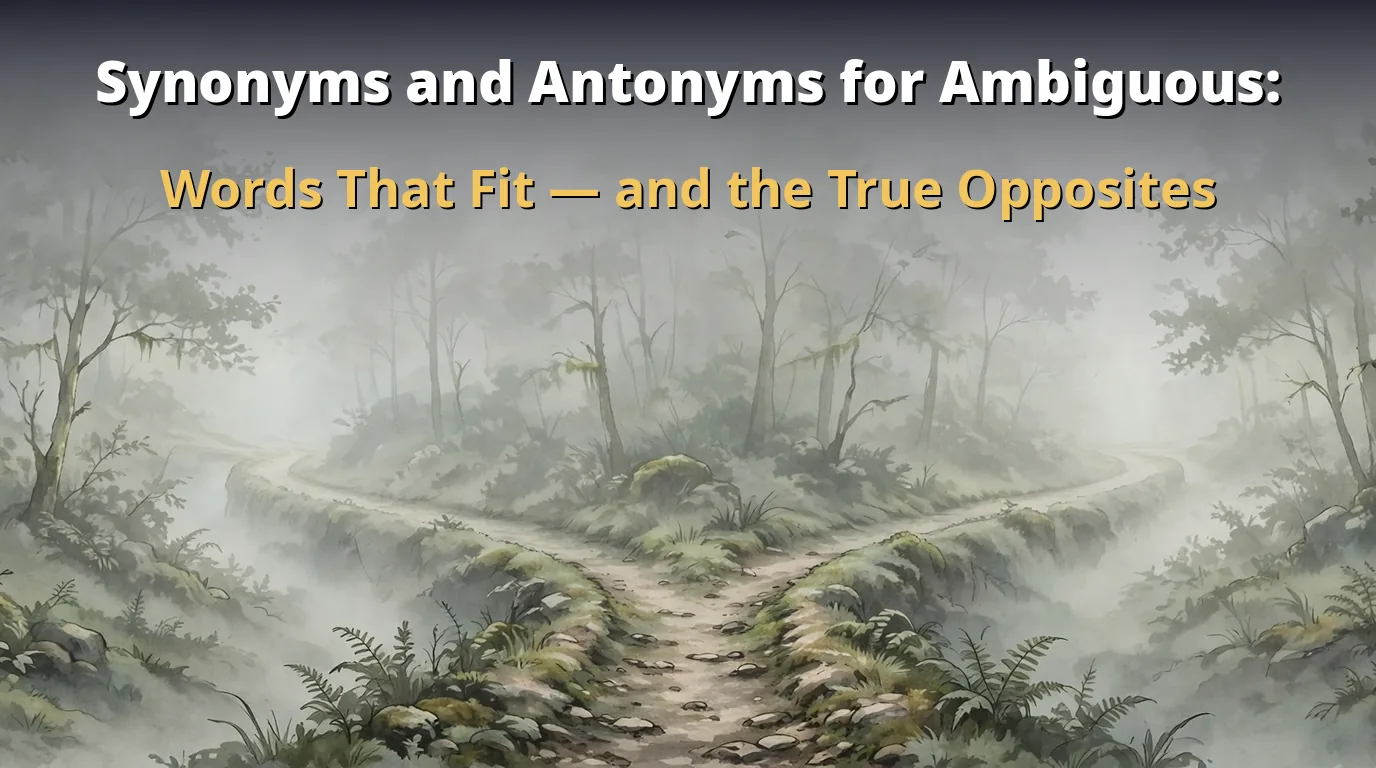
Ambiguous means open to more than one interpretation: wording reasonably understood in two or more ways. Its closest synonyms are unclear, vague, equivocal and indefinite: each with its own shade below.
The opposite side splits by which kind of doubleness you are removing:
- Unambiguous: exactly one possible meaning; the direct opposite.
- Clear: easy to understand; the everyday opposite.
- Explicit: stated directly, with nothing left to infer.
- Unequivocal: leaving no doubt about meaning or position.
- Definite: fixed, decided and known.
- Precise: exact in detail.
Four more words on most synonym lists are relatives, not matches: uncertain (what is known, not what is meant), obscure (meaning hidden), cryptic (deliberately puzzling): and “open to interpretation” is a phrase, not a word. Specific, certain and settled are genuine but belong inside the shades above.
Quick Comparison
| Word | Which side of “ambiguous” it reverses | Example |
|---|---|---|
| Unambiguous | Multiplicity itself: one interpretation only | The clause is unambiguous: payment is due in 30 days. |
| Clear | Understandability: the reading is obvious at once | Her clear instructions left the class in no doubt. |
| Explicit | Directness: stated outright, nothing to infer | The contract is explicit that deposits are not refundable. |
| Unequivocal | Doubt about a position: none remains | He gave an unequivocal answer: no. |
| Definite | Settledness: decided, fixed and known | We finally have a definite date for the hearing. |
| Precise | Exactness: detail pinned down | Give a precise figure, not “several thousand”. |
What Ambiguous Means
Ambiguous comes from the Latin ambiguus, “having a double meaning”, from ambigere, “to go both ways”: ambi- (both) plus agere (to drive): language pulled two ways.
Strictly, something is ambiguous when it supports two or more reasonable readings: “I saw her duck” is ambiguous because duck can be a bird or a movement, and nothing settles which. Looser use covers statements simply hard to pin down: hence the split opposites: unambiguous removes doubleness, precise removes fuzziness.
Two things ambiguous does not mean. It does not mean unknown: tomorrow’s match result is uncertain, but its meaning is not double. Nor is it always a fault: diplomats use deliberate ambiguity on purpose: that is where equivocal comes in.
Synonyms for Ambiguous
Four close synonyms, organised by shade.
1. Unclear
Meaning: Difficult to understand or interpret.
Example: The instructions were unclear, so half the class assembled the shelf backwards.
Shade: The broadest everyday match: anything hard to grasp, from poor handwriting to a confusing explanation. Ambiguous is narrower: the wording itself allows two readings.
2. Vague
Meaning: Not clearly expressed or defined; lacking detail or precision.
Example: He gave a vague account of his whereabouts: “around town, doing stuff”.
Shade: The classic near-synonym: vague means not enough detail, ambiguous means more than one meaning. “I’ll pay you sometime” is vague: no second meaning hides in it.
3. Equivocal
Meaning: Open to more than one interpretation, often deliberately, to avoid committing to a position.
Example: The minister’s equivocal answer let both sides claim she agreed with them.
Shade: The formal member, and the one that adds intention: an ambiguous sentence may be accidental; an equivocal answer is usually a choice. Its noun is equivocation.
4. Indefinite
Meaning: Not clearly fixed, limited or determined.
Example: The talks ended with an indefinite arrangement nobody could quite describe.
Shade: About determination, not meaning: nothing has been pinned down: no fixed time, limit or terms. Where vague lacks detail, indefinite lacks a decision.
Related Words: Uncertain, Obscure and Cryptic: and a Phrase
Four more items from the old page’s synonym list are honest relatives, not exact matches: each fails for a different reason.
Uncertain means not known or not settled: an uncertain outcome or future. It concerns our knowledge, not a statement’s meanings: the election result is uncertain, but the word result is not ambiguous.
Obscure means hard to understand because the meaning is hidden or little known: an obscure reference, an obscure dialect word. It usually has exactly one meaning: the problem is reaching it.
Cryptic means deliberately puzzling, with a hidden meaning to work out: a cryptic remark, a cryptic crossword clue: designed to have precisely one solution. Hard, not double.
Open to interpretation genuinely describes ambiguity: but it is a phrase, not a word, and neutral where ambiguous criticises: a poem “open to interpretation” may be working as intended.
Antonyms for Ambiguous
Ambiguous reverses on several scales: meanings, directness, settledness, exactness. Six core words, by the shade each reverses.
1. Unambiguous
Meaning: Having only one possible meaning or interpretation; not ambiguous.
Example: The judge’s ruling was unambiguous: the fence had to come down.
Best context: Anywhere the doubleness itself is the point: wording, evidence, signals, results.
Nuance: The one exact, built-in opposite: ambiguous with its prefix reversed. If one word must answer the question, this is it; the rest each fix a single shade.
2. Clear
Meaning: Easy to understand or interpret; leaving no confusion.
Example: She gave clear instructions, and nobody had to ask twice.
Best context: Everyday speech and writing: instructions, explanations, answers.
Nuance: The general-purpose opposite: unambiguous counts the meanings (one); clear reports the experience (no effort, no doubt). A statement can be clear in intent while one word stays technically ambiguous.
3. Explicit
Meaning: Stated clearly and directly, leaving nothing to be guessed or inferred.
Example: The policy is explicit: no refunds after thirty days, for any reason.
Best context: Rules, contracts and warnings: anywhere the reader must not read between the lines.
Nuance: Explicit reverses the “left unsaid” side of ambiguity; its partner is implicit (stated indirectly). An explicit statement can still contain an ambiguous word: why explicit and unambiguous are not interchangeable.
4. Unequivocal
Meaning: Leaving no doubt about meaning, intention or position.
Example: The committee gave the proposal its unequivocal support.
Best context: Formal statements and positions: the natural opposite of equivocal in particular.
Nuance: The strongest, most formal word in the set: not just a single meaning, but one no reasonable person could take any other way. Everyday sentences usually want clear.
5. Definite
Meaning: Clearly fixed, decided or known.
Example: After weeks of ambiguous signals, we got a definite answer.
Best context: Answers, dates, plans and arrangements: wherever ambiguous shaded towards “not settled”.
Nuance: Its family does the same job: certain (known for sure) and settled (decided and closed): listed separately on the old page, but the same shade, so they sit inside this entry.
6. Precise
Meaning: Exact and carefully defined; giving detail that cannot be mistaken.
Example: The report gives a precise figure: 4,312 units: instead of “several thousand”.
Best context: Measurements, definitions, figures: wherever ambiguous was really standing in for vague.
Nuance: Its partner specific: naming exactly which one (“a specific clause, not a general promise”): reverses the same shade from the identification side; the old page counted them separately, but they are one family.
Neighbours, Not Antonyms: Implicit
One word sometimes offered as an opposite does not belong here. Implicit means suggested without being stated directly: the opposite of explicit, not of ambiguous. An implicit instruction (“The bin is full”, to the person whose turn it is) can be unambiguous in context; an explicit one can contain a two-meaning word. Stated-versus-implied and single-versus-double are different scales.
Example Sentences
- The headline “Police help dog bite victim” is ambiguous: who did the biting?
- Her answer was deliberately equivocal, and both campaigns quoted it within the hour.
- The safety warning is explicit, precise and entirely unambiguous.
- An uncertain outcome is not an ambiguous one: the coin has not landed, but “heads” means one thing only.
Common Mistakes
Mistake 1: Using “ambiguous” and “vague” as the same word
They answer different failures. Ambiguous = two or more meanings (“I saw her duck”). Vague = not enough detail (“I’ll do it later”). The fix differs: ambiguity needs a meaning chosen; vagueness needs more information.
Mistake 2: Calling an unknown outcome “ambiguous”
“The result is ambiguous” usually means the result is uncertain: not yet known. Ambiguity lives in language, not events: the announcement can be ambiguous; the result cannot.
Mistake 3: Assuming “explicit” guarantees “unambiguous”
“The explicit order was to bank the plane” is stated outright, yet bank does two jobs. Explicit fixes the unsaid; unambiguous fixes the two-way reading.
Mistake 4: Treating “cryptic” as a straight synonym
A cryptic message is hard to decode but built to have one solution, like a cryptic crossword clue. Ambiguous wording has two or more live readings. Hard is not the same as double.
Mini Quiz
1. Which word is the exact opposite of ambiguous, meaning “only one possible interpretation”?
A. Unambiguous
B. Specific
C. Certain
Answer: A. Unambiguous removes the doubleness itself. Specific fixes identification and certain fixes knowledge: neighbouring shades.
2. “The reply was deliberately __: warm-sounding, but it committed the company to nothing.”
A. Explicit
B. Equivocal
C. Precise
Answer: B. Equivocal is the synonym that carries deliberate non-commitment. Explicit and precise point the opposite way.
3. Why is “vague” not an exact synonym of ambiguous?
A. Because vague is only used about the weather
B. Because vague means not enough detail, while ambiguous means more than one possible meaning
C. Because vague means deliberately deceptive
Answer: B. A vague statement starves you of information; an ambiguous one offers two readings at once.
Short Q&A
Q: What is the main antonym of ambiguous?
A: Unambiguous: one interpretation only. In everyday sentences, clear does most of the work.
Q: Is “vague” a synonym for ambiguous?
A: A close one, not exact. Vague = too little detail; ambiguous = too many meanings: and the fixes differ.
Q: Ambiguous or equivocal: which suggests the unclear wording was deliberate?
A: Equivocal. Ambiguous can be accidental; equivocal is a speaker choosing words that avoid a definite position.
Q: Is ambiguity always a mistake?
A: No: diplomacy and negotiation use it on purpose, when wording both sides can accept is the only wording that works. It is a fault in instructions and contracts.
Q: What are the other forms of the word?
A: The noun is ambiguity (“an ambiguity in the contract”), the adverb ambiguously. Unambiguous is ambiguous plus un-: hence the exact opposite.
Key Takeaways
- The synonyms split by shade: unclear for general difficulty, vague for missing detail, equivocal for deliberate non-commitment, indefinite for what is not yet fixed.
- Uncertain, obscure and cryptic are relatives, not synonyms: knowledge, hiddenness and puzzles: and “open to interpretation” is a phrase, not a word.
- Ambiguous has one exact opposite, unambiguous: one meaning where ambiguous allows two or more.
- The other opposites fix one shade each: clear (understandability), explicit (directness), unequivocal (no doubt), definite (settledness: certain and settled in its family), precise (exactness: specific beside it).
- The test is counting readings: if two reasonable interpretations survive, the wording is ambiguous.

Hi, I’m Amna Akhtar. I write about word meanings, opposites, and the small distinctions that make English tricky. I don’t come at language purely from instinct, either. I have a peer-reviewed academic paper “Determinants of Jobs Satisfaction of Female Teachers: An Evidence from District Hafizabad, Pakistan,” published in education economics, and that research background shapes how I think about language content, I want it to actually help people learn, not just look correct on a page. Whether you’re a student, a writer, or just someone who wants to use the right word at the right moment, my goal is to make that easier for you.