Quick Answer
Peninsula has no true dictionary antonym: a fact about how the word works, not a gap in English. Antonyms pair up qualities and states: coastal/inland, connected/disconnected. A peninsula is a thing, a piece of land almost surrounded by water, and things do not come in reverse.
What geography does offer is a set of genuine contrasts, each reversing a different feature of a peninsula:
- Connection: an island: water on all four sides, no land connection at all. The closest contrast there is: it differs from a peninsula in exactly one feature.
- Whole and part: the mainland: the large body of land a peninsula hangs from. A relation, not an opposite: a peninsula is part of its mainland.
- Direction: inland and the interior: away from the coast. Position and direction words, not a rival landform.
- The mirror image: a bay or gulf: water reaching into the land, where a peninsula is land reaching into the water.
So the honest one-line answer is: no antonym: but island is the contrast most people are looking for, labelled a contrast, not an opposite.
Quick Comparison
| Contrast | How it contrasts with “peninsula” | Example |
|---|---|---|
| Island | Connection reversed: water on every side, no link to a mainland | Cuba is an island just south of the Florida peninsula. |
| Mainland | Whole to part: the large landmass the peninsula hangs from | The Iberian Peninsula is part of the European mainland. |
| Inland | Direction reversed: away from the coast, not jutting into the sea | From the peninsula’s tip, the road runs inland to the capital. |
| Interior | Position: the middle of a landmass, far from any shore | The ports face the sea; the farming towns sit in the interior. |
| Bay / gulf | Mirror image: water reaching into the land, not land into water | Tampa Bay cuts into the western coast of the Florida peninsula. |
What a Peninsula Is
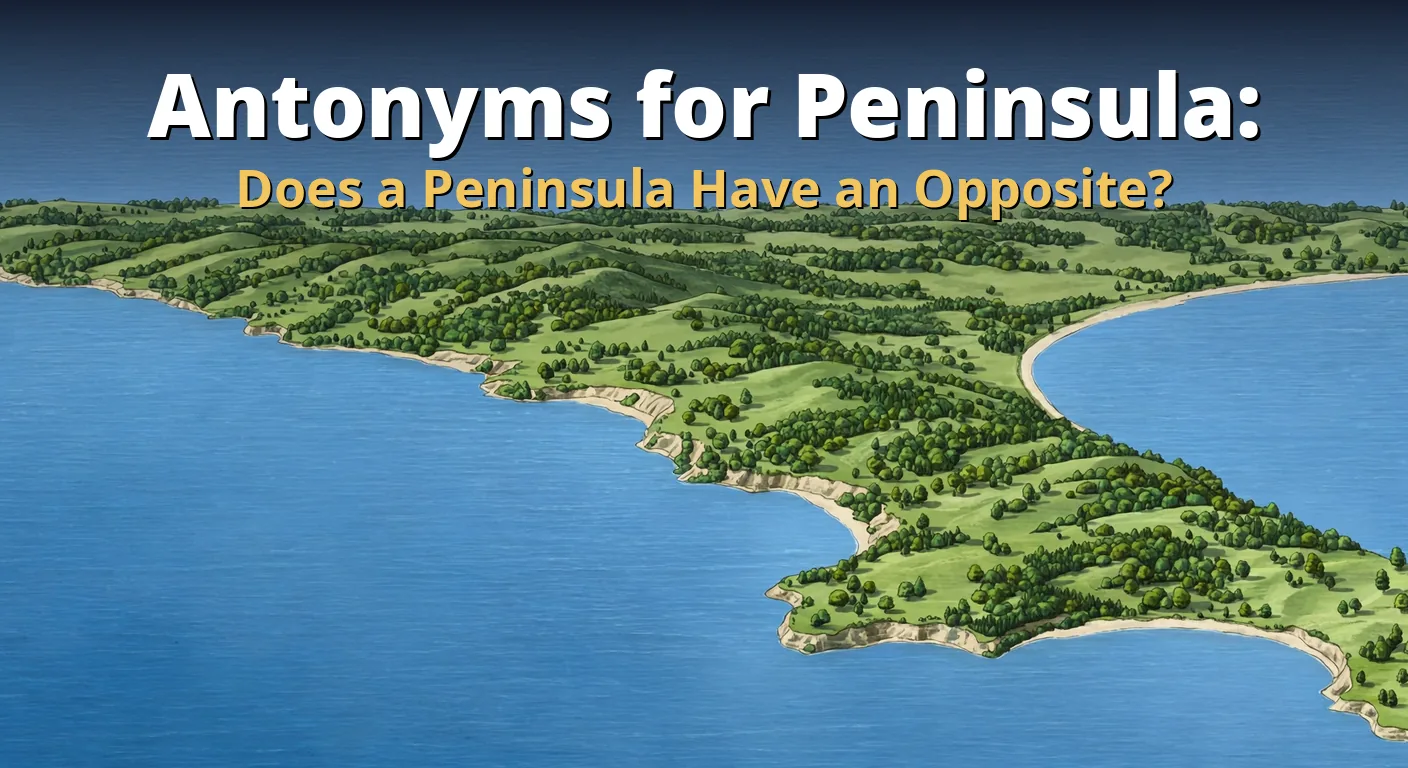
A peninsula is a piece of land almost surrounded by water but still joined to a larger landmass: water on three sides, a land connection on the fourth: land reaching into the sea without quite letting go of the shore behind it.
The word itself makes the point. It comes from the Latin paene, “almost,” and insula, “island”: a peninsula is literally an almost-island. Remove the land connection, and the almost-island becomes a real one.
Real peninsulas come at every scale. Florida sits between the Gulf of Mexico and the Atlantic Ocean. The Iberian Peninsula carries Spain and Portugal. Korea, Arabia and Baja California are all peninsulas: water on three sides, a broader landmass holding them at the fourth.
If You Mean the Connection: Island
An island is land completely surrounded by water, with no natural connection to any mainland. Set the definitions side by side and the contrast is exact:
- Peninsula: water on three sides + a land connection
- Island: water on all sides + no land connection
Only one feature changes: the fourth side: which is why island is the closest contrast peninsula has. Florida and Cuba show it on one map: Florida reaches down from the mainland and stays attached; Cuba is attached to nothing. But closest contrast is the right label, not antonym: the two words name different coastline shapes, not two ends of a scale.
If You Mean the Whole Landmass: Mainland
The mainland is the main continuous body of a country or region, as distinct from its islands and peninsulas. It enters this discussion because a peninsula is joined to it: the fourth-side connection runs into the mainland.
That makes the relationship whole to part, not opposite to opposite: the Iberian Peninsula is a projecting part of the European mainland, not its reverse. A part cannot be the antonym of its whole, any more than a sleeve is the antonym of a coat. Mainland does contrast in sentences: “ferries run between the mainland and the peninsula ports”: but as scale and attachment, and honest lists should say so.
If You Mean Away from the Coast: Inland and Interior
A peninsula is as coastal as land gets: sea on three sides. The words reversing that direction are inland (away from the coast: “twenty miles inland”) and interior (the middle region itself: “the country’s dry interior”).
Two cautions. First, these are words of position, not landforms: nothing about them is shaped like a reversed peninsula. Second, inland is an adjective or adverb and peninsula a noun, and different grammatical kinds cannot be dictionary antonyms. They answer only the question “coastal or not?”
If You Mean the Mirror Image: Bay and Gulf
One more genuine contrast, the most elegant of the four. A peninsula is land reaching into water. A bay: its larger form a gulf: is water reaching into land: a curve of sea cutting into the coastline.
The two are mirror images, and they appear together: every peninsula is partly defined by its flanking bays: Tampa Bay on Florida’s western shore, the Bay of Bengal beside India. If any word deserves to be called the geographic reverse of peninsula, it is bay: still a contrast of shape, not a lexical antonym, but the only one flipping the land and water arrangement itself.
Words That Are Not Antonyms of Peninsula
Isthmus
An isthmus is a narrow strip of land joining two larger landmasses, water on both sides: the neck a peninsula hangs from, as at Panama. Part of the same coastal picture, not a reversal.
Cape and headland
A cape or headland is a smaller point of land jutting into the sea: a peninsula’s smaller relative. Size, not kind.
Coast and shore
The coast is the boundary where land meets water. A peninsula has a coast; a boundary cannot oppose the landform it outlines.
Continent
Peninsulas belong to continents: Iberia to Europe, Arabia to Asia: the whole-and-part trap again, at a bigger size.
Example Sentences
- Florida is a peninsula, joined to the North American mainland; Cuba, just south, is an island.
- The road crosses the base of the peninsula, then runs inland for two hundred miles.
- Tampa Bay cuts into the peninsula’s western coast: water reaching into the land.
- The Iberian Peninsula forms the south-western corner of the European mainland, not its opposite.
Common Mistakes
Mistake 1: Calling “mainland” the opposite of peninsula
This is the whole and part trap. A peninsula is part of its mainland, attached on the fourth side: and a part cannot be the antonym of its whole. Mainland is a genuine contrast of scale and attachment; label it that way.
Mistake 2: Calling “island” an exact dictionary antonym
Island is the closest contrast, and in a geography lesson usually the answer wanted. But the two words name different coastal shapes, differing in one feature. “Closest contrasting landform” costs nothing and is accurate.
Mistake 3: Offering “inland” as a noun antonym
Inland is an adjective and adverb of direction; a direction word cannot be the antonym of a landform noun. If a noun is needed, interior at least names a place: though it, too, is positional, not an opposite landform.
Mistake 4: Inventing an “anti-peninsula”
There is no word like “antipeninsula” in standard English, and none is needed: the four honest contrasts above already cover the ground, each labelled by kind.
Mini Quiz
1. Which feature separates a peninsula from an island?
A. The size of the land
B. The land connection on the fourth side
C. The depth of the surrounding water
Answer: B. A peninsula keeps a land connection; an island has water on every side. Size and depth play no part in the definitions.
2. “The Iberian Peninsula is part of the European _.” Which word completes the sentence: and names a relation, not an opposite?
A. mainland
B. island
C. bay
Answer: A. The peninsula belongs to the mainland; island would detach it, a bay is water.
3. A peninsula is land reaching into water. Which feature is its mirror image?
A. An isthmus
B. A cape
C. A bay
Answer: C. A bay is water reaching into the land. An isthmus is the narrow neck of land, a cape a smaller point of land: both land features.
Short Q&A
Q: What is the antonym of peninsula?
A: Strictly, there isn’t one: landforms do not have dictionary opposites. The closest contrast is island, differing in exactly one feature: no land connection.
Q: Why isn’t “mainland” the antonym?
A: Because a peninsula is part of its mainland, joined to it: and a whole and its part are related, not opposed.
Q: Is a bay really connected to this question?
A: Yes: as the mirror image: land reaching into water, against water reaching into land. Peninsulas are usually flanked by bays, as Tampa Bay flanks Florida.
Q: What does “peninsula” literally mean?
A: “Almost an island,” from the Latin paene (almost) and insula (island): why island, the thing it almost is, makes the closest contrast.
Q: Is “inland” ever the right answer?
A: When the contrast wanted is direction: coastal versus away from the coast. “The village sits inland from the peninsula” is good English; it makes inland a contrast of position, not an antonym.
Key Takeaways
- Peninsula has no true dictionary antonym: it names a landform: water on three sides, joined to a mainland on the fourth.
- The closest contrast is island: the same picture with the land connection removed: a contrast, not an antonym.
- Mainland is the whole the peninsula is part of; inland/interior reverse its coastal direction; bay/gulf mirror it: water reaching into land.
- Honest lists label each contrast by kind instead of dressing any of them up as a dictionary opposite.

I’m Leo Jackson, an English writer with a soft spot for the peculiarities of language and vocabulary. He specializes in exploring the nuances of English synonyms, antonyms, helping students, writers, and professionals choose the right word with confidence. My guides combine careful research with clear, practical explanations.