What Is the Opposite of Paraphernalia?
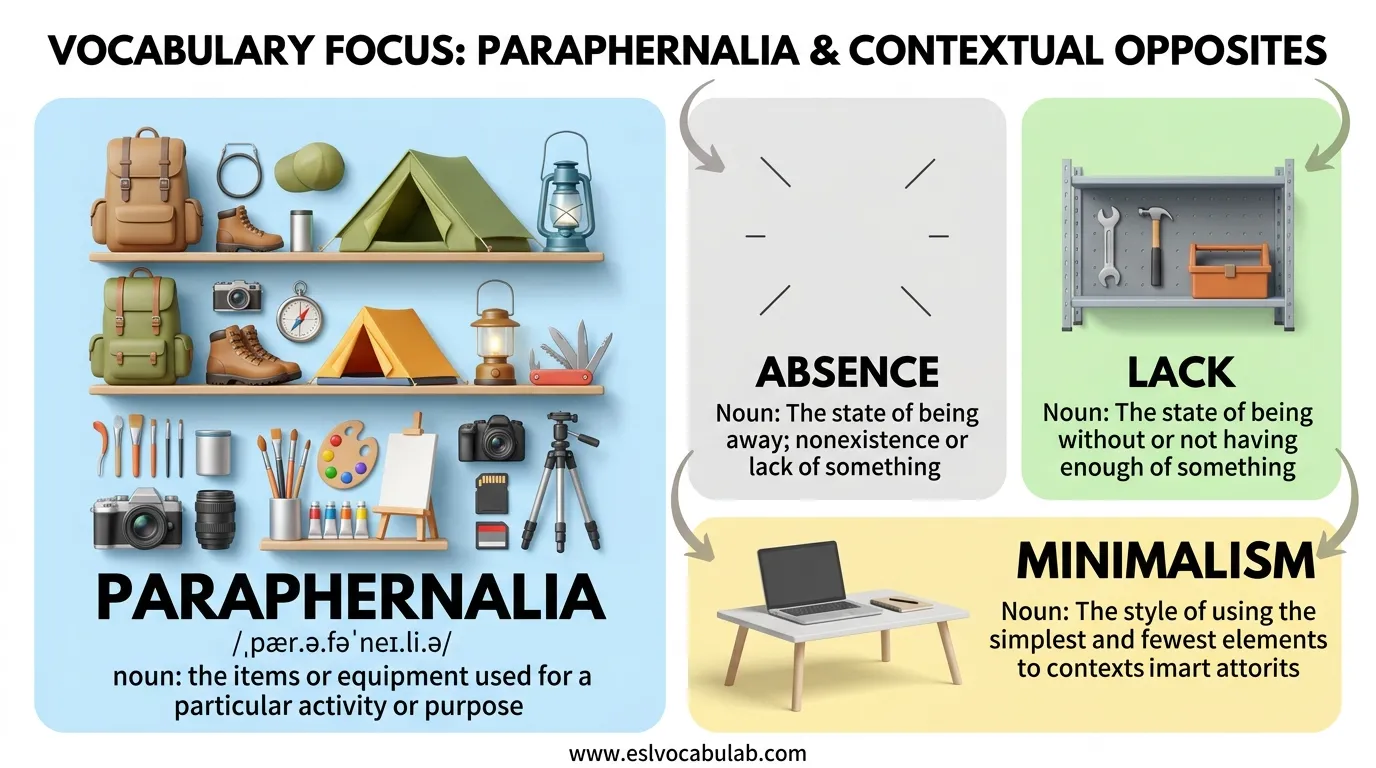
There is no single standard antonym for paraphernalia. The word refers to equipment, articles, or belongings associated with a particular activity. Depending on context, useful opposites include absence, lack, nothing, and minimalism when the contrast is with having many unnecessary items.
The Short Answer
Paraphernalia means a collection of equipment, items, or belongings used for a particular purpose. Because it describes a group of things rather than a single quality, it does not have one exact lexical opposite.
The most useful contextual opposites are:
- Absence: when the items are completely missing
- Lack: when there are not enough items or equipment
- Nothing: when there are no relevant items at all
- Minimalism: when the contrast is between many items and deliberately using very few
The right choice depends on what aspect of paraphernalia you want to contrast.
Paraphernalia and Its Opposites
| Word | Meaning | Example |
| Paraphernalia | A collection of equipment, articles, or belongings associated with something | The room was filled with camping paraphernalia. |
| Absence | The state of something not being present | The absence of equipment made the task difficult. |
| Lack | Not having enough of something needed | The lack of equipment delayed the work. |
| Nothing | No thing or no relevant items | He arrived with nothing for the activity. |
| Minimalism | A deliberate preference for using or owning very few things | Her minimalist approach meant carrying only the essentials. |
Meaning in Brief
Paraphernalia means a collection of equipment, articles, or personal belongings associated with a particular activity, purpose, or situation.
Contextual opposites: absence or lack depending on whether you mean that the items are completely missing or simply insufficient.
For example:
The photographer carried all her camera paraphernalia.
The opposite idea could be:
The absence of camera equipment made photography impossible.
What You’ll Learn
After reading this guide, you will know:
- Why paraphernalia has no single exact antonym
- Which contextual opposites are useful
- How absence differs from lack
- Why nothing and minimalism work only in certain contexts
- How to use these words naturally in sentences
Common Opposites of Paraphernalia
1. Absence
Absence means the state of something not being present.
It can contrast with paraphernalia when the focus is on having none of the expected equipment or items.
Example:
The absence of medical paraphernalia made the treatment difficult.
A clearer contrast can also be:
The room contained medical paraphernalia.
The absence of medical equipment left the room unprepared.
Best context: when the relevant items are completely missing.
2. Lack
Lack means the absence or insufficiency of something.
It is particularly useful when some equipment or items may exist, but there is not enough of them.
Example:
A lack of proper camping equipment made the trip uncomfortable.
Compare:
- Absence = none is present
- Lack = not enough is present
This makes lack one of the most useful contextual opposites of paraphernalia.
3. Nothing
Nothing means not anything.
It can contrast with paraphernalia in informal contexts when the intended meaning is that a person has no relevant items or equipment.
Example:
She brought a bag full of art paraphernalia, while I brought nothing.
However, nothing is not a lexical antonym of paraphernalia. It works because it expresses the absence of the things being discussed.
4. Minimalism
Minimalism can provide a conceptual contrast with paraphernalia when paraphernalia refers to a large collection of unnecessary or specialized items.
The term minimalism emphasizes using or owning very few things.
Example:
Instead of carrying a lot of travel paraphernalia, he prefers minimalism and takes only the essentials.
This is a conceptual opposite, not a direct dictionary antonym.
Choosing the Right Antonym
The best opposite depends on the intended contrast.
When you mean “the items are completely missing”
Use absence.
The absence of safety equipment was concerning.
When you mean “there is not enough equipment”
Use lack.
The lack of proper equipment slowed the project.
When you mean “there are no items”
Use nothing.
Everyone brought camping paraphernalia except Tom, who brought nothing.
When you mean “using very few possessions”
Use minimalism.
Her minimalist approach eliminated most of the unnecessary travel paraphernalia.
There is therefore no one-word replacement that works as the antonym of paraphernalia in every sentence.
Understanding Each Opposite
Absence vs. Lack
These two are the most useful choices when discussing missing equipment.
Absence generally emphasizes that something is not present.
The absence of emergency equipment was a serious problem.
Lack emphasizes that something is missing or insufficient.
The lack of emergency equipment affected the response.
The distinction is small in some contexts, but lack can suggest an insufficient quantity, whereas absence can suggest complete non-presence.
Lack vs. Nothing
Lack is a noun that normally identifies something missing:
a lack of equipment
Nothing means not anything:
They had nothing with them.
So they cannot always be substituted for each other.
Minimalism vs. Paraphernalia
These words contrast at the level of concept, not dictionary meaning.
Paraphernalia emphasizes a collection of associated things.
Minimalism emphasizes deliberately keeping things to a minimum.
The workshop was filled with artistic paraphernalia.
The artist’s minimalist setup contained only a few essential tools.
Paraphernalia and Its Opposites in Sentences
Paraphernalia:
The laboratory contained all the paraphernalia needed for the experiment.
Absence:
The absence of laboratory equipment prevented the experiment from starting.
Lack:
The lack of protective equipment created a safety problem.
Nothing:
He arrived at the campsite with nothing but a bottle of water.
Minimalism:
Her minimalist travel style means avoiding unnecessary paraphernalia.
What Part of Speech Is It?
Paraphernalia is a noun.
It usually refers to a collection or assortment of articles, equipment, or belongings associated with something.
Examples:
- sports paraphernalia
- camping paraphernalia
- office paraphernalia
- medical paraphernalia
- political campaign paraphernalia
- personal paraphernalia
Its contextual opposites are also mainly nouns:
- absence
- lack
- nothing
- minimalism
A Useful Grammar Point
Paraphernalia is generally treated as an uncountable noun in modern English.
We normally say:
The room was full of paraphernalia.
Not:
❌ The room was full of paraphernalias.
When you need to count the items, use expressions such as:
several pieces of paraphernalia
or
various items of paraphernalia
Commonly Confused Opposites
❌ “Essentials” is not a true antonym
Essentials means things that are necessary or most important.
It can contrast with unnecessary paraphernalia in some contexts, but it is not the opposite of paraphernalia itself.
She packed only the essentials instead of taking unnecessary camping paraphernalia.
Here, the contrast is between necessary items and extra equipment, not between essentials and paraphernalia in every possible sense.
❌ “Simplicity” is not always an antonym
Simplicity may contrast with a situation involving lots of equipment or possessions, but paraphernalia can also refer to a small collection of necessary items.
Therefore, calling simplicity a direct antonym would be too broad.
❌ “Equipment” is not an antonym
Equipment is actually one type of thing that paraphernalia can describe.
The laboratory paraphernalia included various pieces of equipment.
So equipment is related to paraphernalia, not its opposite.
A Useful Language Tip
When a noun describes a collection of things, it may not have a neat one-word antonym.
With paraphernalia, it is better to ask:
“What aspect am I trying to contrast?”
- Collection of items → absence/lack
- No items → nothing
- Many possessions vs. very few → minimalism
This approach produces a more accurate antonym than simply searching for a word that looks opposite.
Quick Antonym Quiz
Choose the best word
The expedition was delayed because of a ______ of essential equipment.
A. minimalism
B. lack
C. paraphernalia
Answer: B. lack
Lack means that something needed is missing or insufficient.
Fill in the blank
Unlike travelers who carry lots of travel paraphernalia, she prefers ______ and takes only what she needs.
Answer: minimalism
Here, minimalism expresses the deliberate choice to use or carry very few things.
Frequently Asked Questions
What is the opposite of paraphernalia?
There is no single standard antonym of paraphernalia. Depending on context, absence, lack, nothing, or minimalism can express an opposing idea.
Is lack an antonym of paraphernalia?
Lack can be a contextual opposite when paraphernalia refers to equipment or items that are available. Lack means that the needed items are missing or insufficient, but it is not a direct lexical antonym.
Is absence an antonym of paraphernalia?
Absence can contrast with paraphernalia when the relevant equipment or articles are not present. It is a contextual opposite rather than a fixed dictionary antonym.
Is minimalism the opposite of paraphernalia?
Minimalism can be a conceptual opposite when paraphernalia refers to a large collection of possessions or unnecessary items. It is not a direct antonym in every context.
What to Remember
Paraphernalia is a noun for a collection of equipment, articles, or belongings associated with a particular activity or purpose. Unlike words such as initial and final, it does not have one simple, universal antonym.
Choose the contextual opposite carefully:
- Paraphernalia → absence when the items are not present
- Paraphernalia → lack when the items are missing or insufficient
- Paraphernalia → nothing when there are no relevant items
- Paraphernalia → minimalism when the contrast is with having or using very few things
The most accurate answer to “What is the antonym of paraphernalia?” is therefore: there is no single direct antonym; the appropriate opposite depends on the context.
Antonyms for Narrow: 10 Useful Opposites

I am Clara Stephen, passionate about making English simple and easy to understand through clear synonym, antonyms, word comparisons, vocabulary guides, and language tips. Through thoughtful, reliable content, I aim to be a trusted guide for anyone looking to expand their English vocabulary.