The Main Meaning of Chronic and Its Opposite
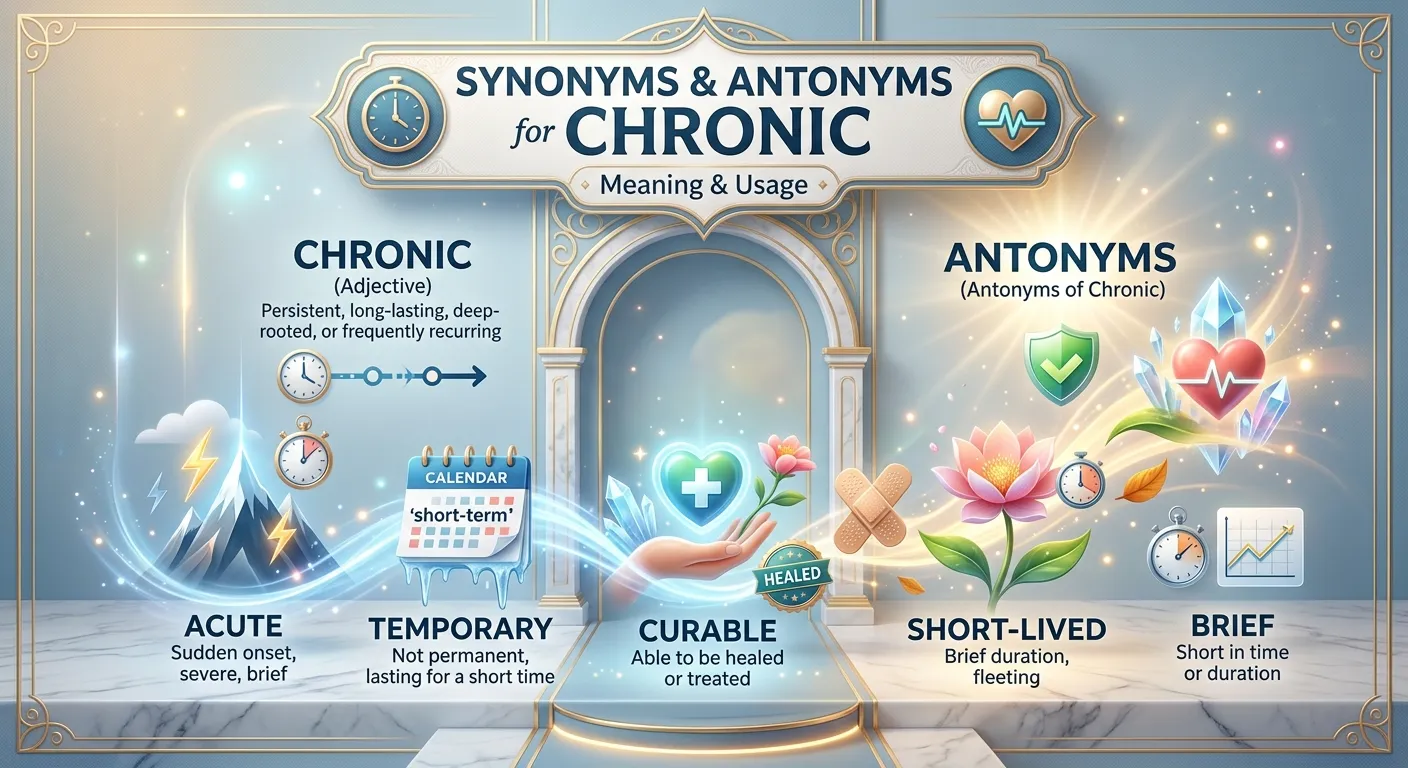
Chronic usually describes something that continues for a long time or keeps occurring repeatedly. Its most useful opposites are acute, temporary, short-term, and occasional, depending on the context. For non-medical uses, acute is especially useful when contrasting a long-lasting condition with a sudden, short-lived one.
At a Glance
The best synonym for chronic depends on the sentence.
Common synonyms: long-lasting, persistent, prolonged, enduring, ongoing, continual, recurrent, longstanding.
Common contextual antonyms: acute, temporary, short-term, brief, occasional, sudden.
The important distinction is that chronic often emphasizes duration or persistence, while its opposite may emphasize short duration, sudden onset, or infrequent occurrence.
Chronic and Its Opposites
| Word | Meaning | Example |
| Chronic | Continuing for a long time or repeatedly occurring | She has chronic back pain. |
| Acute | Sudden, severe, or short in duration, especially medically | He developed acute pain after the injury. |
| Temporary | Lasting for only a limited time | The problem was temporary. |
| Short-term | Continuing for a relatively short period | The company faced a short-term shortage. |
| Occasional | Happening sometimes rather than continuously | He experiences occasional headaches. |
Meaning in Brief
Chronic: Continuing for a long time or repeatedly occurring over an extended period.
Main contextual antonym: acute especially in medical contexts, where it commonly describes a condition that develops suddenly or lasts for a relatively short period.
What You’ll Learn
After reading this guide, you will know:
- What chronic means
- Useful synonyms for chronic
- Which words can serve as its antonyms
- Why acute is not interchangeable with every opposite of chronic
- How to choose the right synonym or antonym from context
Common Synonyms for Chronic
1. Long-lasting
Long-lasting means continuing for a long period.
The treatment provided relief from her long-lasting symptoms.
It is a straightforward alternative when duration is the main idea.
2. Persistent
Persistent describes something that continues despite attempts to stop, remove, or change it.
The patient reported persistent pain.
Persistent can be stronger than simply saying something has lasted a long time because it often suggests that the problem continues despite efforts to resolve it.
3. Prolonged
Prolonged means continuing for longer than usual or expected.
The patient experienced prolonged discomfort after the procedure.
It is common in formal and medical writing.
4. Ongoing
Ongoing means continuing at the present time.
The company is investigating the ongoing problem.
Unlike chronic, ongoing does not necessarily imply that something has existed for a very long time.
5. Longstanding
Longstanding describes something that has existed or continued for a long period.
The two organizations have a longstanding partnership.
It is useful for both problems and positive situations.
6. Recurrent
Recurrent means happening again, especially after disappearing or improving.
She has recurrent migraines.
This is related to chronic but is not an exact synonym. A recurrent problem repeatedly returns, whereas a chronic problem may remain continuously present.
7. Continual
Continual generally means happening repeatedly, often with short interruptions.
The machine required continual maintenance.
It can overlap with chronic in some contexts but focuses more on repeated occurrence than long duration.
8. Enduring
Enduring means lasting for a long time.
The writer’s work has had an enduring influence on literature.
It is often more positive or neutral than chronic, which frequently describes persistent problems or illnesses.
Choosing the Right Antonym
The opposite of chronic changes slightly depending on what the word is describing.
In medical contexts: Acute
Acute is the most important contextual antonym of chronic in medicine.
- Chronic condition: develops or continues over a long period.
- Acute condition: generally begins suddenly and is often short-term, although acute primarily describes suddenness/severity and does not simply mean “brief.”
She has chronic asthma.
He suffered an acute asthma attack.
This distinction is important: acute does not always mean mild, temporary, or completely resolved. It describes a different clinical pattern.
When duration is the focus: Temporary or short-term
If chronic means “lasting for a long time,” temporary and short-term can be clearer opposites.
The company has a chronic staffing problem.
The company has a temporary staffing problem.
Here, temporary directly contrasts with the long-lasting nature of chronic.
When frequency is the focus: Occasional
When chronic refers to a problem that happens repeatedly or regularly, occasional may provide the appropriate contrast.
He suffers from chronic headaches.
He experiences occasional headaches.
The second sentence means the headaches happen sometimes rather than being a persistent or frequent problem.
Understanding Each Antonym
Acute vs. chronic
This is the classic medical contrast.
Chronic emphasizes long duration or persistence.
Acute commonly describes something that develops suddenly and may be severe or relatively short-lived.
Chronic pain may persist for months or years.
Acute pain may begin suddenly after an injury.
However, these terms are not perfect opposites in every sentence. A condition can have an acute episode within a chronic disease.
Temporary vs. chronic
This is a direct duration-based contrast.
Temporary means lasting for a limited time.
Chronic suggests persistence over an extended period.
The power outage was temporary.
The neighborhood has a chronic shortage of electricity.
Short-term vs. chronic
Short-term is useful in business, economics, planning, education, and general writing.
The company needs a short-term solution.
The company faces a chronic supply problem.
The contrast is mainly about duration.
Occasional vs. chronic
Occasional focuses on frequency rather than duration.
She has occasional headaches.
She has chronic headaches.
This distinction makes occasional useful in health-related contexts, although it is not a strict antonym in every situation.
Examples in Context
Here are natural examples showing both synonyms and contextual opposites.
Chronic
The organization has struggled with chronic funding problems.
Persistent
Persistent delays have affected the construction project.
Longstanding
The university has a longstanding relationship with local schools.
Recurrent
The child experienced recurrent infections during the winter.
Acute
The patient was admitted with acute abdominal pain.
Temporary
The website outage was temporary.
Short-term
The company introduced a short-term solution while it searched for a permanent one.
Occasional
I only experience occasional headaches after long working days.
What Part of Speech Is It?
Chronic is an adjective.
It commonly appears before a noun:
- chronic illness
- chronic pain
- chronic problem
- chronic shortage
- chronic stress
- chronic condition
Its main synonyms are also adjectives:
- persistent
- prolonged
- ongoing
- longstanding
- recurrent
- enduring
Its contextual antonyms are likewise commonly adjectives:
- acute
- temporary
- short-term
- occasional
- brief
A Closer Look at Usage
Chronic often modifies nouns describing conditions, problems, shortages, or situations that persist.
chronic disease
chronic unemployment
chronic shortage
chronic problem
It is generally not the natural word for something that happened only once and ended quickly.
For example, a brief delay is natural, while a chronic delay suggests a recurring or persistent problem.
Common Errors to Avoid
Do not treat “acute” as a universal synonym for “short”
Although acute can describe a short-term or sudden condition, its meaning also includes suddenness or severity, especially in medical contexts.
❌ Acute always means something that lasts only a few minutes.
✅ Acute often describes a condition that develops suddenly and may be short-lived or severe.
Do not use “recurrent” as an exact replacement for “chronic”
Recurrent means something repeatedly returns.
Chronic generally emphasizes persistence or long duration.
Compare:
She has chronic pain.
The pain may be continuous.
She has recurrent pain.
The pain may disappear and return repeatedly.
Do not assume “temporary” is always the opposite
Temporary focuses specifically on limited duration. It works well when duration is what chronic means in the sentence, but it does not cover every sense of the word.
Teacher’s Tip
When choosing a synonym or antonym for chronic, identify the feature you want to emphasize:
- Long duration → long-lasting, prolonged, longstanding
- Continued presence → persistent, ongoing
- Repeated return → recurrent
- Sudden medical condition → acute
- Limited duration → temporary, short-term
- Infrequent occurrence → occasional
This prevents you from treating related words as exact substitutes when their meanings differ.
Quick Antonym Quiz
1. Which word is the most appropriate medical contrast to “chronic”?
A. Acute
B. Identical
C. Ordinary
Answer: A. Acute
2. Which word best contrasts with “chronic” when the focus is limited duration?
A. Persistent
B. Temporary
C. Recurrent
Answer: B. Temporary
3. Which word describes a problem that returns repeatedly rather than remaining continuously present?
A. Recurrent
B. Uniform
C. Permanent
Answer: A. Recurrent
Frequently Asked Questions
What is the main antonym of chronic?
The main contextual antonym of chronic is acute, particularly in medical contexts. Chronic emphasizes a condition that persists over a long period, while acute commonly describes one that develops suddenly and may be short-lived or severe.
What are the best synonyms for chronic?
Useful synonyms include persistent, prolonged, long-lasting, longstanding, ongoing, recurrent, continual, and enduring. They are not always interchangeable because each emphasizes a slightly different aspect of duration, persistence, or repetition.
Is temporary the opposite of chronic?
Temporary can be an antonym of chronic when the contrast concerns duration. Temporary describes something that lasts for a limited time, while chronic describes something that persists over an extended period.
Are acute and chronic exact opposites?
They are an important contextual contrast, especially in medicine, but they are not exact opposites in every sense. Chronic primarily emphasizes long duration or persistence, while acute can emphasize sudden onset, severity, or a short-term condition.
What to Remember
Chronic mainly describes something that lasts for a long time or keeps occurring. Its synonyms include persistent, prolonged, long-lasting, longstanding, ongoing, and recurrent.
Its antonym depends on context:
- Acute → the key medical contrast
- Temporary → opposite in duration
- Short-term → opposite in duration or planning
- Occasional → opposite in frequency in some contexts
The most accurate choice is determined by what aspect of “chronic” the sentence is emphasizing.
Antonyms for Unusual: 10 Common Opposites

I’m Leo Jackson, an English writer with a soft spot for the peculiarities of language and vocabulary. Specializes in exploring the nuances of English synonyms, antonyms, helping students, writers, and professionals choose the right word with confidence. My guides combine careful research with clear, practical explanations.