What Is the Opposite of Unusual?
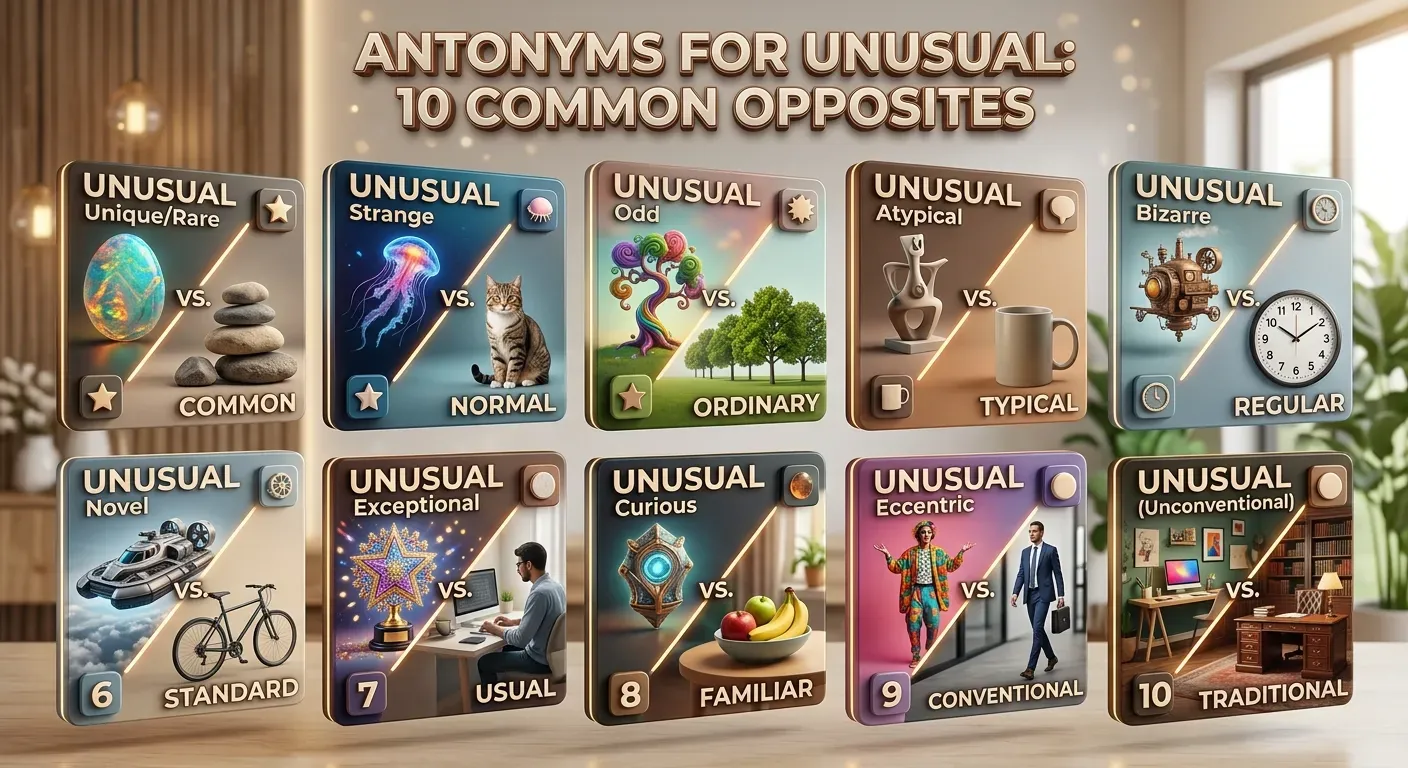
The most common antonym of unusual is usual, meaning normal, expected, or commonly experienced. Other useful opposites include ordinary, common, normal, typical, conventional, and familiar, depending on the context. The best choice depends on what makes something unusual.
The Short Answer
The main antonyms for unusual are:
- Usual :normal or expected
- Ordinary: not special or remarkable
- Common: occurring frequently or found often
- Normal: typical or within the expected range
- Typical: having the usual qualities of a particular group
- Conventional: following accepted customs or traditions
- Familiar: known or recognized from previous experience
- Routine: regularly repeated and predictable
- Standard: accepted as normal or typical
- Average: ordinary in comparison with others
The strongest general opposite is usual, but another word may fit better depending on the sentence.
Unusual and Its Antonym: Side-by-Side
| Word | Meaning | Example |
| Unusual | Different from what is normal or expected | It was unusual to see snow there in April. |
| Usual | Normal or expected | She arrived at her usual time. |
| Ordinary | Not special or remarkable | It looked like an ordinary house. |
| Common | Happening or found frequently | This is a common problem. |
| Typical | Normal for a person, group, or situation | That is typical behavior for him. |
| Conventional | Following accepted customs or practices | They chose a conventional design. |
Definition
Unusual: Different from what is normal, common, or expected.
Main antonym: usual Normal, expected, or regularly occurring.
What You’ll Learn
After reading this guide, you will know:
- The main antonym of unusual
- Other natural opposites and their meanings
- Why usual, ordinary, common, normal, and typical are not always interchangeable
- How to choose the right opposite in different contexts
Common Opposites of Unusual
1. Usual
Usual is the clearest and most direct antonym of unusual. It describes something that normally happens or is expected.
Example:
He took his usual route to work.
Unusual: He took an unusual route to work.
Usual: He took his usual route to work.
Use usual when the contrast is specifically between what normally happens and what does not.
2. Ordinary
Ordinary means normal and not especially interesting, remarkable, or different.
Example:
It seemed like an ordinary day at first.
Unusual: The day became unusual after the unexpected event.
Ordinary: At first, everything seemed ordinary.
Ordinary is especially useful when unusual means remarkable or special.
3. Common
Common means occurring frequently or being found in many places or among many people.
Example:
Headaches are a common complaint.
The opposite could be:
Severe allergic reactions to this ingredient are unusual.
Here, common contrasts with unusual because one happens frequently while the other happens rarely.
Important: Common does not always mean the exact opposite of unusual. Something can be common without being completely ordinary in every other sense.
4. Normal
Normal means conforming to what is expected, usual, or accepted as standard.
Example:
The doctor said the test results were normal.
Compare:
The test results were unusual.
In this context, normal is a natural opposite because the two words describe whether something falls within an expected range.
5. Typical
Typical means having the qualities or characteristics that are normally associated with a particular person, group, place, or situation.
Example:
Warm weather is typical in this region during summer.
Compare:
Heavy snowfall is unusual in this region during summer.
Typical is particularly useful when you are talking about what is characteristic of something rather than simply what happens frequently.
6. Conventional
Conventional means following traditional, accepted, or commonly used ways of doing something.
Example:
They chose a conventional approach to the problem.
If someone chooses a highly creative or unexpected approach, you could describe it as unusual.
Conventional is more specific than usual and often relates to customs, methods, beliefs, designs, or behavior.
7. Familiar
Familiar means well known or recognized because you have encountered it before.
Example:
The neighborhood looked familiar to me.
Something can be unusual because it is strange or unfamiliar, so familiar can work as a contextual opposite.
However, familiar is not a universal antonym of unusual. It works best when the contrast involves recognition or previous experience.
8. Routine
Routine describes something that happens regularly and follows a familiar pattern.
Example:
The meeting was a routine part of the weekly schedule.
A sudden change to the schedule would be unusual.
Routine is a useful contextual opposite when unusual describes something unexpected or outside the normal pattern.
9. Standard
Standard means accepted as normal, typical, or expected within a particular situation.
Example:
The company uses standard procedures for processing applications.
An unusual procedure would depart from those accepted practices.
Standard works especially well in technical, professional, academic, and organizational contexts.
10. Average
Average means ordinary or typical when compared with a larger group.
Example:
The student’s score was close to the class average.
An exceptionally high or low result may be considered unusual.
Average is therefore a contextual opposite, especially when unusual means exceptional or far from the norm.
Choosing the Right Antonym
Not every opposite of unusual works in every sentence.
When unusual means “not normal”
Use:
- usual
- normal
- ordinary
Example:
It was unusual for him to arrive late.
Natural opposite:
It was usual for him to arrive on time.
When unusual means “not common”
Use:
- common
- frequent
- widespread
Example:
This condition is unusual in young children.
Natural contrast:
This condition is common in older adults.
Here, common focuses on frequency rather than whether something is interesting or remarkable.
When unusual means “not typical”
Use:
- typical
- standard
- average
Example:
Her reaction was unusual for someone in that situation.
Natural contrast:
Her reaction was typical for someone in that situation.
When unusual means “not traditional”
Use:
- conventional
- traditional
- standard
Example:
They used an unusual teaching method.
A contrasting description could be:
They used a conventional teaching method.
Here, conventional is more precise than usual because the issue is the accepted method of teaching.
When unusual means “not familiar”
Use:
- familiar
- recognizable
- known
Example:
The voice sounded unusual to me.
If the contrast is based on recognition, familiar may be the most natural choice.
How These Antonyms Differ
The words above overlap, but they emphasize different ideas.
| Antonym | Main idea | Best used when… |
| Usual | Expected or normal | Something happens as it normally does |
| Ordinary | Not remarkable | Something is not special or exceptional |
| Common | Frequent | Something happens or appears often |
| Normal | Within the expected range | Something conforms to an accepted norm |
| Typical | Characteristic | Something represents what is normal for a group or situation |
| Conventional | Accepted or traditional | Something follows established practices |
| Familiar | Known | Something has been encountered before |
| Routine | Regular and predictable | Something follows a repeated pattern |
| Standard | Accepted level or method | Something follows an established standard |
| Average | Typical compared with others | Something is near the middle of a range |
Examples in Context
Here are some natural ways to use these opposites:
- Usual: She ordered her usual coffee.
- Ordinary: It started as an ordinary afternoon.
- Common: This is a common mistake among beginners.
- Normal: The temperature returned to normal.
- Typical: That response is typical of young children.
- Conventional: The building has a conventional design.
- Familiar: I heard a familiar voice behind me.
- Routine: The inspection was a routine procedure.
- Standard: All employees must follow the standard process.
- Average: His performance was close to average.
Grammar and Word Class
Unusual is an adjective.
It describes a person, thing, event, action, or situation that is different from what is normal or expected.
Examples:
- an unusual idea
- an unusual event
- an unusual sound
- an unusual response
Most of its useful antonyms are also adjectives:
- usual
- ordinary
- common
- normal
- typical
- conventional
- familiar
- standard
- average
Routine can function as an adjective as well as a noun, but its adjective use is the relevant form when directly contrasting it with unusual.
Commonly Confused Opposites
Unusual vs. Uncommon
Uncommon and unusual are closely related, but they are not always identical.
- Uncommon usually emphasizes rarity or low frequency.
- Unusual can mean rare, unexpected, strange, remarkable, or different from the norm.
For example:
Snow is uncommon in this area.
This focuses on how rarely snow occurs.
The snowstorm was unusual.
This focuses more broadly on how unexpected or atypical the event was.
Unusual vs. Ordinary
These can be opposites when unusual means remarkable or exceptional.
She wore an unusual dress.
She wore an ordinary dress.
But ordinary does not specifically mean frequent, so it is not always the best replacement for common.
A Useful Language Tip
Usual is the safest general antonym for unusual, but do not automatically replace unusual with usual.
Ask what kind of contrast you mean:
- usual → expected or normal
- common → frequent
- typical → characteristic
- ordinary → not remarkable
- conventional → traditional or accepted
- familiar → known from experience
Choosing the antonym based on meaning makes your writing more precise.
Quick Practice
Choose the best antonym for unusual in each sentence.
1. It is ______ for the shop to close this early.
A. usual
B. unusual
C. strange
Answer: A. usual
The sentence describes something that normally happens.
2. This type of mistake is very ______ among new learners.
A. common
B. unusual
C. unfamiliar
Answer: A. common
Here, the meaning is about something happening frequently.
3. The architect rejected the ______ design and chose a more creative one.
A. conventional
B. unusual
C. unfamiliar
Answer: A. conventional
The contrast concerns a traditional or accepted design.
Frequently Asked Questions
What is the main antonym of unusual?
The main antonym of unusual is usual. It means normal, expected, or regularly occurring. Depending on the context, ordinary, common, normal, or typical may be more precise.
Is common an antonym of unusual?
Yes, common can be a contextual antonym of unusual when the contrast concerns frequency. Common means occurring or appearing frequently, while unusual can mean rare or infrequent in that context.
What is a stronger opposite of unusual?
There is no single “strongest” antonym in every context. Ordinary, typical, common, and normal emphasize different aspects of the opposite meaning. The best choice depends on whether you mean frequency, expectation, typicality, or lack of distinctiveness.
Can usual and ordinary always replace unusual?
No. Usual means expected or normal, while ordinary often means not special or remarkable. They overlap, but they are not interchangeable in every sentence.
Is typical the opposite of unusual?
Yes, typical can be an antonym of unusual when the meaning is “representative of what normally happens or is expected.” For example, “a typical response” contrasts naturally with “an unusual response.”
What to Remember
Usual is the clearest general antonym of unusual, but the most precise opposite depends on the intended meaning.
- Usual → expected or normal
- Ordinary → not remarkable
- Common → frequent
- Normal → within the expected range
- Typical → characteristic of a group or situation
- Conventional → traditional or accepted
- Familiar → known from experience
When choosing an antonym, focus on why something is unusual. That small distinction can lead you to a much more accurate word.
Antonyms for Meticulous: 10 Precise Opposites

I’m Leo Jackson, an English writer with a soft spot for the peculiarities of language and vocabulary. Specializes in exploring the nuances of English synonyms, antonyms, helping students, writers, and professionals choose the right word with confidence. My guides combine careful research with clear, practical explanations.