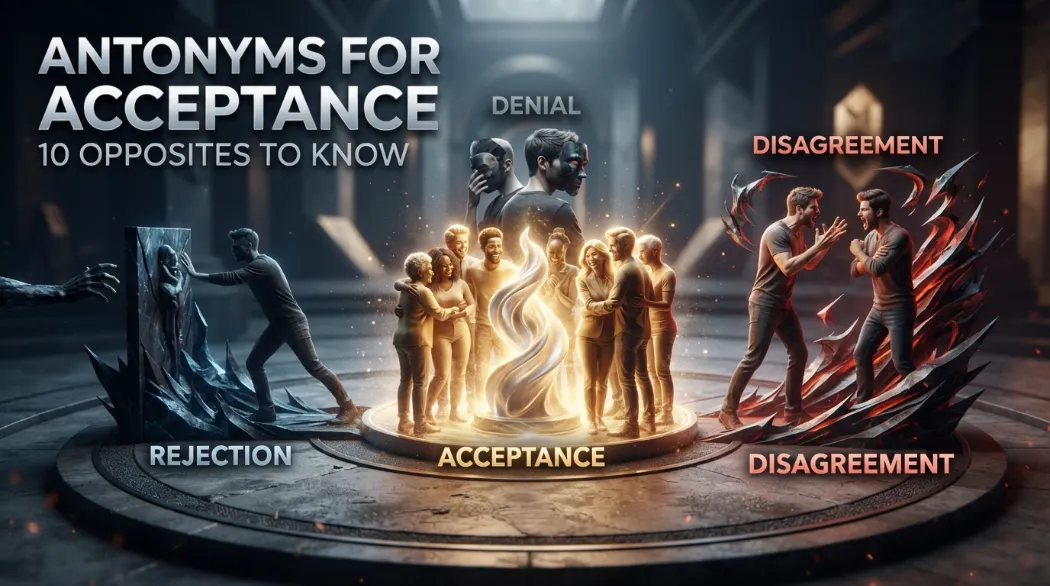
Featured Snippet
The main antonym of acceptance is rejection, meaning a refusal to approve, receive, agree to, or recognize something. Depending on context, other opposites include refusal, denial, disapproval, resistance, and nonacceptance. The best antonym depends on what “acceptance” means in the sentence.
Quick Answer
The strongest and most common antonym of acceptance is rejection.
- Acceptance = the act of agreeing to, approving, receiving, or recognizing something.
- Rejection = the act of refusing, declining, or not approving something.
Other useful opposites include refusal, denial, disapproval, resistance, nonacceptance, and exclusion. However, these are not interchangeable in every situation.
Quick Comparison Table
| Word | Meaning | Example |
| Acceptance | Agreement, approval, or willingness to receive something | Her acceptance of the offer surprised us. |
| Rejection | Refusal to accept, approve, or consider something | His rejection of the proposal was unexpected. |
| Refusal | The act of saying no or declining something | Her refusal to sign the document was clear. |
| Denial | Refusal to acknowledge, admit, or accept something as true | He issued a denial of the accusation. |
| Disapproval | A negative judgment or lack of approval | The plan received widespread disapproval. |
One-Line Definition
Acceptance: The act of agreeing to, approving, receiving, or recognizing something.
Main antonym: Rejection The act of refusing to accept, approve, or consider something.
Learning Outcomes
After reading this guide, you will know:
- The main antonym of acceptance
- Other useful opposites and their meanings
- How different antonyms work in different contexts
- How to choose the most precise opposite in a sentence
Core Antonyms of Acceptance
1. Rejection
Rejection is the clearest and most general opposite of acceptance. It means refusing to accept, approve, consider, or choose something.
Example:
The company sent him a letter of rejection after the interview.
Best for: Offers, applications, proposals, ideas, requests, invitations, and people or things that are not accepted.
2. Refusal
Refusal means deliberately saying no to something or declining to do or accept it.
Example:
Her refusal to accept the award surprised everyone.
Difference:
Rejection often focuses on something being turned down, while refusal emphasizes the act of saying no.
3. Denial
Denial can be an opposite of acceptance when acceptance means acknowledging or admitting something as true or real.
Example:
His denial of responsibility continued despite the evidence.
Best for: Facts, accusations, responsibility, requests, claims, or something being acknowledged.
Note: Denial is not a universal antonym of acceptance. It is especially appropriate when acceptance means acknowledgment or admission.
4. Disapproval
Disapproval means a negative opinion or lack of approval.
Example:
The proposal met with strong disapproval from the committee.
Best for: Decisions, behavior, plans, ideas, or actions that someone does not approve of.
5. Resistance
Resistance means opposition to something rather than willingness to accept or cooperate with it.
Example:
The new policy faced resistance from several employees.
Best for: Changes, policies, ideas, authority, or situations where people actively oppose something.
6. Nonacceptance
Nonacceptance literally means the state or act of not accepting something.
Example:
The organization notified applicants of the nonacceptance of their proposals.
Best for: Formal, administrative, or technical contexts.
Usage note: Although accurate, nonacceptance is less natural in everyday English than rejection or refusal.
7. Disagreement
Disagreement is an opposite of acceptance when acceptance means agreeing with an opinion, proposal, or statement.
Example:
There was considerable disagreement about the proposed changes.
Best for: Opinions, arguments, decisions, interpretations, and proposals.
Important: Disagreement is a contextual opposite, not a direct antonym of every meaning of acceptance.
8. Exclusion
Exclusion means deliberately leaving someone or something out rather than including or accepting them.
Example:
The policy resulted in the exclusion of several applicants.
Best for: Groups, memberships, participation, access, or social acceptance.
9. Opposition
Opposition means active resistance or disagreement with something.
Example:
The proposal faced strong opposition from local residents.
Best for: Policies, plans, political proposals, decisions, or ideas.
10. Intolerance
Intolerance can contrast with acceptance when acceptance refers to respecting or welcoming people, beliefs, lifestyles, or differences.
Example:
Education can help reduce intolerance toward people from different backgrounds.
Best for: Social, cultural, religious, or personal differences.
Important: This is a contextual antonym rather than a direct opposite in every use of acceptance.
Contextual Antonyms of Acceptance
The opposite changes slightly depending on what acceptance means.
When acceptance means “approval”
Use:
- Rejection
- Disapproval
- Refusal
- Opposition
Example:
Acceptance: The committee gave acceptance to the proposal.
Opposite: The committee gave rejection to the proposal.
More naturally:
The committee accepted the proposal.
The committee rejected the proposal.
When acceptance means “agreeing to receive something”
Use:
- Rejection
- Refusal
- Declining
Example:
She accepted the job offer.
She rejected the job offer.
When acceptance means “acknowledgment of something as true”
Use:
- Denial
- Disbelief
- Doubt
Example:
His acceptance of the facts helped resolve the dispute.
His denial of the facts prolonged the dispute.
Here, denial is usually more precise than rejection.
When acceptance means “welcoming or recognizing people”
Use:
- Exclusion
- Rejection
- Intolerance
Example:
The organization promotes acceptance of people from different backgrounds.
The opposite could be exclusion or intolerance, depending on whether the focus is on leaving people out or refusing to respect differences.
Antonym Meaning & Usage
Not all opposites of acceptance have the same strength or meaning.
| Antonym | Main idea | Strength/Use |
| Rejection | Refusing to accept or approve | Strong, general |
| Refusal | Saying no or declining | Direct, everyday |
| Denial | Refusing to acknowledge or admit | Specific context |
| Disapproval | Not approving of something | Milder than rejection |
| Resistance | Opposing or pushing back | Active opposition |
| Nonacceptance | Not accepting | Formal/technical |
| Disagreement | Not sharing the same view | Neutral |
| Exclusion | Leaving someone or something out | Social/access context |
| Opposition | Actively being against something | Strong opposition |
| Intolerance | Lack of acceptance of differences | Social/cultural context |
Rejection vs. Refusal
These words are closely related, but the focus differs.
- Rejection often means something has been turned down.
- Refusal often emphasizes someone’s decision to say no.
Example:
The university sent a rejection letter.
She gave a firm refusal to the request.
Rejection vs. Disapproval
Rejection usually means something is not accepted or is turned down. Disapproval means something is viewed negatively or is not approved.
Example:
The proposal received disapproval, but it was not formally rejected.
Acceptance vs. Denial
These are opposites only in certain contexts.
Acceptance: acknowledging something as true or real.
Denial: refusing to acknowledge or admit it.
Example:
Acceptance of the problem is the first step toward solving it.
Denial of the problem can make it harder to solve.
Example Sentences
Here are natural examples showing different antonyms of acceptance:
- The applicant received a rejection letter.
- His refusal to compromise created tension.
- She remained in denial about the seriousness of the situation.
- The decision was met with widespread disapproval.
- Employees showed resistance to the new system.
- There was considerable disagreement over the proposed changes.
- The rules led to the exclusion of several members.
- The new law faced strong opposition.
- The campaign aimed to challenge social intolerance.
Grammar & Word Class
Acceptance is a noun.
It commonly comes from the verb accept:
- Accept — verb
- Acceptance — noun
- Acceptable — adjective
- Accepted — adjective/past participle
Most of its direct and contextual opposites in this article are also nouns:
- acceptance → rejection
- acceptance → refusal
- acceptance → denial
- acceptance → disapproval
- acceptance → resistance
- acceptance → opposition
Their corresponding verbs are also useful:
- accept → reject
- accept → refuse
- accept → deny
- accept → oppose
A useful grammar pattern
The noun acceptance is often followed by of:
- acceptance of the offer
- acceptance of responsibility
- acceptance of differences
- acceptance of the decision
The same pattern frequently appears with its antonyms:
- rejection of the proposal
- refusal of the request
- denial of responsibility
- opposition to the proposal
Notice that opposition normally takes to, not of.
Common Mistakes
Mistake 1: Treating “denial” as the opposite in every situation
❌ The company sent a denial letter because it did not accept my job application.
✅ The company sent a rejection letter because it did not accept my job application.
Why? For applications, offers, and proposals, rejection is usually more natural. Denial is better when someone refuses to acknowledge or admit something.
Mistake 2: Using “disagreement” for every type of rejection
❌ The university gave me a disagreement.
✅ The university gave me a rejection.
Why? Disagreement concerns different opinions or views. It does not normally mean that an application or request was rejected.
Mistake 3: Assuming one antonym works in every context
Acceptance can mean approval, receiving something, acknowledging a fact, or welcoming differences. Therefore, its best opposite changes with the context.
Mini Quiz
Choose the best antonym:
The university sent the student a letter of ______ after reviewing her application.
A. denial
B. rejection
C. disagreement
Answer: B. rejection
Explanation: An unsuccessful application is normally described as a rejection, not a denial or disagreement.
Short Questions & Answers
Q: What is the main antonym of acceptance?
The main antonym of acceptance is rejection. Acceptance means agreeing to, approving, receiving, or recognizing something, while rejection means refusing or not accepting it.
Q: Is refusal an antonym of acceptance?
Yes. Refusal is an antonym of acceptance when acceptance means agreeing to receive or do something. Refusal emphasizes the act of saying no or declining.
Q: Is denial the opposite of acceptance?
Denial can be the opposite of acceptance when acceptance means acknowledging or admitting something as true. It is not the best antonym for every meaning of acceptance.
Q: What is the opposite of acceptance in social situations?
Depending on the context, rejection, exclusion, or intolerance can contrast with social acceptance. Rejection means not accepting someone, exclusion means leaving someone out, and intolerance means refusing to respect differences.
Q: What is the difference between acceptance and rejection?
Acceptance means agreeing to, approving, receiving, or recognizing something, while rejection means refusing, declining, or not approving it.
Key Takeaways
- Rejection is the strongest general antonym of acceptance.
- Refusal is useful when someone deliberately says no.
- Denial is appropriate when acceptance means acknowledging something as true.
- Disapproval contrasts with acceptance when the issue is approval.
- Exclusion and intolerance are useful in social contexts.
- The best antonym depends on the specific meaning of acceptance.
Antonyms for Praise: Opposite Words & Examples

Hi, I’m Amna Akhtar. I write about word their meanings, opposites, and the small distinctions that make English tricky. I don’t come at language purely from instinct, either. I have a peer-reviewed academic paper “Determinants of Jobs Satisfaction of Female Teachers: An Evidence from District Hafizabad, Pakistan,” published in education economics, and that research background shapes how I think about language content, I want it to actually help people learn, not just look correct on a page. Whether you’re a student, a writer, or just someone who wants to use the right word at the right moment, my goal is to make that easier for you.