The Main Antonym Explained
The clearest antonym of feminism is anti-feminism, which means opposition to feminism. Because feminism is a social and political movement or belief concerning women’s equal rights and opportunities, its opposite is best expressed by terms describing opposition to that movement rather than by a simple everyday opposite.
Answer in Brief
The most direct antonym of feminism is anti-feminism.
Other words can describe contrasting ideas in particular contexts, including patriarchy, traditional gender roles, gender inequality, male dominance, and sexism. However, these are not exact synonyms for anti-feminism. They describe different concepts and should not be treated as interchangeable.
Feminism and Its Antonym
| Word | Meaning | Example |
| Feminism | Belief or movement supporting equal rights and opportunities for women | She studies the history of feminism. |
| Anti-feminism | Opposition to feminism | The article examines anti-feminism. |
| Patriarchy | A social system in which men traditionally hold greater power or authority | The author discusses patriarchy in society. |
| Sexism | Unfair treatment or prejudice based on sex | The policy was criticized as sexism. |
| Traditional gender roles | Conventional expectations about men’s and women’s roles | The family followed traditional gender roles. |
Definition
Feminism: A belief and movement seeking equal rights, power, and opportunities for women.
Main antonym: anti-feminism Opposition to feminism.
What to Know About Feminism
After reading this guide, you will understand:
- The direct antonym of feminism
- Why anti-feminism is more precise than words such as patriarchy
- How related terms differ in meaning
- How to use these words accurately in sentences
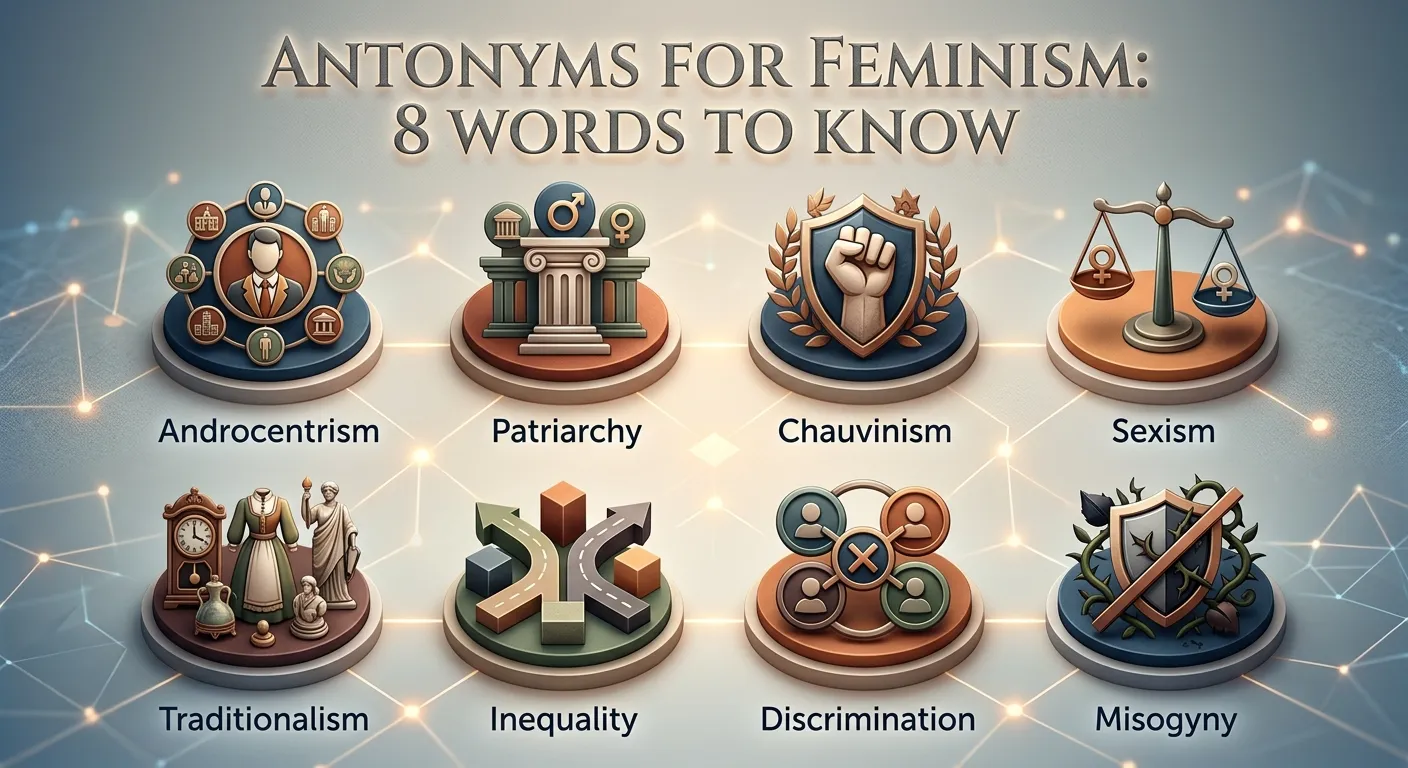
Main Antonyms for Feminism
Because feminism names an ideology or movement rather than a simple quality, it does not have a large set of exact dictionary antonyms. The following terms are best treated according to their relationship to the concept.
1. Anti-feminism
Anti-feminism is the most direct opposite of feminism. Cambridge Dictionary defines it as opposition to feminism.
Example:
The book examines the history of anti-feminism.
This is the best choice when you specifically mean opposition to feminism.
2. Patriarchy
Patriarchy refers to a social system or structure in which men traditionally hold greater power or authority.
Example:
The essay explores how patriarchy has shaped social institutions.
Important: Patriarchy is not a strict dictionary antonym of feminism. Feminism can discuss, criticize, or seek to change patriarchal structures, but the two words describe different types of concepts.
3. Traditional Gender Roles
Traditional gender roles describe conventional expectations about how people of all gender should behave or what roles they should occupy.
Example:
The discussion focused on traditional gender roles within the family.
This can contrast with feminist approaches that challenge some traditional expectations, but it is not automatically anti-feminist.
4. Male Dominance
Male dominance describes a situation or structure in which men hold greater authority, influence, or control.
Example:
The study examined male dominance in the workplace.
This is a contextual contrast, not a direct lexical antonym of feminism.
5. Gender Inequality
Gender inequality means unequal treatment, opportunities, rights, or outcomes associated with gender.
Example:
The organization works to reduce gender inequality.
This term often describes a condition that feminist movements seek to address, so it should not be presented as a direct antonym.
6. Sexism
Sexism refers to prejudice, discrimination, or unfair treatment based on sex or gender.
Example:
The company introduced new policies to address sexism at work.
Sexism is related to the opposite side of many feminist concerns, but someone can oppose feminism without necessarily being sexist. Therefore, the terms should not be treated as identical.
7. Anti-egalitarianism
Anti-egalitarianism describes opposition to egalitarian ideas, including the idea that people should have equal status or opportunities.
Example:
The debate included competing views about egalitarianism and anti-egalitarianism.
This is broader than anti-feminism, because egalitarianism concerns equality more generally.
8. Gender Traditionalism
Gender traditionalism refers to maintaining conventional ideas about gender roles and expectations.
Example:
The survey examined attitudes toward gender traditionalism.
This can contrast with some feminist perspectives, but it is not necessarily the same as opposition to feminism.
Different Meanings, Different Opposites
The best contrasting term depends on what the writer means by feminism.
If feminism means an ideology or movement
Use:
Anti-feminism
This is the most precise choice because anti-feminism specifically means opposition to feminism.
If feminism means support for gender equality
A contextual contrast may involve:
- gender inequality
- male dominance
- gender traditionalism
These describe contrasting social conditions or ideas, but they are not exact lexical antonyms.
If feminism is being discussed as a challenge to traditional gender expectations
A contextual contrast may be:
- traditional gender roles
- gender traditionalism
- patriarchal norms
Again, these terms describe related concepts rather than being interchangeable with anti-feminism.
How These Antonyms Differ
The important distinction is opposition versus contrast.
Anti-feminism directly identifies a position opposed to feminism. Cambridge specifically defines anti-feminism as opposition to feminism.
Patriarchy describes a social structure.
Sexism describes prejudice or discriminatory treatment.
Gender inequality describes unequal conditions.
Traditional gender roles describe conventional expectations.
So, while these concepts can appear in discussions about feminism, they should not all be presented as exact antonyms.
See the Antonyms in Action
- Feminism: Feminism has influenced debates about women’s rights and opportunities.
- Anti-feminism: The article examines arguments associated with anti-feminism.
- Patriarchy: The historian discusses patriarchy in several social institutions.
- Traditional gender roles: The family maintained traditional gender roles.
- Gender inequality: The report examines gender inequality in employment.
- Sexism: The organization introduced measures to address sexism.
- Male dominance: The research focuses on male dominance within the institution.
- Gender traditionalism: The survey measured attitudes toward gender traditionalism.
What Part of Speech Is It?
Feminism is an uncountable noun. Cambridge lists it as a noun and defines it in terms of beliefs and activities concerning equal rights, power, and opportunities for women.
Anti-feminism is also an uncountable noun.
Related forms include:
- feminist: noun/adjective
- feminist movement: noun phrase
- anti-feminist: noun/adjective
- anti-feminism: noun
Cambridge lists anti-feminist as both a noun and adjective and defines it as someone or something opposed to feminism.
A Closer Look at Usage
Feminism vs. Anti-feminism
This is the clearest lexical contrast:
The course examines feminism and anti-feminism.
Feminism vs. Patriarchy
This is a conceptual contrast, not a simple word-pair antonym:
The course examines feminism’s relationship to patriarchy.
Feminism vs. Sexism
These words describe different concepts:
The course examines feminism as a response to sexism.
This is more accurate than saying that sexism is simply the antonym of feminism.
Commonly Confused Opposites
❌ “Patriarchy is the exact antonym of feminism.”
This is too simplistic.
✅ “Anti-feminism is the most direct antonym of feminism, while patriarchy can describe a contrasting social structure.”
The distinction matters because an antonym should represent an opposite meaning, while a related contrast may simply describe a different but connected concept.
❌ “Sexism means the opposite of feminism.”
✅ “Sexism is a related concept that concerns prejudice or discrimination based on sex or gender.”
This keeps the meanings separate and avoids treating related concepts as exact opposites.
Teacher’s Tip
When writing about ideological or social concepts, do not force an ordinary antonym pattern onto the word.
For feminism, ask:
“Do I mean opposition to feminism, or a social condition that contrasts with a feminist goal?”
If you mean opposition, anti-feminism is the precise term. If you mean a contrasting social condition, choose a term such as gender inequality or male dominance according to the sentence.
Quick Questions About Feminism
What is the direct antonym of feminism?
The direct antonym of feminism is anti-feminism, meaning opposition to feminism.
Is patriarchy the opposite of feminism?
Not exactly. Patriarchy describes a social system or structure, whereas feminism refers to a set of beliefs and activities concerning women’s equal rights and opportunities. They can be discussed as contrasting concepts, but they are not exact lexical antonyms.
Is sexism an antonym of feminism?
Not in the strict lexical sense. Sexism concerns prejudice or discrimination based on sex or gender, while feminism concerns beliefs and activities supporting women’s equal rights and opportunities. They are related concepts, but they should not be treated as interchangeable opposites.
What is the difference between feminism and anti-feminism?
Feminism refers to beliefs and activities aimed at achieving equal rights, power, and opportunities for women, while anti-feminism refers specifically to opposition to feminism.
In Summary
The most precise antonym of feminism is anti-feminism. Other terms such as patriarchy, sexism, gender inequality, traditional gender roles, and male dominance can provide useful contextual contrasts, but they describe different concepts.
For accurate writing, use anti-feminism when you mean direct opposition to feminism, and choose the other terms only when their specific meanings fit the context.
Antonyms for Colonialism: 15 Words to Know

I am Clara Stephen, passionate about making English simple and easy to understand through clear synonym, antonyms, word comparisons, vocabulary guides, and language tips. Through thoughtful, reliable content, I aim to be a trusted guide for anyone looking to expand their English vocabulary.