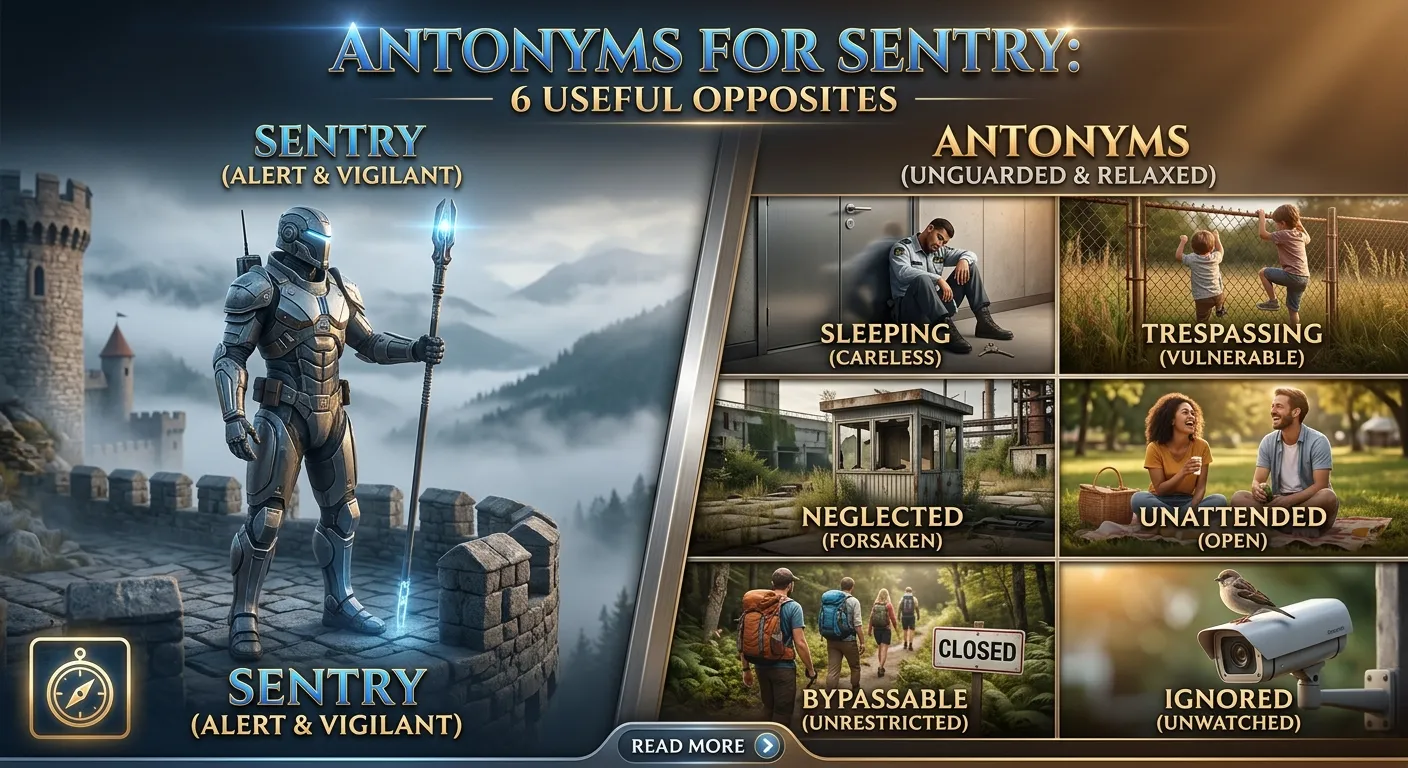
Featured Snippet
A sentry is a person who guards a place, so attacker, intruder, enemy, and foe can describe contrasting roles. There is no single universal antonym that fits every context.
The Short Answer
The most useful contextual antonyms for sentry are attacker, intruder, enemy, foe, opponent, and traitor. A sentry protects a place or position, while these words describe people who may oppose, enter, attack, or betray the protected side. Cambridge’s thesaurus lists enemy, foe, opponent, attacker, and traitor as antonyms under the guardian sense of sentry.
Sentry and Its Antonym: Side-by-Side Comparison
| Word | Meaning | Example |
|---|---|---|
| Sentry | A person, usually a soldier, who guards a place | The sentry stood at the gate. |
| Attacker | Someone who uses violence to hurt someone | The attacker approached the building. |
| Intruder | Someone who enters a place without permission | The sentry spotted an intruder. |
| Enemy | A person, group, or force that opposes or tries to harm another | The sentry watched for enemy forces. |
| Foe | An enemy or opponent | The sentry remained alert for the approaching foe. |
| Opponent | Someone who is against another person or group | The sentry faced an opponent during the conflict. |
| Traitor | Someone who betrays their own side or group | The traitor revealed the location of the guards. |
Meaning in Brief
Sentry: A person, usually a soldier, who stands guard over a place or entrance.
Main contextual opposites: attacker and intruder people whose roles contrast with the sentry’s protective role.
What You’ll Learn
- What sentry means
- Which words can contrast with sentry
- Why attacker and intruder are useful contextual opposites
- How enemy, foe, opponent, and traitor differ
- How to use these words naturally in sentences
Common Opposites of Sentry
There is an important point about this word: sentry is a role noun, so its opposite changes according to the relationship being described. It does not have one perfect antonym in every sentence.
1. Attacker
An attacker is a person who uses violence to hurt someone. In a security or military setting, an attacker contrasts directly with a sentry because the sentry guards while the attacker threatens or assaults.
Example:
The sentry noticed the attacker approaching the gate.
Best context: Security, military, and physical conflict.
2. Intruder
An intruder is someone who enters a place without permission. This is one of the clearest contextual opposites when a sentry is guarding a building, gate, or restricted area.
Example:
The sentry stopped an intruder from entering the compound.
Best context: Buildings, restricted areas, security, and unauthorized entry.
3. Enemy
An enemy is a person, country, or force that opposes another and may try to harm or defeat them. In military contexts, an enemy can be the opposing side that a sentry is watching for.
Example:
The sentry reported the movement of enemy forces.
Best context: Military conflict or opposition between groups.
4. Foe
Foe means an enemy or opponent. It is similar to enemy but is often more literary or formal in tone.
Example:
The sentry remained alert as the foe moved closer.
Best context: Literary writing, historical writing, and formal descriptions.
5. Opponent
An opponent is someone who competes against or opposes another person or group. It is broader than enemy and does not necessarily imply violence.
Example:
The sentry faced an opponent during the simulated battle.
Best context: Competition, conflict, debate, or military-style contexts.
Important: Opponent is a contextual opposite, not a direct dictionary antonym of sentry in every situation.
6. Traitor
A traitor is someone who betrays their own country, group, or side. Cambridge’s thesaurus includes traitor among the antonyms associated with the guardian sense of sentry.
Example:
The traitor secretly gave information to the enemy.
Best context: Betrayal, military settings, organizations, and political or historical writing.
Choosing the Right Antonym
The best opposite depends on what the sentry is doing and who is being contrasted with the sentry.
| If the sentry is guarding against… | Useful opposite |
|---|---|
| Someone trying to enter | Intruder |
| Someone attacking | Attacker |
| An opposing military force | Enemy |
| An opposing person or force | Foe |
| Someone competing or opposing | Opponent |
| Someone betraying their own side | Traitor |
This distinction matters because these words are not interchangeable.
For example:
- The sentry stopped an intruder. → Focuses on unauthorized entry.
- The sentry spotted an attacker. → Focuses on an attempt to cause harm.
- The sentry watched for the enemy. → Focuses on an opposing force.
- The sentry discovered a traitor. → Focuses on betrayal.
How These Antonyms Differ
Sentry vs. Intruder
These words describe opposing roles around a protected location.
Sentry: guards the location.
Intruder: enters the location without permission.
Sentry vs. Attacker
These words contrast protective and aggressive roles.
Sentry: watches and protects.
Attacker: attempts to hurt or assault.
Sentry vs. Enemy
The contrast is broader.
An enemy is an opposing person, group, country, or force. A sentry is specifically a person performing guard duty.
Sentry vs. Foe
Foe is essentially an enemy or opponent, but its tone can be more literary.
Sentry vs. Opponent
Opponent does not necessarily imply hostility or violence. Two people can be opponents in a game or debate. Therefore, it is a weaker contextual contrast with sentry.
Sentry vs. Traitor
A traitor is different because betrayal is the defining idea. A traitor may be a member of the same group rather than an outside attacker.
See the Antonyms in Action
- The sentry stood outside the military compound.
- The intruder tried to enter through a side gate.
- The attacker moved toward the guarded entrance.
- The enemy forces approached the position.
- The foe appeared on the other side of the battlefield.
- The opponent challenged the guards during the exercise.
- The traitor secretly shared information with the enemy.
What Part of Speech Is It?
Sentry is a countable noun.
- singular: sentry
- plural: sentries
Example:
One sentry guarded the entrance.
Two sentries stood outside the building.
Most of the useful contextual opposites are also nouns:
- attacker
- intruder
- enemy
- foe
- opponent
- traitor
A Useful Language Tip
Don’t search for an antonym of sentry by simply looking for a word meaning “not a guard.” Instead, identify the role opposite you mean.
If the contrast is about entering a protected place, use intruder and if it is about attacking, use attacker. If it is about an opposing side, enemy or foe may fit better.
Commonly Confused Opposites
Is “civilian” an antonym of sentry?
Not generally. A civilian is someone who is not a member of the armed forces, but a sentry is defined by their guarding role, not simply by military status. A civilian could also perform security-related work.
Is “guard” an antonym of sentry?
No. Guard is actually a close synonym of sentry, not its opposite. Cambridge lists guard among the words related to sentry.
Is “enemy” always the opposite of sentry?
No. Enemy works when the sentence contrasts the sentry with an opposing person or force. In a building-security context, intruder may be more precise.
Quick Antonym Quiz
1. Which word best describes someone entering a restricted place without permission?
A. Sentry
B. Intruder
C. Guardian
Answer: B. Intruder
An intruder enters a place where they are not allowed to be.
2. Which word best contrasts with a sentry in an attack?
A. Attacker
B. Watchman
C. Sentinel
Answer: A. Attacker
An attacker is someone who uses violence to hurt someone, making it a natural contextual contrast with a person guarding the area.
Questions About Sentry and Its Antonyms
What is the opposite of sentry?
There is no single antonym that works in every context. Attacker, intruder, enemy, foe, opponent, and traitor can all contrast with sentry in particular contexts. Cambridge’s thesaurus lists several of these as antonyms under the guardian sense.
Is intruder an antonym of sentry?
Intruder is a strong contextual opposite. A sentry guards a place, while an intruder enters a place without permission.
Is attacker an antonym of sentry?
Attacker can function as a contextual antonym. The sentry has a protective role, while an attacker attempts to hurt or assault.
Is guard an antonym of sentry?
No. Guard is a synonym or closely related word, not an antonym. Cambridge lists guard among the words related to sentry.
What is the difference between a sentry and an enemy?
A sentry is a person assigned to guard a place, while an enemy is a person, country, or force that opposes another side. They describe different roles rather than simple word-for-word opposites.
What to Remember
Sentry means a person who stands guard, usually at a particular place. Because it describes a role rather than a simple quality, it has several contextual opposites rather than one universal antonym. Intruder fits unauthorized entry, attacker fits an assault, and enemy or foe fits an opposing side.
Antonyms for Feminism: 8 Words to Know

Hi, I’m Amna Akhtar. I write about word their meanings, opposites, and the small distinctions that make English tricky. I don’t come at language purely from instinct, either. I have a peer-reviewed academic paper “Determinants of Jobs Satisfaction of Female Teachers: An Evidence from District Hafizabad, Pakistan,” published in education economics, and that research background shapes how I think about language content, I want it to actually help people learn, not just look correct on a page. Whether you’re a student, a writer, or just someone who wants to use the right word at the right moment, my goal is to make that easier for you.