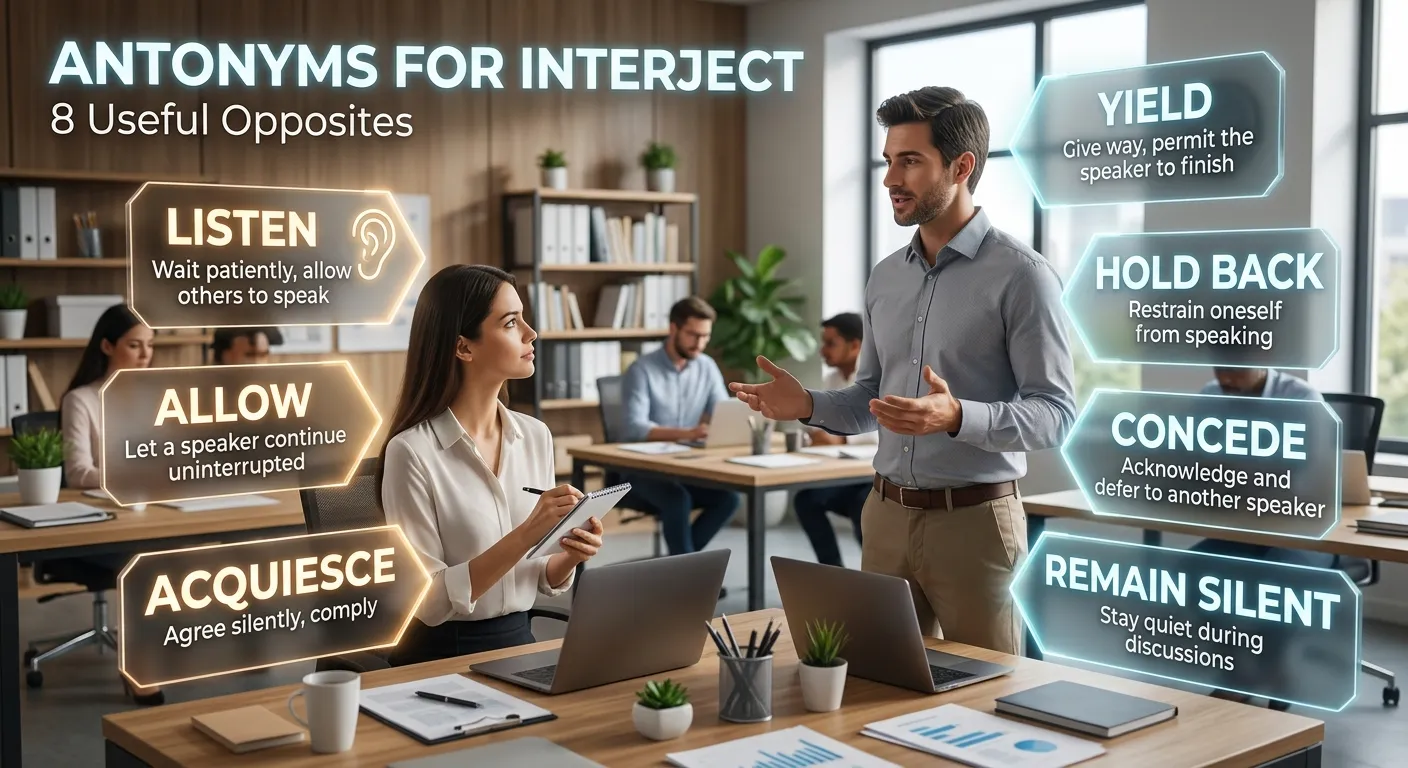
If you are looking for antonyms for interject, the clearest opposite in conversation is listen, because to interject means to speak while someone else is speaking, often interrupting them. Other contextual opposites include remain silent, wait, hold back, and refrain, depending on the sentence and the degree of contrast.
The Opposite of Interject at a Glance
Quick Answer
The most natural opposite of interject is listen when the context is conversation. Wait, remain silent, refrain, and hold back can also express the opposite idea when someone chooses not to interrupt or add a comment.
Interject is a formal verb meaning to say something while another person is speaking, usually by interrupting them.
Quick Word Comparison
| Word | Meaning | Example |
| Interject | Speak while someone else is speaking | Maya interjected with a question. |
| Listen | Pay attention without interrupting | Maya listened to the speaker. |
| Wait | Delay speaking until an appropriate time | Maya waited for her turn. |
| Remain silent | Not speak or interrupt | Maya remained silent during the discussion. |
Definition
Interject: To say something while another person is speaking, often interrupting them.
Main antonym: Listen to pay attention to someone who is speaking rather than interrupting.
What You’ll Learn
After reading this guide, you will know:
- The most useful antonyms for interject
- Why listen is a natural conversational opposite
- How wait, remain silent, and refrain differ
- Which opposite fits different situations
- How to use these words naturally in sentences
Common Opposites of Interject
There is no single perfect antonym for interject in every sentence. The best opposite depends on what aspect of interjecting you want to contrast: speaking, interrupting, or inserting a comment.
1. Listen
Meaning: To give attention to what someone is saying rather than interrupting.
Example:
Instead of interjecting during the presentation, she listened carefully.
Why it works:
In a conversation, listen creates a natural behavioral contrast with interject. Someone who listens allows another person to continue speaking.
2. Wait
Meaning: To delay speaking or acting until the appropriate time.
Example:
He waited until the speaker finished before asking his question.
Why it works:
Wait is especially useful when the intended contrast is not interrupting immediately.
3. Remain Silent
Meaning: To continue without speaking.
Example:
The students remained silent while the teacher explained the instructions.
Why it works:
This is a stronger contrast than listen because it focuses on not speaking at all.
4. Refrain
Meaning: To deliberately avoid doing something.
Example:
She refrained from interjecting while her colleague explained the problem.
Why it works:
Refrain is useful when the emphasis is on deliberately choosing not to interrupt.
5. Hold Back
Meaning: To stop yourself from saying or doing something.
Example:
I wanted to correct him, but I held back until he had finished speaking.
Why it works:
This is a more conversational expression than refrain and highlights self-control.
6. Let Someone Speak
Meaning: To allow another person to continue talking without interruption.
Example:
Please let her speak before you respond.
Why it works:
This is not a one-word antonym, but it expresses the opposite conversational behavior very clearly.
7. Hear Out
Meaning: To listen to someone until they have finished explaining their thoughts.
Example:
I decided to hear him out before giving my opinion.
Why it works:
Hear out is useful when the contrast is between interrupting someone and allowing them to finish.
8. Stay Quiet
Meaning: To avoid speaking for a period of time.
Example:
He stayed quiet while the other team members discussed the proposal.
Why it works:
This is an informal alternative to remain silent.
Choosing the Right Antonym
The opposite of interject changes slightly depending on what you want to emphasize.
| If you mean… | A useful opposite is… | Example |
| Not interrupting | listen | She listened instead of interjecting. |
| Speaking at the proper time | wait | He waited for his turn to speak. |
| Not speaking | remain silent | She remained silent during the argument. |
| Deliberately avoiding an interruption | refrain | He refrained from interjecting. |
| Controlling an urge to speak | hold back | She held back until the discussion ended. |
| Allowing someone to finish | hear out | We heard him out before responding. |
| Allowing another person to speak | let someone speak | Let her speak without interruption. |
| Informally not speaking | stay quiet | He stayed quiet throughout the meeting. |
This distinction matters because interject specifically involves saying something while another person is speaking. Cambridge defines it as saying something while someone else is speaking, while Oxford describes it as interrupting someone’s speech with an opinion or remark.
How These Antonyms Differ
Not all of these words are strict dictionary antonyms. Some are contextual opposites expressions that describe the contrasting behavior.
Listen vs. Remain Silent
Listen means paying attention to another person’s speech. It does not necessarily mean saying nothing for the entire conversation.
She listened carefully and took notes.
Remain silent focuses specifically on not speaking.
She remained silent throughout the meeting.
Wait vs. Refrain
Wait suggests delaying your speech until the right moment.
Wait until he finishes speaking.
Refrain suggests deliberately choosing not to do something.
She refrained from interrupting him.
Hold Back vs. Refrain
These are close, but their tone differs.
Hold back is more conversational:
I had a question, but I held back.
Refrain is more formal:
The audience refrained from interrupting the speaker.
Hear Out vs. Listen
Listen is broad. Hear someone out specifically suggests allowing them to finish explaining their point before responding.
I listened to her explanation.
I heard her out before making a decision.
See the Antonyms in Action
Here are some natural examples showing the contrast:
- Instead of interjecting, David listened to his colleague.
- She waited until the presentation ended before asking a question.
- The audience remained silent while the speaker explained the issue.
- He refrained from interjecting during the interview.
- I decided to hold back and let her finish.
- We should hear him out before reaching a conclusion.
- Please let her speak without interruption.
- The student stayed quiet while the teacher gave instructions.
Grammar and Word Forms
Interject is a verb. It can be used both transitively and intransitively and is generally marked as formal in learner dictionaries.
Common forms include:
- interject: present/base form
- interjects: third-person singular
- interjected: past tense/past participle
- interjecting: present participle/gerund
Examples:
She interjected with a question.
He often interjects during meetings.
They kept interjecting while she was speaking.
The useful opposites in this article are not all the same grammatical type. Listen, wait, refrain, hold back, and hear out are verbs or verb phrases, while silent and quiet are adjectives.
A Useful Language Tip
When you need a single-word opposite, listen or wait will often work better than trying to force a perfect antonym.
For example:
❌ She did not interject; she was refrain.
✅ She did not interject; she waited for her turn.
Refrain normally needs a complement such as from interrupting or from interjecting:
She refrained from interjecting.
Common Errors to Avoid
Mistake 1: Treating “listen” as a perfect opposite in every context
Listen works especially well when interject refers to interrupting a conversation. It is not a universal opposite for every possible use.
Mistake 2: Using “silent” as a verb
❌ She silent while he was speaking.
✅ She remained silent while he was speaking.
Silent is an adjective, so it needs a suitable verb such as remain, stay, or be.
Mistake 3: Using “refrain” without the right structure
❌ She refrained the discussion.
✅ She refrained from interrupting the discussion.
The common structure is refrain from + -ing form.
Quick Antonym Quiz
Which sentence uses an opposite of interject most naturally?
A. She waited until the speaker finished.
B. She interjected with a question.
C. She interrupted the speaker.
Answer: A. She waited until the speaker finished.
Why? Waited expresses the contrasting behavior: allowing the speaker to finish before speaking.
Frequently Asked Questions
What is the opposite of interject?
The most natural conversational opposite of interject is listen. Depending on the context, wait, remain silent, refrain, and hold back can also express the opposite behavior.
Is “listen” a direct antonym of interject?
Not in every context. Listen is best understood as a contextual opposite when interject means interrupting someone who is speaking. It describes paying attention rather than breaking into the conversation.
What is a stronger opposite of interject?
Remain silent can express a stronger contrast because it emphasizes not speaking at all. However, it is a contextual opposite rather than a universal lexical antonym.
Can “wait” be an antonym of interject?
Yes, in conversational contexts. Wait emphasizes delaying your comment until the other person has finished or until it is your turn to speak.
Is “refrain” an opposite of interject?
Refrain can express the opposite action when it means deliberately avoiding an interruption. The natural construction is refrain from interjecting or refrain from interrupting.
What to Remember
Interject means to speak while someone else is speaking, often by interrupting them.
There is no need to force one universal antonym. For conversation, listen is a natural contrast; wait emphasizes timing; remain silent emphasizes not speaking; and refrain emphasizes deliberately avoiding an interruption.
Antonyms for Exploration: Meanings & Examples

I’m Leo Jackson, an English writer with a soft spot for the peculiarities of language and vocabulary. Specializes in exploring the nuances of English synonyms, antonyms, helping students, writers, and professionals choose the right word with confidence. My guides combine careful research with clear, practical explanations.