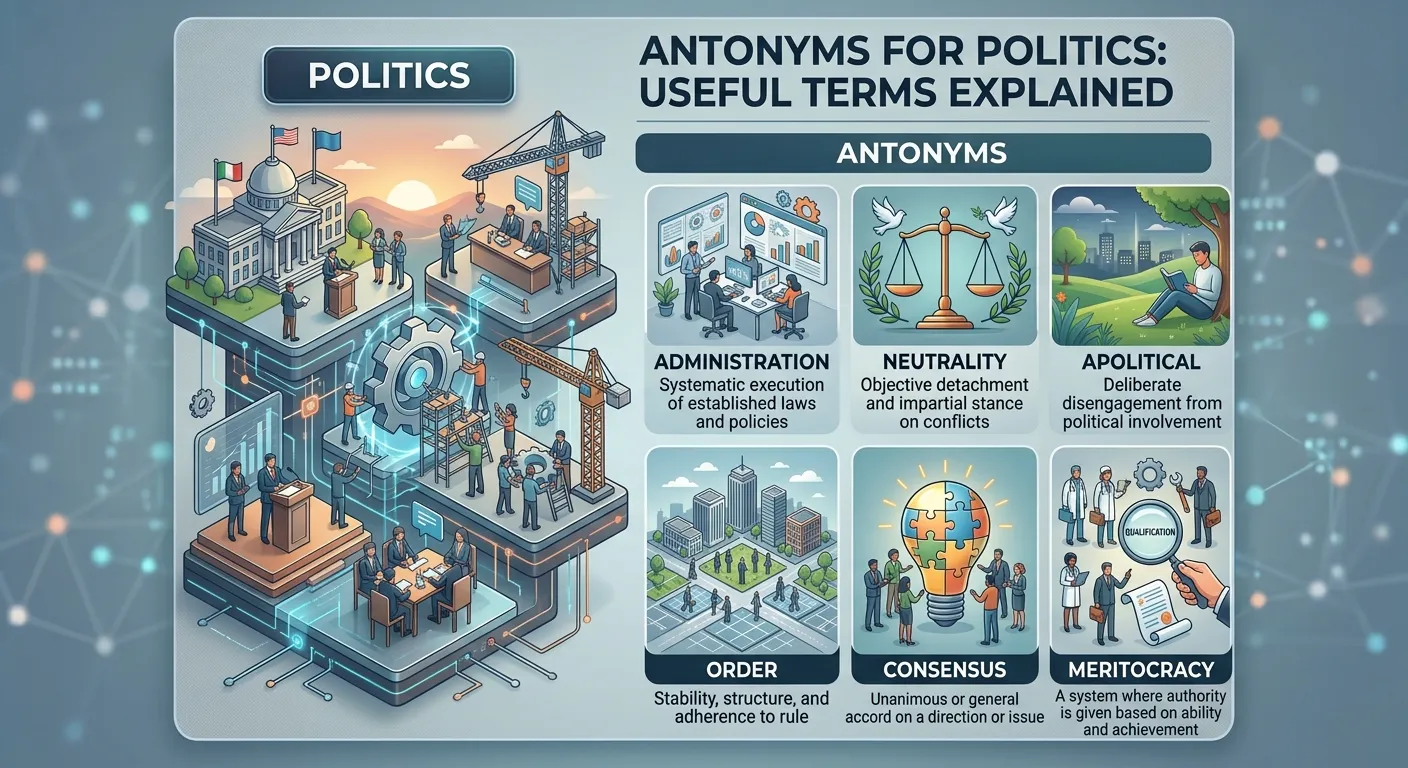
The Opposite of Politics at a Glance
There is no single exact antonym for politics in every context. Depending on the meaning, useful opposites or contrasts include apolitical, nonpolitical, politically neutral, and free from political involvement. Because politics is a broad noun, the best opposite depends on the sentence and intended meaning.
The Short Answer
The most useful opposite of politics is usually apolitical when you mean a lack of political interest, involvement, or affiliation. Nonpolitical works when something is not related to politics at all. Neutral can describe a person or position that does not take a political side.
However, these words are not perfect grammatical antonyms because politics is a noun while apolitical, nonpolitical, and neutral are adjectives.
Quick Word Comparison
| Word | Meaning | Example |
| Politics | Activities and ideas connected with government, power, and public affairs | She follows politics closely. |
| Apolitical | Not interested or involved in politics | The organization describes itself as apolitical. |
| Nonpolitical | Not related to politics | The event was designed as a nonpolitical gathering. |
| Neutral | Not supporting either side in a political disagreement | The organization remained neutral during the debate. |
| Political disengagement | Lack of participation or involvement in political activity | Political disengagement can affect voter participation. |
Meaning in Brief
Politics: The activities, ideas, debates, and relationships involved in government, public affairs, and the exercise of power.
Main contextual opposite: apolitical not concerned with or involved in politics.
Because politics has several related meanings, there is no single word that reverses all of them perfectly.
What You’ll Learn
After reading this guide, you will understand:
- Why politics does not have one exact antonym
- When to use apolitical and nonpolitical
- How neutral differs from apolitical
- Which expressions work when talking about political participation
- How to use these terms naturally in sentences
Common Opposites of Politics
The following are useful contextual opposites or contrasts, rather than a list of perfect one-word antonyms.
1. Apolitical
Apolitical means not interested in, involved in, or concerned with politics.
It is the closest common adjective for describing a person, group, activity, or position that stands apart from politics.
Example:
The charity tries to remain apolitical when providing emergency aid.
Best use: When the focus is on avoiding political involvement or having no political affiliation.
2. Nonpolitical
Nonpolitical means not related to politics.
It is useful when describing an activity, subject, decision, or organization that has no political character or purpose.
Example:
The school organized a nonpolitical cultural event.
Best use: When something is simply outside the political sphere.
Apolitical vs. nonpolitical:
These words overlap, but they are not always interchangeable. Apolitical often describes a stance, person, or organization that avoids political involvement. Nonpolitical more directly describes something that is unrelated to politics.
3. Politically Neutral
Politically neutral describes someone or something that does not support one political side over another.
Example:
The moderator remained politically neutral throughout the discussion.
Best use: When neutrality or impartiality between political positions is the main idea.
Unlike apolitical, politically neutral does not necessarily mean that a person has no political opinions. Someone can understand politics and have political views while choosing not to support either side in a particular dispute.
4. Neutrality
Neutrality is the state of not taking a side.
Example:
The organization maintained neutrality during the political dispute.
This is particularly useful when the opposite of political partisanship is intended.
Important: Neutrality is not a complete opposite of politics. A person can participate actively in politics while remaining neutral between competing parties or positions.
5. Political Disengagement
Political disengagement refers to a lack of participation or involvement in political activity.
Example:
The survey examined political disengagement among young adults.
This phrase is useful when politics refers specifically to political participation or involvement.
It is more precise than simply calling someone apolitical, because a person may be disengaged from political activity without being completely uninterested in political issues.
6. Political Noninvolvement
Political noninvolvement means choosing not to participate in political activity.
Example:
Her political noninvolvement was a personal choice.
This is a formal expression and is usually clearer than trying to use a single noun as the antonym of politics.
7. Private Affairs
In some contexts, private affairs can contrast with politics or public affairs.
Example:
The discussion focused on private affairs rather than public politics.
This is a contextual contrast, not a direct antonym.
It works when politics is being contrasted with matters that belong to an individual’s private life.
Choosing the Right Antonym
The best opposite changes according to what politics means in your sentence.
| If politics means… | Useful opposite or contrast |
| Political involvement | Apolitical, political noninvolvement |
| Something related to politics | Nonpolitical |
| Taking a political side | Neutral, politically neutral |
| Participation in political activity | Political disengagement |
| Political affairs as public affairs | Private affairs |
| Party-based political support | Neutrality, nonpartisanship |
This is why simply choosing one word as the antonym of politics can be misleading.
How These Opposites Differ
Apolitical vs. Nonpolitical
Apolitical usually describes a person, group, organization, or approach that does not engage with or identify with politics.
Nonpolitical usually means that something is not political in nature.
Compare:
- The organization is apolitical.
→ It avoids political involvement or affiliation. - The event is nonpolitical.
→ The event itself is not related to politics.
Apolitical vs. Neutral
These words are also different.
Someone who is apolitical may have little interest in political matters or deliberately avoid political involvement.
Someone who is neutral may be fully aware of political issues but choose not to support either side.
Example:
The journalist tried to remain neutral during the debate.
This does not necessarily mean the journalist is apolitical.
Neutral vs. Nonpolitical
Neutral means not taking a side.
Nonpolitical means not related to politics.
For example:
- The referee remained neutral.
- The sports event was nonpolitical.
The first sentence concerns a person’s position. The second describes the nature of an event.
Examples in Context
Here are natural examples showing how the different terms work:
- The charity maintains an apolitical position.
- The festival was intended to be completely nonpolitical.
- The moderator remained politically neutral during the discussion.
- Some people choose political disengagement because they feel disconnected from public affairs.
- The organization emphasized its neutrality during the dispute.
- The meeting dealt with private affairs rather than political matters.
- His political noninvolvement does not mean that he knows nothing about current events.
What Part of Speech Is It?
Politics is a noun.
The most common contextual opposites discussed above belong to different grammatical categories:
| Word | Part of Speech |
| politics | noun |
| apolitical | adjective |
| nonpolitical | adjective |
| neutral | adjective / noun |
| neutrality | noun |
| disengagement | noun |
| noninvolvement | noun |
This grammatical difference matters. You cannot always replace the noun politics directly with an adjective such as apolitical.
For example:
❌ She prefers apolitical.
✅ She prefers to remain apolitical.
Or:
❌ The organization is politics.
✅ The organization is apolitical.
Commonly Confused Opposites
“Apolitical” does not always mean “neutral”
Apolitical generally suggests a lack of political involvement or concern.
Neutral means not taking a side.
A person may be politically knowledgeable and active while remaining neutral in a particular disagreement.
“Nonpolitical” does not mean “unimportant”
Something can be nonpolitical while still being important.
For example:
The committee discussed several nonpolitical issues related to school facilities.
The word only tells us that the issues are not political in nature.
“Neutral” is not the opposite of every meaning of politics
Politics can refer to government, political activity, power relationships, or political debate. Neutral mainly contrasts with taking sides, so it fits only some contexts.
A Useful Language Tip
When someone asks for an antonym of politics, first identify the intended meaning.
If they mean “not involved in politics,” use apolitical.
And if they mean “not related to politics,” use nonpolitical.
If they mean “not taking a political side,” use neutral or politically neutral.
This produces a much more accurate answer than treating one word as a universal antonym.
Quick Practice
Choose the best word:
1. The organization does not support any political party and describes itself as ______.
A. political
B. apolitical
C. partisan
Answer: B. apolitical
It means the organization avoids political involvement or affiliation.
2. The school wanted to hold a ______ cultural event.
A. nonpolitical
B. partisan
C. political
Answer: A. nonpolitical
The event was not related to politics.
3. The mediator remained ______ during the political dispute.
A. neutral
B. partisan
C. political
Answer: A. neutral
Neutral means not taking either side.
Frequently Asked Questions
What is the opposite of politics?
There is no single exact antonym for politics in every context. Apolitical is often the closest choice when the meaning is a lack of political involvement, while nonpolitical means unrelated to politics and neutral means not taking a political side.
Is “apolitical” the opposite of “politics”?
Apolitical can express the opposite idea when politics means political involvement or concern. However, it is an adjective, while politics is a noun, so it is not a direct grammatical replacement.
What is the opposite of political involvement?
Useful expressions include political disengagement, political noninvolvement, and apolitical. The best choice depends on whether you mean avoiding participation, avoiding affiliation, or simply lacking political involvement.
Is “nonpolitical” the same as “apolitical”?
Not exactly. Nonpolitical usually means unrelated to politics, while apolitical often describes a person, organization, or position that avoids political involvement or does not identify politically.
What to Remember
Politics has no single universal antonym because it covers several related ideas. For most vocabulary questions, the most useful choices are apolitical, nonpolitical, and neutral, but each expresses a different kind of contrast.
- Apolitical → not involved or concerned with politics
- Nonpolitical → not related to politics
- Neutral → not taking a side
- Political disengagement → lack of political participation
- Neutrality → the state of not taking sides
Antonyms for Sentry: 6 Useful Opposites

I am Clara Stephen, passionate about making English simple and easy to understand through clear synonym, antonyms, word comparisons, vocabulary guides, and language tips. Through thoughtful, reliable content, I aim to be a trusted guide for anyone looking to expand their English vocabulary.