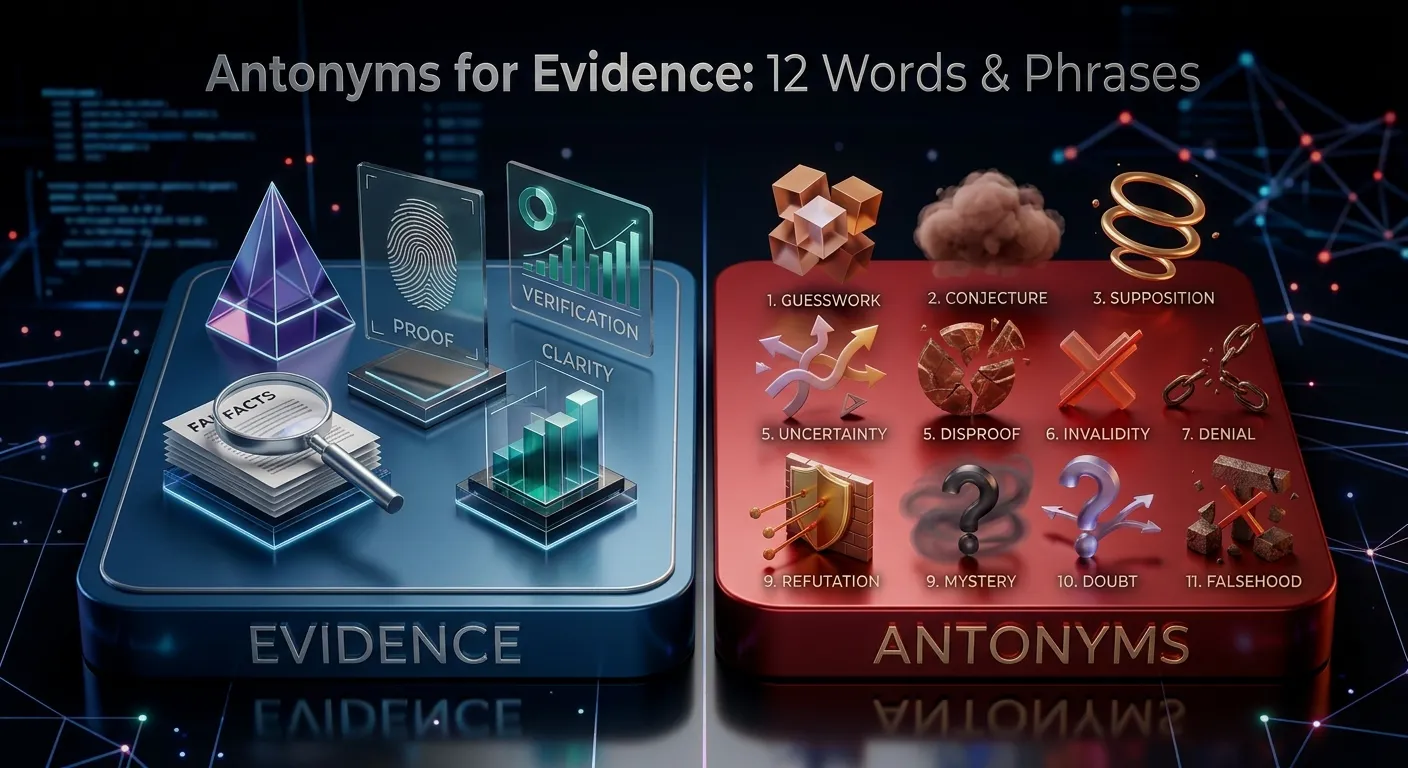
The word “evidence” has no single perfect antonym. In most contexts, useful opposites include lack of evidence, absence of evidence, unsupported claim, assertion, speculation, and conjecture. The best choice depends on whether you mean a lack of proof, an unverified statement, or an idea based on insufficient facts.
What Is the Opposite of the Word Evidence?
There is no exact one-word antonym for evidence in every context. Lack of evidence or absence of evidence is the clearest opposite when evidence is missing. When contrasting evidence with an unsupported idea or statement, assertion, speculation, conjecture, or unsupported claim may be more appropriate.
At a Glance
The most natural opposite depends on what evidence means in the sentence:
- Lack of evidence: evidence is missing
- Absence of evidence: no evidence is present
- Unsupported claim: a statement without supporting evidence
- Assertion: a statement presented without necessarily providing proof
- Speculation: an idea based on incomplete information
- Conjecture: an opinion or conclusion based on incomplete evidence
- Assumption: something accepted as true without sufficient proof
- Guess: an answer or opinion without reliable supporting evidence
- Rumor: unverified information passed from one person to another
- Unsubstantiated claim: a claim without adequate supporting evidence
- Opinion: a personal belief or judgment rather than factual proof
- Anecdote: an individual account that may not provide reliable evidence
Evidence and Its Opposites
| Word or phrase | Meaning | Example |
| Evidence | Information that supports or helps establish a fact | The researchers found evidence supporting the theory. |
| Lack of evidence | A situation in which supporting evidence is missing | The claim remains unproven because of a lack of evidence. |
| Unsupported claim | A claim made without adequate evidence | The article contained an unsupported claim. |
| Assertion | A statement made without necessarily being demonstrated or proved | His assertion was not supported by data. |
| Speculation | An idea based on incomplete information | The cause of the delay remains speculation. |
| Conjecture | A conclusion or opinion based on incomplete information | The explanation is still conjecture. |
Definition
Evidence: facts, information, signs, or other material used to support or establish that something is true.
Closest contextual opposite: Lack of evidence a situation in which sufficient supporting information is absent.
What You’ll Learn
After reading this guide, you will know:
- Why evidence does not have one exact lexical antonym
- Which expressions describe the absence of evidence
- How assertion, speculation, conjecture, and assumption differ
- Which opposite works best in academic, legal, and everyday contexts
Common Opposites of Evidence
Because evidence is a noun meaning supporting information, its opposites are usually contextual expressions rather than simple one-word antonyms.
1. Lack of Evidence
Lack of evidence is often the most natural opposite when the intended meaning is that supporting information is not available.
Example:
There was a lack of evidence to support the accusation.
This does not necessarily mean that the claim is false. It means that sufficient evidence has not been provided or found.
2. Absence of Evidence
Absence of evidence means that evidence is not present or has not been found.
Example:
The absence of evidence made it difficult to reach a firm conclusion.
Lack of evidence and absence of evidence are very close in meaning.
3. Unsupported Claim
An unsupported claim is a statement for which adequate evidence has not been provided.
Example:
The report made an unsupported claim about the effects of the policy.
This is particularly useful in academic and analytical writing.
4. Assertion
An assertion is a statement presented as true. An assertion may be correct, but the word itself does not indicate that evidence has been supplied.
Example:
The author’s assertion was not backed by reliable data.
Therefore, assertion is not a strict antonym of evidence. It becomes a contextual contrast when a statement is being presented without supporting proof.
5. Speculation
Speculation is an idea or explanation based on incomplete information rather than established evidence.
Example:
Without further information, the cause of the problem remains speculation.
This word is especially useful when someone is guessing about a possible explanation.
6. Conjecture
Conjecture refers to an opinion or conclusion formed without enough evidence to establish it as certain.
Example:
The proposed explanation remains conjecture until more evidence is available.
It is more formal than guess and commonly appears in academic or analytical contexts.
7. Assumption
An assumption is something accepted as true without sufficient proof.
Example:
The conclusion was based on the assumption that all participants had understood the instructions.
An assumption can later be supported by evidence, so it is not inherently the opposite of evidence.
8. Guess
A guess is an answer or opinion formed without knowing the facts with certainty.
Example:
Without any evidence, choosing an explanation would be little more than a guess.
Guess is much more informal than conjecture or speculation.
9. Rumor
A rumor is information or a story that circulates without being confirmed.
Example:
The accusation was based on a rumor rather than verified evidence.
A rumor can eventually turn out to be true, so its defining feature is lack of verification, not necessarily falsity.
10. Unsubstantiated Claim
An unsubstantiated claim is a claim that lacks sufficient supporting evidence.
Example:
The researcher rejected the unsubstantiated claim because no supporting data were provided.
This is a particularly precise expression when discussing research, journalism, or formal arguments.
11. Opinion
An opinion is a personal belief, view, or judgment.
Example:
The article should distinguish evidence from personal opinion.
An opinion can be supported by evidence, so opinion is not automatically an opposite of evidence. The contrast is useful when distinguishing personal judgment from supporting factual material.
12. Anecdote
An anecdote is a short account of an individual experience or event.
Example:
One personal anecdote does not necessarily provide strong evidence for a general conclusion.
An anecdote can be evidence in some contexts, but it is often contrasted with stronger, systematic evidence in research.
The Opposite Changes With Meaning
The best opposite of evidence depends on the intended contrast.
When evidence means “supporting information”
Use:
- lack of evidence
- absence of evidence
- insufficient evidence
The investigators found insufficient evidence to support the claim.
When evidence is contrasted with an unsupported statement
Use:
- unsupported claim
- assertion
- unsubstantiated claim
The statement was an unsupported claim rather than a conclusion based on evidence.
When evidence is contrasted with uncertain reasoning
Use:
- speculation
- conjecture
- assumption
- guess
Until the test results are available, any explanation is speculation.
When evidence is contrasted with personal views
Use:
- opinion
- belief
- personal judgment
The essay should separate evidence from personal opinion.
How These Opposites Differ
The most important point is that these words describe different kinds of contrast.
| Term | What it emphasizes | Best context |
| Lack of evidence | Evidence is missing | General, academic, legal |
| Absence of evidence | No evidence is present or found | Formal writing |
| Unsupported claim | A claim has insufficient support | Academic, analytical |
| Assertion | A statement is simply put forward | Formal argument |
| Speculation | An idea is based on incomplete information | News, analysis, everyday speech |
| Conjecture | An uncertain conclusion | Formal/academic |
| Assumption | Something is accepted without proof | Reasoning, research |
| Guess | An uncertain answer without reliable knowledge | Everyday speech |
| Rumor | Unverified information circulating | Everyday communication |
| Unsubstantiated claim | A claim lacks supporting proof | Academic/formal |
| Opinion | Personal belief or judgment | General discussion |
| Anecdote | Individual experience or story | Everyday/research contexts |
Evidence and Its Opposites in Context
Here are some natural examples showing why context matters:
Evidence vs. lack of evidence
There was strong evidence that the product was defective.
There was a lack of evidence linking the product to the complaint.
Evidence vs. speculation
The conclusion was based on scientific evidence.
Any explanation without the test results would be speculation.
Evidence vs. assertion
The researcher supported the conclusion with evidence.
The opposing statement was merely an assertion.
Evidence vs. assumption
The decision was based on evidence rather than an assumption.
Evidence vs. opinion
The report clearly separated statistical evidence from personal opinion.
What Part of Speech Is It?
Evidence is primarily a noun.
It can be:
- uncountable: There is little evidence to support the theory.
- used with quantifying expressions: a piece of evidence, several pieces of evidence
Be careful with evidences. In ordinary modern English, evidence is generally uncountable when referring to proof or supporting information.
For example:
✅ The researchers found strong evidence.
❌ The researchers found strong evidences.
When referring to individual items, use pieces of evidence:
The lawyer presented three pieces of evidence.
The main contextual opposites above are mostly nouns or noun phrases as well:
- evidence → lack of evidence
- evidence → assertion
- evidence → speculation
- evidence → conjecture
- evidence → assumption
- evidence → opinion
Common Errors to Avoid
1. Treating “disproof” as the universal opposite
Disproof is not simply the absence of evidence. It means evidence or reasoning that demonstrates that something is false or cannot be true.
Evidence: supports a proposition.
Disproof: provides grounds for rejecting a proposition.
Therefore, disproof is better understood as the opposite function of supporting evidence in certain arguments, not as a general antonym of evidence.
2. Assuming “lack of evidence” means “evidence of falsity”
These ideas are different.
Lack of evidence: sufficient evidence has not been found or provided.
Evidence of falsity: information supports the conclusion that something is false.
A claim can lack evidence without being proven false.
3. Using “opinion” as an exact antonym
An opinion is not necessarily unsupported. A person can form an evidence-based opinion.
Her opinion was based on extensive research.
So opinion is a contextual contrast, not a strict antonym.
A Useful Language Tip
When writing about research or arguments, “lack of evidence” is usually safer than inventing a one-word antonym for evidence. If you mean that someone made a statement without supporting proof, “unsupported claim” or “unsubstantiated claim” is more precise.
Quick Antonym Quiz
Which phrase best describes a claim made without supporting proof?
A. Evidence
B. Unsupported claim
C. Verification
Answer: B. Unsupported claim
An unsupported claim is a statement for which adequate evidence has not been provided.
Which word best describes an idea based on incomplete information?
A. Speculation
B. Evidence
C. Verification
Answer: A. Speculation
Speculation refers to an uncertain idea or explanation formed without enough established information.
Frequently Asked Questions
What is the opposite of the word evidence?
There is no single exact antonym. Lack of evidence or absence of evidence is the clearest opposite when evidence is missing. Unsupported claim, speculation, and conjecture can work as contextual contrasts.
What is the one-word antonym of evidence?
There is no universally accurate one-word antonym for evidence. Words such as assertion, speculation, conjecture, and assumption express different kinds of contrast rather than one exact opposite.
Is lack of evidence the same as disproof?
No. Lack of evidence means that sufficient supporting evidence has not been found or provided. Disproof means that evidence or reasoning demonstrates that a proposition is false or untenable.
Is speculation the opposite of evidence?
Not exactly. Speculation is an uncertain idea based on incomplete information, while evidence is information used to support or establish a conclusion. They can be contrasted when an explanation is based on speculation rather than supporting evidence.
What is the difference between evidence and an unsupported claim?
Evidence provides information that supports a conclusion or proposition. An unsupported claim is a statement for which adequate supporting evidence has not been provided.
Conclusion
Evidence is unusual because it does not have one clean, dictionary-style antonym. The best opposite depends on the intended meaning:
- Lack of evidence → supporting evidence is missing
- Absence of evidence → evidence is not present or has not been found
- Unsupported claim → a statement lacks adequate support
- Speculation → an uncertain idea based on incomplete information
- Conjecture → an unproven conclusion or opinion
- Assumption → something accepted without sufficient proof
- Disproof → evidence or reasoning showing that something is false, rather than merely a lack of evidence
For precise writing, describe the specific kind of contrast you mean instead of treating one word as the universal antonym of evidence.
Antonyms for Typical: 12 Useful Opposites to Know

I’m Leo Jackson, an English writer with a soft spot for the peculiarities of language and vocabulary. Specializes in exploring the nuances of English synonyms, antonyms, helping students, writers, and professionals choose the right word with confidence. My guides combine careful research with clear, practical explanations.