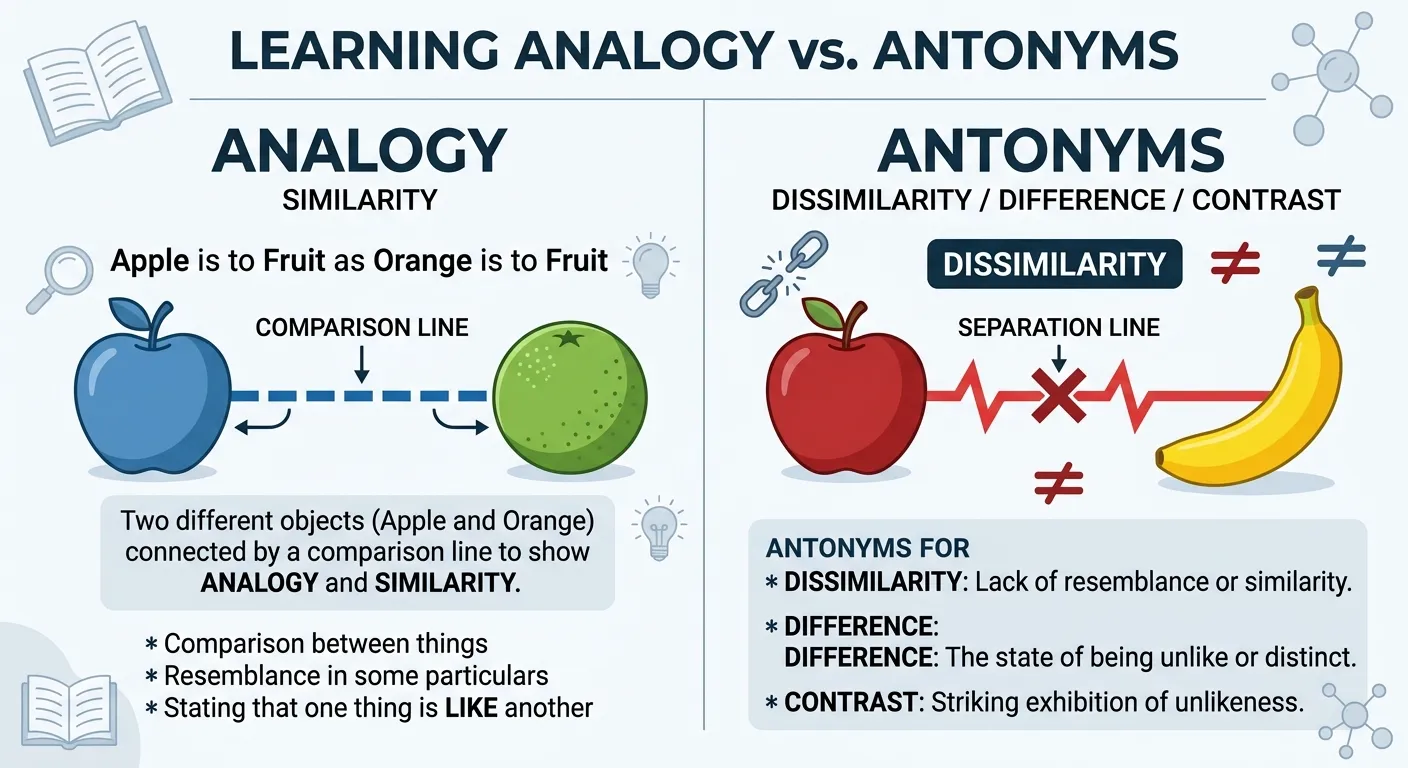
Analogy: A comparison between two things that have similar features.
Main antonym: Dissimilarity a lack of similarity between two things.
What is the Opposite of Analogy?
An analogy is a comparison based on similarities between two things. The clearest antonyms for analogy are dissimilarity and difference, which emphasize how things are unlike rather than alike. Unlikeness and disagreement can also work in certain contexts, but they are less direct.
Quick Answer
The strongest antonym of analogy is dissimilarity when you mean a lack of similarity between two things. Difference is the most common everyday alternative, while unlikeness emphasizes that things are not alike. Disagreement can sometimes contrast with analogy, but it is a weaker, context-dependent opposite.
Quick Comparison
| Word | Meaning | Example |
|---|---|---|
| Analogy | A comparison based on similarities | The teacher drew an analogy between the brain and a computer. |
| Dissimilarity | A lack of similarity | The dissimilarity between the two designs was obvious. |
| Difference | A way in which two things are unlike | There is a major difference between the two methods. |
| Unlikeness | The quality of being unlike | The unlikeness of the two systems made comparison difficult. |
| Disagreement | A lack of agreement or correspondence | There was disagreement between the two accounts. |
Pronunciation
Analogy is pronounced:
/əˈnæl.ə.dʒi/
uh-NAL-uh-jee
The stress falls on the second syllable: NAL.
Etymology
Analogy comes from Greek analogía, meaning “proportion” or “correspondence.” It entered English through Latin and French and developed into its modern sense of a comparison based on similarities or corresponding relationships.
Learning Outcomes
After reading this guide, you will know:
- The strongest antonyms of analogy
- Why dissimilarity is the closest direct opposite
- The difference between dissimilarity, difference, and unlikeness
- When disagreement can work as a contextual contrast
- How to use these words naturally in sentences
Core Antonyms for Analogy
1. Dissimilarity
Dissimilarity is the strongest and most direct antonym of analogy when analogy refers to similarity between things.
An analogy highlights shared features; dissimilarity highlights features that make things unlike.
Example:
The dissimilarity between the two scientific models made the analogy unhelpful.
Cambridge lists dissimilarity as an antonym of analogy, and Thesaurus.com also identifies it as a strong antonym.
2. Difference
Difference is the most familiar everyday opposite of analogy.
While an analogy focuses on similarities that allow two things to be compared, a difference identifies how they are unlike.
Example:
The analogy between the two systems is interesting, but there is a major difference in how they operate.
Thesaurus.com identifies difference as the strongest antonym of analogy.
3. Unlikeness
Unlikeness means the quality or state of being unlike or different.
It is closely related to dissimilarity but is less common in everyday English.
Example:
The unlikeness of the two situations made the proposed analogy difficult to understand.
Use unlikeness when you specifically want to emphasize that two things do not resemble each other.
4. Disagreement
Disagreement can function as a weaker, context-dependent antonym of analogy.
An analogy suggests a correspondence or similarity between things, while disagreement can indicate that two things do not correspond in a particular respect.
Example:
There was significant disagreement between the two accounts, making the analogy questionable.
However, disagreement is not a direct antonym in every context. It usually refers to conflicting opinions, statements, or positions rather than a simple lack of similarity. Thesaurus.com lists it as a weaker antonym of analogy.
5. Contrast
Contrast is a useful contextual opposite when the purpose is to emphasize differences rather than similarities.
For example, an analogy brings two things together by highlighting a shared feature, while a contrast draws attention to how they differ.
Example:
Instead of making an analogy between the two theories, the professor used contrast to explain their differences.
Contrast is best treated as a contextual opposite rather than a strict dictionary antonym of analogy. It describes a method of emphasizing differences, not simply the absence of analogy.
Analogy vs. Its Most Useful Opposites
Analogy vs. Dissimilarity
The writer drew an analogy between the two economic systems.
The researcher emphasized their dissimilarity.
This is the clearest conceptual contrast because analogy focuses on similarity, while dissimilarity focuses on lack of similarity.
Analogy vs. Difference
The analogy between the two machines was useful.
The engineer then explained the key differences between them.
Difference is generally more natural than dissimilarity in everyday speech and writing.
Analogy vs. Unlikeness
The analogy depends on the similarities between the examples.
Their unlikeness makes the comparison less convincing.
Unlikeness is grammatically correct but less common than difference or dissimilarity.
Analogy vs. Contrast
The teacher used an analogy to explain the difficult concept.
Later, she used contrast to show how the two concepts differ.
These words describe different ways of organizing a comparison. An analogy emphasizes a shared relationship, while contrast emphasizes differences.
Antonym Meaning and Usage
The best opposite depends on what you want to emphasize.
| Antonym | Best used when you want to emphasize… |
| Dissimilarity | A lack of similarity |
| Difference | Specific ways things are unlike |
| Unlikeness | The general quality of being unlike |
| Disagreement | Conflicting views, statements, or correspondence |
| Contrast | Differences deliberately highlighted for comparison |
Dissimilarity vs. Difference
These two are the most useful choices.
Dissimilarity sounds more formal and directly describes a lack of similarity:
The dissimilarity between the samples was statistically significant.
Difference is broader and much more common:
There is a clear difference between the two approaches.
If you simply want an everyday word, difference is usually the better choice. If you specifically want to emphasize the absence of similarity, dissimilarity is more precise.
Difference vs. Contrast
A difference is a feature that makes two things unlike.
A contrast is the act or result of placing things together to emphasize those differences.
The main difference is the cost.
The author uses contrast to highlight the difference in cost.
So contrast should not automatically replace analogy in every sentence.
Example Sentences
Here are natural examples showing the main opposites in context:
- Dissimilarity: The dissimilarity between the two theories became obvious after further research.
- Difference: The main difference between the two products is their design.
- Unlikeness: The unlikeness of the two situations made the analogy difficult to defend.
- Disagreement: There was disagreement between the researchers about whether the comparison was valid.
- Contrast: The writer used contrast rather than analogy to highlight the opposing ideas.
Grammar and Word Class
Analogy is a countable or uncountable noun.
As a countable noun, it commonly refers to a particular comparison:
The teacher made an analogy between the brain and a computer.
It can also describe the general process or use of comparison:
We can understand the concept by analogy.
Oxford notes common patterns such as analogy between A and B, analogy with something, and by analogy.
Its main antonyms are also nouns:
- analogy → noun
- dissimilarity → noun
- difference → noun
- unlikeness → noun
- disagreement → noun
- contrast → noun
Useful Patterns
analogy between A and B
She drew an analogy between the two systems.
analogy with something
There is an analogy with an earlier case.
by analogy
The principle can be understood by analogy.
difference between A and B
There is a major difference between the two approaches.
contrast between A and B
The contrast between the two theories is striking.
Word Formation
Dissimilarity provides a useful example of English word formation.
It is built from:
dis- + similarity → dissimilarity
The prefix dis- can express separation, reversal, or lack of a particular quality in some words. Here, dissimilarity means a lack of similarity.
However, you should not assume that adding dis- to any word automatically creates its correct antonym. English word formation is not completely predictable.
The related adjective is:
similar → dissimilar
And the noun forms are:
similarity → dissimilarity
Related Words
Understanding the related vocabulary can help distinguish analogy from its opposites.
Similarity
Similarity is a key concept behind an analogy. It refers to the quality of having features in common.
The analogy depends on the similarity between the two systems.
Comparison
Comparison is the act of examining two or more things to identify similarities or differences.
An analogy is a type of comparison that particularly emphasizes similarity.
The teacher used a comparison to make the concept easier to understand.
Contrast
Contrast focuses attention on differences between things.
The article compares the two theories and then uses contrast to highlight their weaknesses.
Dissimilarity
Dissimilarity focuses specifically on the absence of similarity.
The dissimilarity between the examples was greater than expected.
Common Mistakes
Mistake 1: Treating “difference” as a perfect replacement in every sentence
Difference is a useful antonym of analogy, but the words do not have identical grammatical roles.
❌ The difference between the heart and a pump explained the concept.
If the intended meaning is a comparison used for explanation, analogy is more appropriate:
✅ The analogy between the heart and a pump explained the concept.
The difference is a feature of the things being compared; an analogy is the comparison itself.
Mistake 2: Assuming “disagreement” always means the opposite of analogy
Disagreement normally refers to conflicting opinions, statements, or positions.
The researchers had a disagreement about the interpretation.
It does not simply mean that two objects are dissimilar.
For physical or conceptual differences, dissimilarity or difference is usually more appropriate.
Mistake 3: Confusing “contrast” with “dissimilarity”
These words are related but not identical.
Dissimilarity describes how things differ.
Contrast describes the act or effect of emphasizing those differences.
The dissimilarity between the colors was obvious.
The designer used contrast to make the colors stand out.
Expert Tip
When someone asks for the antonym of analogy, start with dissimilarity or difference rather than trying to find a single opposite that works in every sentence.
An analogy connects two things through similarity; its strongest conceptual opposite separates them through difference.
Short Questions & Answers
Q: What is the main antonym of analogy?
A: The strongest antonym of analogy is dissimilarity because an analogy highlights similarities between things, while dissimilarity describes a lack of similarity. Difference is the most common everyday alternative.
Q: What is the simplest opposite of analogy?
A: Difference is the simplest and most familiar opposite in everyday English. It emphasizes how two things are unlike, while an analogy emphasizes a similarity between them.
Q: Is dissimilarity a true antonym of analogy?
A: Yes. Dissimilarity is directly listed as an antonym of analogy by Cambridge, and it expresses the absence of similarity that an analogy depends on.
Q: Is difference an antonym of analogy?
A: Yes. Difference is a strong antonym of analogy because an analogy focuses on similarities, while a difference identifies ways in which things are unlike. Thesaurus.com lists difference as the strongest antonym.
Q: Is contrast the opposite of analogy?
A: Contrast can be a contextual opposite because it emphasizes differences rather than similarities. However, it is better described as a contextual contrast than a strict dictionary antonym.
Q: Is disagreement an antonym of analogy?
A: Disagreement can work in limited contexts, especially when two accounts or positions fail to correspond. However, it is a weaker and less direct antonym than dissimilarity or difference.
Key Takeaways
- Dissimilarity is the strongest direct antonym of analogy.
- Difference is the most familiar everyday opposite.
- Unlikeness emphasizes the quality of being unlike but is less common.
- Contrast is a useful contextual opposite when differences are deliberately emphasized.
- Disagreement can work in contexts involving conflicting views or a lack of correspondence, but it is not a general opposite of analogy.
- Analogy is a noun describing a comparison based on similarities.
- Choose dissimilarity when you want precision and difference when you want natural everyday English.
Antonyms of Obliged: 10 Clear Opposites & Examples

I’m Leo Jackson, an English writer with a soft spot for the peculiarities of language and vocabulary. Specializes in exploring the nuances of English synonyms, antonyms, helping students, writers, and professionals choose the right word with confidence. My guides combine careful research with clear, practical explanations.