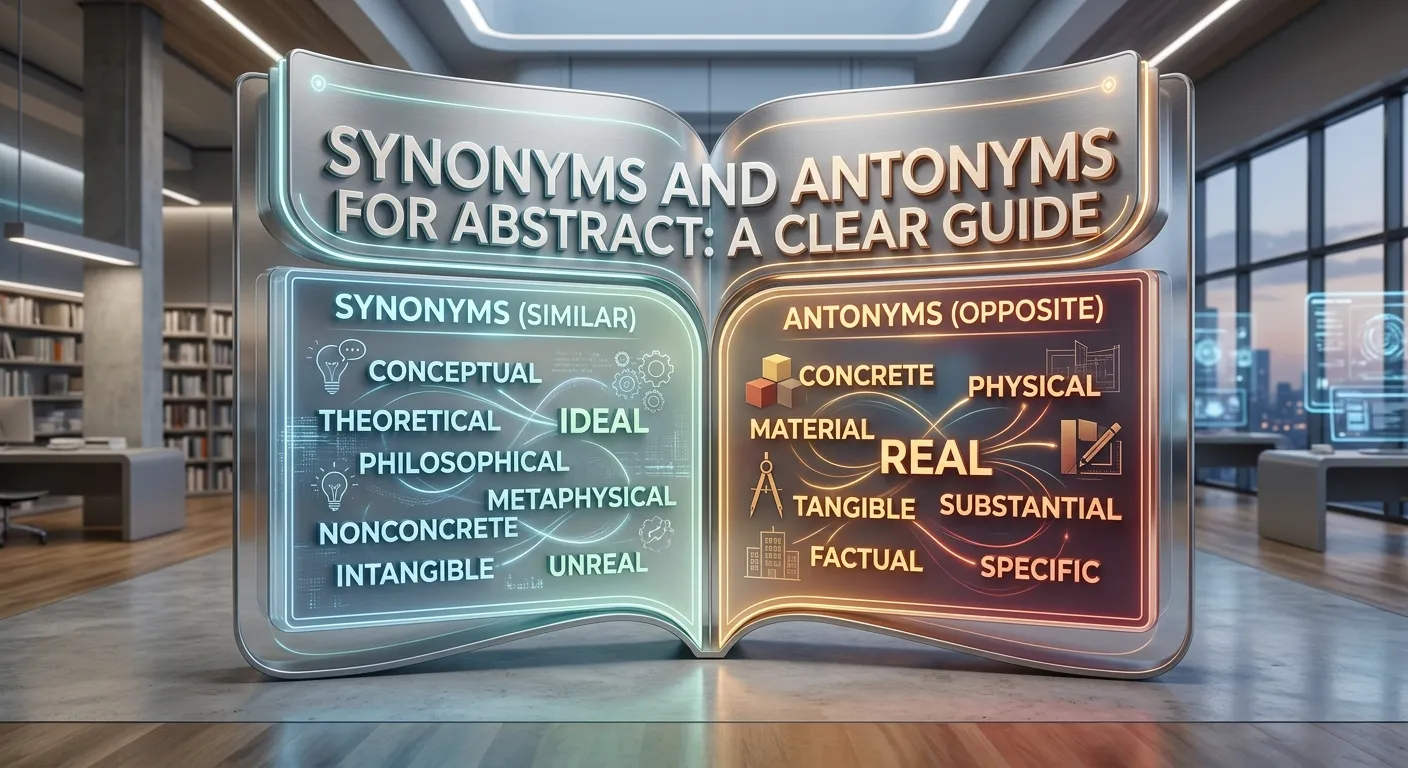
Featured Snippet Block
Abstract can mean theoretical, conceptual, or not concrete and is often contrasted with concrete or specific. Common synonyms include conceptual, theoretical, intangible, and hypothetical. When abstract is a noun meaning a brief summary of a text, its related vocabulary is different.
Quick Answer
The best synonyms for abstract depend on the meaning:
- Conceptual: based on ideas rather than physical things
- Theoretical: concerned with ideas or principles rather than practical application
- Intangible: unable to be physically touched or measured directly
- Hypothetical: based on an imagined or assumed situation
- Nonconcrete: not physical, definite, or tangible
The strongest antonyms for abstract are usually:
- Concrete
- Specific
- Tangible
- Practical
- Physical
However, abstract has more than one meaning, so the correct synonym or antonym depends on the context.
Quick Comparison Table
| Word | Meaning | Example |
| Abstract | Based on ideas rather than physical or specific things | Justice is an abstract concept. |
| Concrete | Existing in a physical or definite form | The students used concrete examples. |
| Conceptual | Related mainly to ideas or concepts | The course introduces conceptual models. |
| Theoretical | Based on ideas or principles rather than practical application | The discussion was mainly theoretical. |
| Tangible | Real and capable of being physically perceived | The project produced tangible results. |
| Specific | Clearly defined or particular | Give me a specific example. |
One-Line Definition
Abstract: Existing mainly as an idea, concept, quality, or thought rather than as a physical or clearly defined thing.
Main antonym: Concrete Existing in a definite, specific, or physical form rather than only as an idea.
Learning Outcomes
After reading this guide, you will know:
- The main synonyms and antonyms of abstract
- How the meaning of abstract changes by context
- When to use concrete, specific, tangible, or practical
- The difference between abstract as an adjective and abstract as a noun
- How to use these words naturally in sentences
Synonyms for Abstract
When abstract means based on ideas rather than physical or concrete things, these are the most useful synonyms.
1. Conceptual
Conceptual means relating to ideas, concepts, or mental understanding rather than physical objects.
Example:
The first chapter introduces the conceptual framework of the study.
Best for: Academic, educational, and analytical contexts.
2. Theoretical
Theoretical describes ideas, principles, or explanations that are concerned with theory rather than practical application.
Example:
The course covers both theoretical and practical aspects of economics.
Usage note:
Theoretical is a close synonym in academic contexts, but it does not always mean exactly the same as abstract.
3. Intangible
Intangible describes something that cannot be physically touched or possessed as a material object.
Example:
Trust is an intangible quality that takes time to develop.
Best for: Qualities, benefits, assets, feelings, and concepts.
4. Conceptualized
Conceptualized means formed or understood as an idea or concept rather than as something directly observable.
Example:
The researchers conceptualized success as more than financial achievement.
Usage note:
This is more specialized and is particularly useful in academic or research writing.
5. Hypothetical
Hypothetical describes something imagined or assumed for the purpose of discussion or reasoning.
Example:
The teacher presented a hypothetical situation for the students to analyze.
Usage note:
Hypothetical is not a universal synonym for abstract. It is appropriate when something is assumed or imagined rather than actual.
6. Nonconcrete
Nonconcrete means not concrete, physical, definite, or tangible.
Example:
The lesson focuses on several nonconcrete ideas such as freedom and identity.
Usage note:
This word is understandable and logically formed, but abstract is usually more natural and idiomatic in everyday English.
Antonyms for Abstract
The best antonym depends on what abstract means in the sentence.
1. Concrete
Concrete is the strongest general antonym of abstract when something is definite, physical, or based on actual examples.
Example:
The teacher used concrete examples to explain the abstract concept.
Best for: General, academic, and educational contexts.
2. Specific
Specific means clearly defined, particular, or precisely identified.
Example:
The instructions were too abstract, so the teacher gave a specific example.
Usage note:
Specific is especially useful when abstract means general or insufficiently defined, rather than purely nonphysical.
3. Tangible
Tangible means real, physical, or capable of being clearly perceived.
Example:
The training produced tangible benefits for employees.
Usage note:
Tangible is a particularly useful opposite when the contrast concerns something that can be physically experienced or clearly demonstrated.
4. Physical
Physical refers to something relating to the body or material world rather than an idea or concept.
Example:
The sculpture provides a physical representation of an otherwise abstract idea.
Best for: Objects, material forms, and physical reality.
5. Practical
Practical relates to real situations, applications, or actions rather than theory or ideas alone.
Example:
The course combines abstract theories with practical skills.
Usage note:
Practical is a contextual antonym. It is especially appropriate when abstract means theoretical rather than applied.
6. Definite
Definite means clearly established, identified, or limited rather than vague or uncertain.
Example:
The proposal needs a definite plan rather than an abstract idea.
Usage note:
This is most useful when abstract suggests something vague or insufficiently specific.
Contextual Synonyms and Antonyms
Because abstract has several meanings, there is no single synonym or antonym that works in every sentence.
When “abstract” means theoretical or conceptual
Synonyms:
- conceptual
- theoretical
- intangible
Antonyms:
- concrete
- practical
- tangible
Example:
The students discussed an abstract theory before applying it to a practical situation.
When “abstract” means nonphysical
Synonyms:
- intangible
- conceptual
- nonconcrete
Antonyms:
- physical
- tangible
- material
Example:
Love is an abstract concept, while a gift is a tangible object.
When “abstract” means vague or insufficiently specific
Synonyms:
- vague
- general
- indefinite
- conceptual
Antonyms:
- specific
- definite
- precise
- explicit
Example:
The instructions were too abstract, so the manager provided specific steps.
Important: In this context, specific may be a better antonym than concrete.
Abstract as a Noun: A Different Meaning
Abstract can also be a noun, especially in academic and research writing.
An abstract is a short summary of a research paper, article, thesis, or academic document.
Example:
The researcher wrote a 250-word abstract for her paper.
In this meaning, abstract does not have a straightforward antonym like concrete.
Instead, related terms include:
- summary
- synopsis
- overview
- précis
These are related words, not antonyms.
Important distinction
- abstract (adjective) = conceptual, theoretical, or nonphysical
- abstract (noun) = a brief summary of a longer work
This difference is important because the appropriate synonyms and antonyms depend on which word class and meaning are intended.
Abstract vs. Concrete
Abstract and concrete form the clearest general contrast.
| Abstract | Concrete |
| Based on ideas or concepts | Definite or physical |
| Often difficult to visualize physically | Usually easier to visualize or identify |
| Example: freedom | Example: a chair |
| Example: justice | Example: a court building |
Example:
Justice is an abstract concept, while a courtroom is a concrete place.
Abstract vs. Specific
These words can be opposites when abstract means general or not clearly defined.
Compare:
- abstract idea → a broad idea that is not expressed in specific terms
- specific idea → a clearly defined or particular idea
Example:
Instead of saying “improve education,” the policy should give specific goals.
Here, specific is more appropriate than concrete because the contrast concerns precision, not physical existence.
Abstract vs. Practical
This contrast is common in education and professional settings.
- Abstract → focused on ideas, theories, or concepts
- Practical → focused on real-world application
Example:
The course gives students both abstract knowledge and practical skills.
Neither word is a perfect antonym in every context, but they form a natural contrast when discussing theory versus application.
Example Sentences
- The students struggled to understand the abstract concept of justice.
- The teacher used concrete examples to make the lesson easier.
- The research provides a theoretical explanation of the problem.
- Trust is an intangible part of a successful relationship.
- Please give me a specific example.
- The workshop focuses on practical solutions.
- The sculpture gives physical form to an abstract idea.
- The instructions were too vague, so the manager made them more definite.
- The study includes an abstract summarizing the main findings.
- The researcher revised the abstract before submitting the paper.
Grammar & Word Class
Abstract as an adjective
When abstract describes an idea, concept, quality, or subject, it is an adjective.
Examples:
- abstract idea
- abstract concept
- abstract theory
- abstract thought
- abstract art
Its common adjective synonyms and contextual antonyms include:
| Abstract-related adjective | Common contrast |
| conceptual | concrete |
| theoretical | practical |
| intangible | tangible |
| vague | specific |
| nonphysical | physical |
Abstract as a noun
When abstract means a short summary of a paper or article, it is a countable noun.
Example:
The journal requires an abstract with every research paper.
Plural: abstracts
Common Mistakes
Mistake 1: Assuming “concrete” is always the opposite
❌ The abstract of my research paper is concrete.
This sentence may be grammatically possible but is confusing because abstract here is a noun meaning a summary.
✅ The abstract of my research paper summarizes the main findings.
But:
✅ The abstract concept became easier to understand through a concrete example.
The correct interpretation depends on whether abstract is a noun or adjective.
Mistake 2: Using “theoretical” as a synonym in every situation
❌ The imaginary friend is theoretical.
✅ The imaginary friend is fictional.
Theoretical relates to theories and principles, while imaginary can describe something created in the imagination.
Mistake 3: Confusing “abstract” with “vague”
Abstract does not always mean unclear.
An abstract concept can be clearly explained.
For example:
Freedom is an abstract concept, but the definition of freedom can still be precise.
Use vague when something lacks clarity or detail.
Expert Tip
When choosing an antonym for abstract, first ask what kind of contrast you mean:
idea → concrete
theory → practical
general → specific
nonphysical → tangible or physical
This simple test will help you choose a more precise antonym instead of using concrete for every situation.
Mini Quiz
Choose the best antonym
The teacher explained the abstract theory with ______ examples.
A. theoretical
B. concrete
C. hypothetical
Answer: B. concrete
Explanation: Concrete examples are definite, specific examples that help explain an abstract idea.
Choose the best word
The instructions were too ______, so the students did not know exactly what to do.
A. abstract
B. tangible
C. physical
Answer: A. abstract
Explanation: Here, abstract means insufficiently specific or practical.
Short Questions & Answers
Q: What is the main synonym of abstract?
A: There is no single synonym that fits every meaning. For abstract meaning conceptual or nonphysical, useful synonyms include conceptual, theoretical, intangible, and nonconcrete.
Q: What is the main antonym of abstract?
A: The strongest general antonym of abstract is concrete. However, specific, tangible, physical, practical, or definite may be better depending on the context.
Q: Is concrete the opposite of abstract?
A: Yes. Concrete is the clearest general antonym when abstract means existing mainly as an idea rather than as something definite or physical.
Q: What is the difference between abstract and concrete?
A: Abstract refers to ideas, concepts, or qualities that are not physical or directly tangible, while concrete refers to something definite, specific, or physically existing.
Q: Is practical an antonym of abstract?
A: Practical can be a contextual antonym of abstract when abstract means theoretical rather than focused on real-world application. It is not a universal antonym.
Q: What does abstract mean in academic writing?
A: In academic writing, abstract commonly has two meanings. As an adjective, it can describe theoretical or conceptual ideas. As a noun, an abstract is a brief summary of a research paper, article, thesis, or other academic work.
Key Takeaways
Abstract has several meanings, so the best synonym or antonym depends on context.
- Conceptual, theoretical, and intangible are useful synonyms.
- Concrete is the strongest general antonym.
- Specific works when abstract means general or insufficiently defined.
- Practical works when the contrast is theory versus application.
- Tangible and physical work when the contrast involves material reality.
- As a noun, abstract means a brief summary and has a completely different meaning.
The most useful rule is: identify the meaning of “abstract” first, then choose the synonym or antonym that matches that meaning.
Antonyms for Imaginary: 10 Opposite Words

Hi, I’m Amna Akhtar. I write about word their meanings, opposites, and the small distinctions that make English tricky. I don’t come at language purely from instinct, either. I have a peer-reviewed academic paper “Determinants of Jobs Satisfaction of Female Teachers: An Evidence from District Hafizabad, Pakistan,” published in education economics, and that research background shapes how I think about language content, I want it to actually help people learn, not just look correct on a page. Whether you’re a student, a writer, or just someone who wants to use the right word at the right moment, my goal is to make that easier for you.