The Opposite of Counterclaim at a Glance
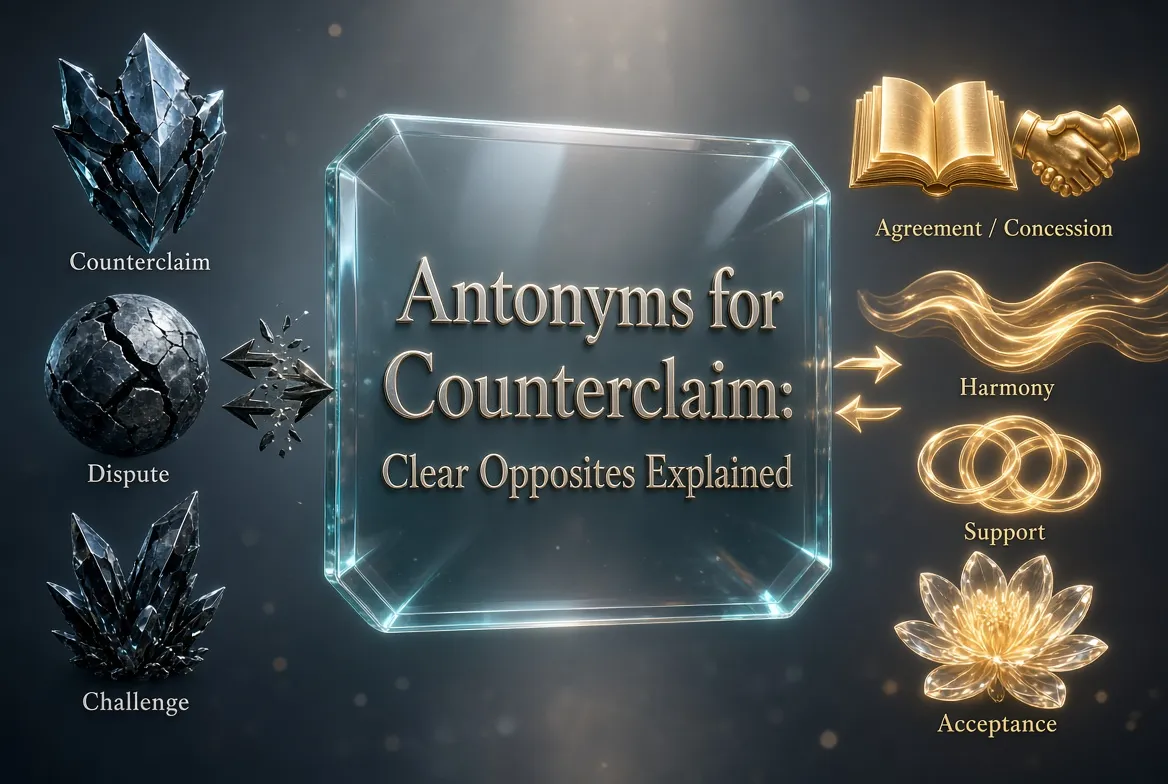
The strongest antonym for counterclaim is usually concession when counterclaim means a statement that challenges or opposes another claim. A concession accepts or acknowledges part of the opposing position. Depending on context, agreement, acceptance, support, or affirmation may also express the opposite idea.
Answer in Brief
A counterclaim is a claim made against or in response to another claim. Its opposite depends on what kind of contrast you need:
- Concession: accepts a point made by the opposing side.
- Agreement: expresses the same or a compatible position.
- Acceptance: acknowledges or accepts a claim.
- Support: argues in favor of a claim rather than against it.
- Affirmation: confirms or reinforces a statement or position.
For academic writing, concession is often the most useful contrasting term because it describes acknowledging an opposing point rather than presenting a competing claim.
Counterclaim vs. Its Opposite
| Word | Meaning | Example |
| Counterclaim | A claim that challenges or responds to another claim | The writer presented a counterclaim to the proposed policy. |
| Concession | An acknowledgment that accepts a point made by the opposing side | The essay made a concession before defending its main position. |
| Agreement | Acceptance of the same or a compatible position | Both researchers reached agreement on the main issue. |
| Support | Evidence or argument in favor of a claim | The new data provide support for the original claim. |
Meaning in Brief
Counterclaim: A claim or argument that challenges, opposes, or responds to another claim.
Main contextual opposite: Concession an acknowledgment that accepts or gives some ground to an opposing point instead of challenging it.
The exact opposite changes slightly with context because counterclaim describes a type of argumentative response rather than a simple quality such as hot/cold or large/small.
What You’ll Learn
After reading this guide, you will know:
- What counterclaim means
- Which words provide the clearest contrasting ideas
- Why concession is especially useful in argumentative writing
- How agreement, acceptance, and support differ from a counterclaim
- How to choose the right word for academic and everyday contexts
Useful Antonyms to Know
1. Concession
Concession is the clearest contextual opposite when a counterclaim challenges an opposing argument.
A concession acknowledges that another person or argument has a valid point, even if you ultimately disagree with the overall conclusion.
Example:
The writer made a concession that the opposing proposal could reduce costs.
Best context: argumentative essays, debates, academic writing, and persuasive writing.
2. Agreement
Agreement means having the same opinion or accepting that another position is correct or reasonable.
A counterclaim introduces opposition; agreement moves toward the same position.
Example:
The two researchers expressed agreement about the need for further study.
Best context: general discussion, academic writing, meetings, and debates.
3. Acceptance
Acceptance means receiving or acknowledging something as valid, true, or satisfactory.
It can contrast with a counterclaim when the counterclaim challenges the validity of an original claim.
Example:
The committee’s acceptance of the evidence strengthened the original argument.
Best context: formal writing, decisions, arguments, and evaluation of evidence.
4. Support
Support means providing reasons, evidence, or arguments that strengthen a claim.
This is particularly useful when contrasting an argument against a claim with an argument for it.
Example:
Several studies provide strong support for the original hypothesis.
Best context: academic writing, research, essays, reports, and debates.
5. Affirmation
Affirmation means a statement or action that confirms, reinforces, or supports something.
Where a counterclaim questions or challenges a position, an affirmation reinforces it.
Example:
The new findings served as an affirmation of the earlier conclusion.
Best context: formal and academic writing.
Choosing the Right Antonym
Counterclaim is primarily an argumentative term, so there is no single opposite that works in every sentence.
If the contrast is “challenge vs. acknowledge”
Use concession.
The author introduced a counterclaim but later made a concession about the opposing evidence.
If the contrast is “disagree vs. agree”
Use agreement.
The first paragraph presents a counterclaim, while the final paragraph shows agreement with the central principle.
If the contrast is “oppose vs. support”
Use support.
The evidence does not challenge the theory; instead, it provides support for it.
If the contrast is “challenge vs. confirm”
Use affirmation.
Rather than offering a counterclaim, the new evidence provides affirmation of the original conclusion.
How These Antonyms Differ
The words above are related, but they are not interchangeable in every context.
| Opposite | Main idea | Best use |
| Concession | Acknowledging an opposing point | Argument and essay writing |
| Agreement | Sharing or accepting a position | General and formal discussion |
| Acceptance | Treating something as valid or acceptable | Evaluation and decision-making |
| Support | Strengthening a claim | Evidence and argument |
| Affirmation | Confirming or reinforcing a position | Formal or academic contexts |
Concession vs. Agreement
A concession does not necessarily mean complete agreement.
For example:
The writer conceded that the policy was expensive but argued that it was necessary.
The writer accepts one point but still disagrees with the larger argument.
Agreement, by contrast, indicates that the speaker or writer shares the position.
Support vs. Affirmation
Support often refers to evidence or reasoning that strengthens an argument.
Affirmation emphasizes confirmation or reinforcement.
The survey provides support for the theory.
The new finding is an affirmation of the earlier conclusion.
See the Antonyms in Action
Here are natural examples showing the contrast:
- The author presented a counterclaim against the proposed solution.
- The author made a concession about one weakness in the opposing argument.
- The researchers reached agreement on the study’s main conclusion.
- The evidence provides strong support for the original claim.
- The results offer affirmation of the earlier findings.
- The committee showed acceptance of the evidence presented.
These examples show why the best antonym depends on the particular relationship between the two ideas.
What Part of Speech Is It?
Counterclaim is primarily a noun.
It can also function as a verb:
- Noun: The essay includes a counterclaim.
- Verb: The defendant counterclaimed against the plaintiff.
The most useful contrasting words in this article are mainly nouns:
- concession: noun
- agreement: noun
- acceptance: noun
- support: noun
- affirmation: noun
This makes them especially suitable when discussing argumentative structures, claims, and positions.
Commonly Confused Opposites
One common mistake is assuming that concession means complete agreement.
❌ Incorrect idea:
A concession always means that the writer completely agrees with the opposing argument.
✅ Correct idea:
A concession acknowledges a point without necessarily accepting the entire opposing position.
Another mistake is treating support as a direct dictionary-style antonym of counterclaim. It is better understood as a contextual opposite: a counterclaim challenges a position, while supporting evidence strengthens it.
Teacher’s Tip
When writing an argumentative essay, think of the relationship this way:
Claim → Counterclaim → Response
A counterclaim introduces an opposing position. A concession acknowledges part of that position. Your response can then explain why your original argument still stands.
This distinction helps you avoid using counterclaim and concession as if they were exact opposites in every situation.
Quick Practice
Choose the best word for each sentence.
1. The researcher presented evidence that gave strong ___ to the original hypothesis.
A. counterclaim
B. support
C. concession
Answer: B. support
Support strengthens the original hypothesis rather than challenging it.
2. The writer acknowledged that the opposing side had one valid point. This was a ___.
A. concession
B. counterclaim
C. contradiction
Answer: A. concession
A concession recognizes a valid point made by the opposing side.
Frequently Asked Questions
What is the opposite of counterclaim?
There is no single universal antonym. Concession is often the most useful contextual opposite in argumentative writing, while agreement, acceptance, support, and affirmation can work in other contexts.
Is concession a direct antonym of counterclaim?
Not exactly. They describe contrasting argumentative actions: a counterclaim presents a competing or opposing claim, while a concession acknowledges a point made by the opposing side.
What is the opposite of counterclaim in an essay?
Concession is often the best contextual contrast when discussing an essay’s treatment of an opposing argument. Support may be more appropriate when the contrast is between challenging and strengthening a claim.
Can agreement replace counterclaim?
No. Agreement does not normally replace counterclaim. A counterclaim is a specific argumentative claim, while agreement describes sharing or accepting a position.
Is support an antonym of counterclaim?
Support can function as a contextual opposite when the intended contrast is between challenging a claim and providing evidence or reasoning in its favor. It is not a universal lexical antonym.
What to Remember
Counterclaim refers to a claim that challenges or responds to another claim. Its most useful contextual contrasts are concession, agreement, acceptance, support, and affirmation.
For argumentative and academic writing, concession is especially important because it allows a writer to acknowledge an opposing point without abandoning the main argument.
Antonyms for Acceptance: 10 Opposites to Know

I’m Leo Jackson, an English writer with a soft spot for the peculiarities of language and vocabulary. Specializes in exploring the nuances of English synonyms, antonyms, helping students, writers, and professionals choose the right word with confidence. My guides combine careful research with clear, practical explanations.