The Opposite of Luxury at a Glance
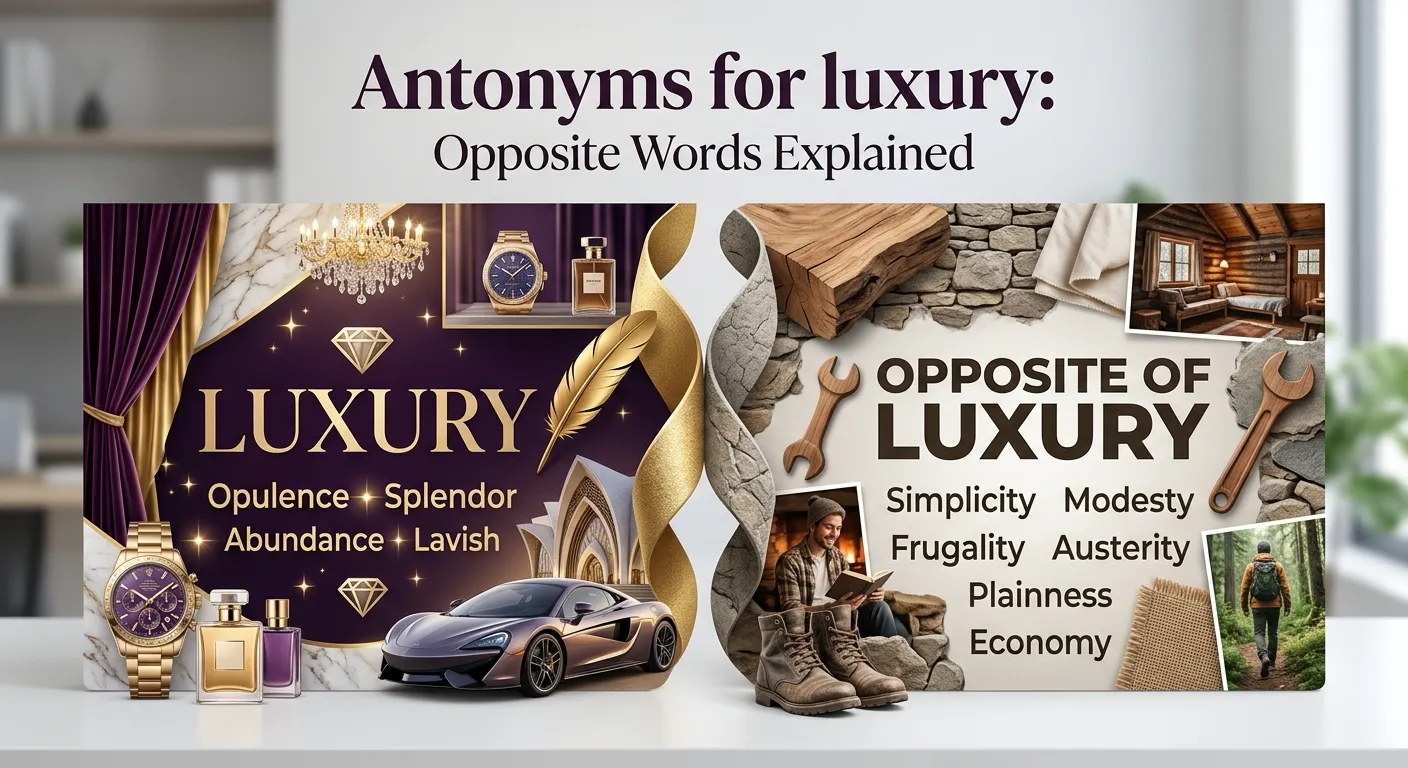
The most useful antonyms of luxury are necessity, simplicity, austerity, frugality, and basicness, depending on context. Luxury describes something highly comfortable, expensive, or nonessential, while these contrasting words emphasize essential needs, modest living, limited spending, or simple conditions.
The Short Answer
There is no single antonym that fits every use of luxury.
- Necessity: something essential rather than nonessential.
- Simplicity: a lack of unnecessary complexity, decoration, or extravagance.
- Austerity: a deliberately strict or plain way of living.
- Frugality: careful and economical use of money or resources.
- Basicness: a simple, essential level without extra comforts.
- Modesty: a restrained or unpretentious quality.
- Plainness: a lack of decoration or extravagance.
- Hardship: difficult living conditions involving a lack of comfort or resources.
For most everyday comparisons, necessity is the clearest opposite when luxury means something nonessential. Simplicity or austerity works better when the contrast is about lifestyle.
Luxury and Its Antonym
| Word | Meaning | Example |
| Luxury | Something expensive, highly comfortable, or nonessential | The hotel offers luxury accommodation. |
| Necessity | Something essential or required | Clean water is a necessity. |
| Simplicity | A plain, uncomplicated, or unadorned quality | She prefers simplicity in her home. |
| Austerity | A deliberately strict and limited lifestyle | The family adopted a period of austerity. |
| Frugality | Careful use of money and resources | His frugality helped him save mon |
Definition
Luxury: A condition, item, or experience that provides exceptional comfort, quality, or expense beyond what is necessary.
Main contextual antonym: Necessity something that is essential or required rather than optional or indulgent.
What You’ll Learn
After reading this guide, you will know:
- The main contextual antonyms of luxury
- Why necessity is not always the best opposite
- How simplicity, austerity, and frugality differ
- Which words work best for lifestyle, spending, and physical goods
- How to use these opposites naturally
Common Opposites of Luxury
1. Necessity
Necessity is the clearest opposite when luxury means something that is not essential.
A necessity is something needed for a particular purpose or basic well-being, while a luxury is something desirable but not essential.
Example:
For many households, a reliable refrigerator is a necessity rather than a luxury.
Best context: essential goods, basic needs, everyday life, and practical decisions.
2. Simplicity
Simplicity describes a lack of unnecessary decoration, complexity, or extravagance.
It contrasts with luxury when luxury refers to an elaborate or highly indulgent lifestyle.
Example:
She prefers the simplicity of a small home to the extravagance of a luxury apartment.
Best context: lifestyle, design, homes, fashion, and personal preferences.
3. Austerity
Austerity refers to a deliberately strict, restrained, or limited way of living or spending.
It provides a strong contrast with luxury because it emphasizes reducing unnecessary expenditure and comfort.
Example:
The company adopted an austerity program to reduce unnecessary spending.
Best context: economics, government, organizations, personal finance, and formal writing.
4. Frugality
Frugality means using money and resources carefully and avoiding unnecessary spending.
It contrasts with luxury when the focus is on spending habits rather than the physical quality of an object.
Example:
Her frugality allowed her to save enough money for emergencies.
Best context: personal finance, budgeting, spending, and resource management.
5. Basicness
Basicness refers to a simple or fundamental level without additional features, comforts, or extras.
It can contrast with luxury when discussing products, services, accommodation, or facilities.
Example:
The basicness of the room was acceptable because we only needed a place to sleep.
Best context: products, services, accommodation, and features.
Usage note: Basicness is grammatically valid but less common and less polished than phrases such as basic conditions, basic accommodation, or a basic option. It should not be treated as the universal opposite of luxury.
6. Modesty
Modesty can describe something restrained, moderate, or free from extravagance.
It contrasts with luxury when the focus is on an understated lifestyle or appearance.
Example:
Despite his success, he chose a lifestyle of modesty rather than luxury.
Best context: lifestyle, homes, possessions, behavior, and personal choices.
7. Plainness
Plainness means a lack of decoration, ornament, or elaborate features.
It can serve as a contextual opposite of luxury when describing appearance or design.
Example:
The plainness of the furniture gave the room a calm, practical feel.
Best context: clothing, furniture, architecture, design, and appearance.
8. Hardship
Hardship means a condition that causes difficulty, suffering, or a lack of normal comfort or resources.
It is a much stronger contrast than simplicity or frugality and should be used only when genuine difficulty is involved.
Example:
The family experienced financial hardship after losing its main source of income.
Best context: poverty, difficult circumstances, financial problems, and challenging living conditions.
Important: Hardship is not a direct lexical antonym of luxury in every sentence. It describes difficult circumstances rather than simply the absence of luxury.
Choosing the Right Antonym
The best opposite changes according to what luxury means in the sentence.
When luxury means “something nonessential”
Use necessity.
A private swimming pool is a luxury, while clean drinking water is a necessity.
Here, the contrast is between optional and essential.
When luxury means “extravagant living”
Use simplicity, modesty, or austerity.
He exchanged a life of luxury for a life of simplicity.
The contrast is between extravagance and plain or restrained living.
When luxury relates to spending
Use frugality.
Her lifestyle reflects frugality rather than luxury.
The contrast is between careful spending and lavish spending.
When luxury contrasts with difficult living conditions
Use hardship.
The workers moved from conditions of hardship to a more comfortable standard of living.
Here, the contrast is about comfort and resources, not simply spending.
How These Antonyms Differ
These words are related but should not be used interchangeably.
Necessity vs. Simplicity
Necessity concerns whether something is needed.
Simplicity concerns whether something is plain or uncomplicated.
A simple item can still be unnecessary, and a necessary item can be expensive.
A basic phone may be simple, but a phone can still be a necessity.
Simplicity vs. Austerity
Simplicity can be a personal preference and does not necessarily involve hardship or severe financial restriction.
Austerity usually suggests deliberate limitation, especially in spending or resources.
She chose simplicity in her home.
The organization introduced austerity measures to cut costs.
Austerity vs. Frugality
Frugality usually describes careful personal use of money or resources.
Austerity is stronger and often suggests systematic or deliberate restrictions.
His frugality helped him build savings.
The government introduced austerity measures.
Frugality vs. Poverty
These concepts should not be confused.
Frugality is a way of managing resources carefully.
Poverty is a condition of having insufficient resources to meet basic needs.
A wealthy person can be frugal, while a person experiencing poverty may have little choice about spending.
Examples in Context
Here are natural examples showing the different contrasts:
- For some people, air conditioning is a necessity; for others, an upgraded system may be a luxury.
- The designer replaced luxury with simplicity in the new collection.
- The household adopted frugality after its expenses increased.
- The company introduced austerity measures during the financial downturn.
- The hotel offers both basic accommodation and luxury suites.
- She prefers modesty to extravagance when choosing furniture.
- The plainness of the design makes the product affordable.
- Many families experience financial hardship without access to basic necessities.
What Part of Speech Is It?
Luxury is primarily a noun.
It can refer to:
- an expensive or highly comfortable thing — a luxury car
- a nonessential advantage or pleasure — free time is a luxury for some workers
- a state of great comfort — They lived in luxury.
The main contextual antonyms are also mostly nouns:
- necessity: noun
- simplicity: noun
- austerity: noun
- frugality: noun
- basicness: noun
- modesty: noun
- plainness: noun
- hardship: noun
The adjective luxurious is related to luxury.
They stayed at a luxurious resort.
Its contextual opposites can include simple, basic, modest, plain, or austere, depending on the intended meaning.
A Useful Language Tip
Do not automatically replace luxury with necessity.
The two words form a strong contrast only when the sentence is about whether something is essential or nonessential.
If the sentence is about an extravagant lifestyle, simplicity or austerity may communicate the intended contrast much more naturally.
Common Errors to Avoid
Using poverty as the universal antonym
❌ The antonym of luxury is always poverty.
✅ Poverty can contrast with luxury when the focus is on living conditions or lack of resources.
Poverty describes an economic condition, not simply the absence of expensive or comfortable things.
Treating frugality as deprivation
❌ Frugality means having no money.
✅ Frugality means being careful and economical with money or resources.
A frugal person may have substantial financial resources.
Using austerity for every simple lifestyle
❌ Her simple bedroom proves that she lives in austerity.
✅ Her simple bedroom reflects her preference for simplicity.
Austerity usually implies stronger restriction or deliberate reduction.
Teacher’s Tip
Think of luxury on two different scales:
Need:
necessity ↔ luxury
Lifestyle:
austerity / simplicity ↔ luxury
This simple distinction helps you select a natural antonym instead of using the same word in every context.
Quick Antonym Quiz
1. Which word is the best opposite of luxury when discussing something essential?
A. Necessity
B. Extravagance
C. Comfort
Answer: A. Necessity
A necessity is something essential, while a luxury is generally nonessential.
2. Which word best contrasts with luxury when discussing careful spending?
A. Frugality
B. Hardship
C. Plainness
Answer: A. Frugality
Frugality means using money and resources carefully.
3. Which word best describes deliberate restrictions on spending?
A. Simplicity
B. Austerity
C. Luxury
Answer: B. Austerity
Austerity involves deliberate restraint or reduced spending.
Frequently Asked Questions
What is the opposite of luxury?
The most useful opposite depends on context. Necessity is the clearest opposite when luxury means something nonessential, while simplicity, austerity, and frugality work better for lifestyle and spending contexts.
What is the strongest antonym of luxury?
There is no single strongest antonym for every meaning of luxury. Necessity gives the clearest contrast with nonessential goods, while austerity gives a stronger contrast with an extravagant lifestyle.
Is poverty an antonym of luxury?
Poverty can contrast with luxury when discussing economic conditions, but it is not a universal antonym. Poverty describes insufficient resources, whereas luxury describes exceptional comfort, expense, or nonessential abundance.
Is simplicity the opposite of luxury?
Simplicity can be a contextual opposite of luxury when luxury refers to extravagance, elaborate design, or an indulgent lifestyle. It does not mean the same thing as poverty or deprivation.
What is the difference between luxury and necessity?
A luxury is generally desirable but not essential, while a necessity is something needed for a particular purpose or basic well-being.
In Summary
Luxury has several useful contextual antonyms rather than one universal opposite. Necessity is the clearest choice when the contrast is between essential and nonessential. Simplicity, austerity, and frugality are better for lifestyle and spending, while hardship describes a much more difficult living condition.
Antonyms for Setting: Opposites by Context

Hi, I’m Amna Akhtar. I write about word their meanings, opposites, and the small distinctions that make English tricky. I don’t come at language purely from instinct, either. I have a peer-reviewed academic paper “Determinants of Jobs Satisfaction of Female Teachers: An Evidence from District Hafizabad, Pakistan,” published in education economics, and that research background shapes how I think about language content, I want it to actually help people learn, not just look correct on a page. Whether you’re a student, a writer, or just someone who wants to use the right word at the right moment, my goal is to make that easier for you.