The Opposite of Antagonist at a Glance
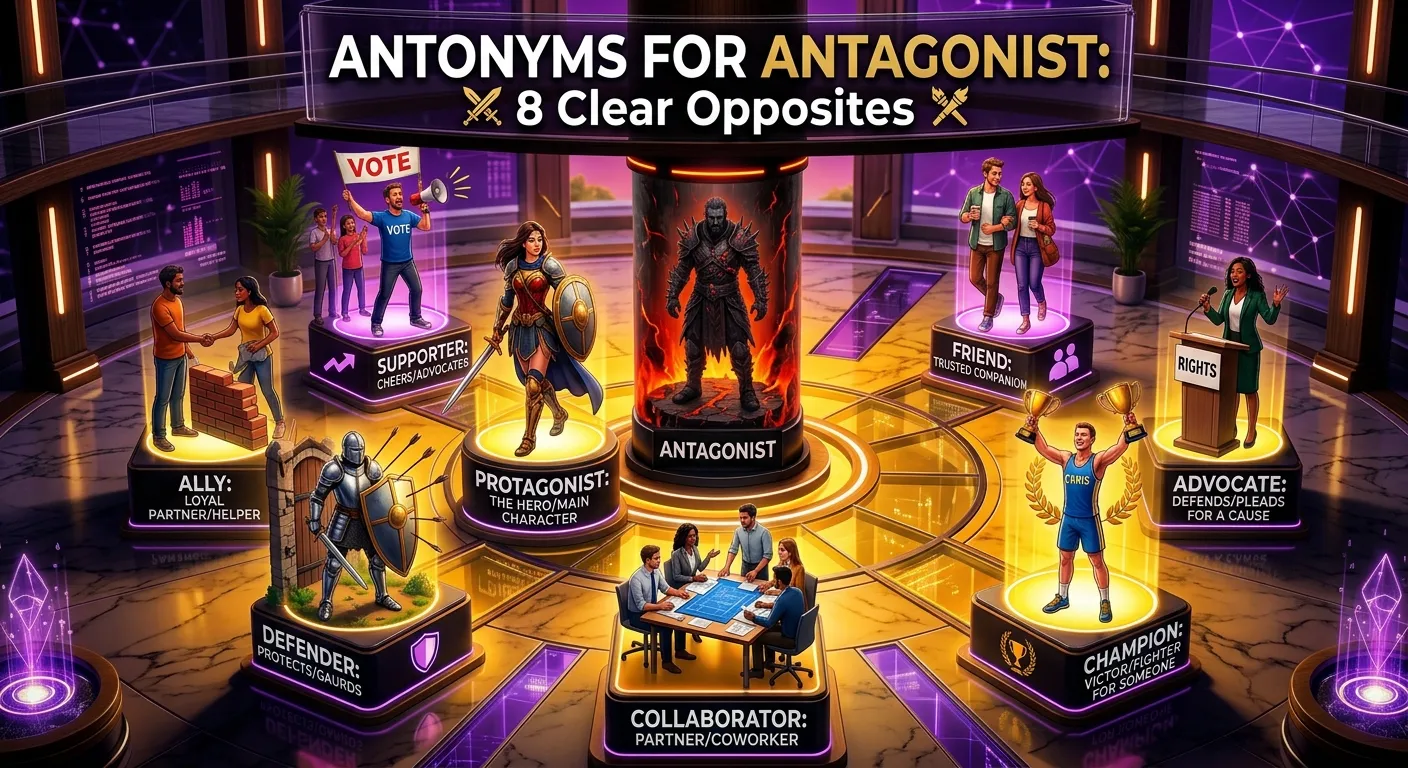
The most common antonym of antagonist is protagonist, especially in literature, film, and storytelling. A protagonist is the central character, while an antagonist opposes that character. In broader contexts, ally, supporter, friend, and helper can describe someone who works with rather than against another person.
Answer in Brief
Protagonist is the clearest opposite of antagonist when discussing stories.
- Protagonist: the central character whose goals drive the story.
- Ally: a person who supports or cooperates with someone.
- Supporter: someone who favors or backs another person or cause.
- Friend: someone who has a friendly relationship rather than an opposing one.
- Helper: someone who assists another person.
The right antonym depends on context. Protagonist is the natural literary contrast, while ally and supporter work better when antagonist refers to a person who actively opposes someone.
Antagonist vs. Its Opposite
| Word | Meaning | Example |
| Antagonist | A person or character who opposes another | The antagonist tries to stop the hero. |
| Protagonist | The central character in a story | The protagonist searches for the missing child. |
| Ally | Someone who supports or cooperates with another | The hero gains an ally during the journey. |
| Supporter | Someone who backs a person, idea, or cause | She became a strong supporter of the campaign. |
Meaning in Brief
Antagonist: A person, character, or force that opposes another person, character, or force.
Main antonym: Protagonist the central character in a story, especially the character whose goals and experiences drive the plot.
The relationship is clearest in fiction:
Protagonist → central character
Antagonist → opposing character or force
However, antagonist does not always mean “villain,” and protagonist does not necessarily mean “good person.” These words primarily describe roles in a conflict or story, not moral character.
What You’ll Learn
After reading this guide, you will know:
- The main antonym of antagonist
- How protagonist and antagonist differ
- Which contextual opposites work outside literature
- Why antagonist does not always mean villain
- How to use these words naturally in sentences
Common Opposites of Antagonist
1. Protagonist
Protagonist is the strongest and most established antonym of antagonist in literature, drama, film, and storytelling.
The protagonist is the central character around whom the main action or conflict develops. The antagonist is the character or force that opposes the protagonist.
Example:
The protagonist must overcome the antagonist before reaching her goal.
Best context: novels, films, plays, short stories, and other narratives.
Important: A protagonist is not necessarily morally good, and an antagonist is not necessarily evil. The terms describe their roles in the story.
2. Ally
An ally is someone who supports, assists, or cooperates with another person or group.
This makes ally a useful contextual opposite when antagonist means someone who actively opposes another person.
Example:
The detective found an unexpected ally inside the organization.
Best context: relationships, conflicts, politics, organizations, teamwork, and fiction.
Unlike protagonist, ally is not specifically a storytelling term.
3. Supporter
A supporter is someone who backs a person, group, idea, or cause.
It contrasts with an antagonist when the antagonist actively works against that person or cause.
Example:
The candidate thanked her supporters after the event.
Best context: causes, teams, organizations, public discussions, and general relationships.
4. Friend
A friend is someone with whom a person has a friendly and supportive relationship.
It can serve as a contextual opposite of antagonist when the contrast is between someone who opposes a person and someone who maintains a friendly relationship with them.
Example:
The character’s best friend helps her when the antagonist appears.
Best context: everyday relationships and fiction.
5. Helper
A helper is someone who assists another person.
It contrasts with an antagonist when the important difference is working against someone versus helping them.
Example:
The protagonist’s helper provides the information needed to solve the mystery.
Best context: everyday language, storytelling, teamwork, and informal contexts.
6. Collaborator
A collaborator is someone who works jointly with another person toward a shared goal.
This provides a useful contextual contrast when an antagonist creates opposition while a collaborator works cooperatively.
Example:
The scientist found a collaborator who shared her research goals.
Best context: work, research, education, creative projects, and organizations.
7. Partner
A partner is a person who works or acts together with another person.
It can contrast with antagonist when the relationship involves cooperation rather than opposition.
Example:
The detective’s partner helped uncover the evidence.
Best context: work, business, relationships, teamwork, and fiction.
8. Advocate
An advocate is someone who publicly supports a person, idea, or cause.
It can function as a contextual opposite of antagonist when the antagonist opposes something that the advocate supports.
Example:
She became an advocate for the new educational program.
Best context: causes, public discussion, policy, education, and formal writing.
Different Meanings, Different Opposites
The best antonym changes depending on how antagonist is being used.
When antagonist means an opposing character
Use protagonist.
The protagonist confronts the antagonist in the final scene.
This is the standard literary contrast.
When antagonist means a person who opposes someone
Use ally, supporter, or friend, depending on the relationship.
Instead of becoming an antagonist, he became an ally.
When antagonist means an opposing force
Words such as supporting force, ally, or cooperating force may express the contextual contrast, although there is no single fixed antonym.
For example, in a story, the antagonist may be a natural force, institution, or social pressure rather than a person.
How These Antonyms Differ
The most important distinction is between protagonist and the broader relationship words.
Protagonist vs. Ally
A protagonist is a narrative role.
An ally is a relationship role.
A protagonist can have several allies, and an ally can support the protagonist without being the story’s central character.
The protagonist worked with an ally to defeat the antagonist.
Ally vs. Supporter
An ally usually suggests cooperation or a shared interest.
A supporter simply backs someone or something and does not necessarily work closely with them.
The organization gained thousands of supporters.
The two groups became allies and worked together.
Antagonist vs. Villain
These words are often treated as synonyms, but they are not exact equivalents.
An antagonist is a character or force that opposes the protagonist.
A villain is a character presented as wicked or morally bad.
An antagonist can have understandable motives, and a villain may not always be the main opposing force.
See the Antonyms in Action
Here are natural examples:
- The protagonist discovers that the antagonist has been following her.
- The hero finds an unexpected ally in a former enemy.
- Thousands of supporters attended the team’s celebration.
- Her friend encourages her to continue the difficult journey.
- A helpful collaborator joins the research project.
- The detective works closely with his partner.
- The organization gains an advocate for its educational program.
- The protagonist relies on a helper to escape the antagonist.
These examples show that protagonist is the direct literary contrast, while the other words express different forms of support or cooperation.
What Part of Speech Is It?
Antagonist is primarily a noun.
The main antonym, protagonist, is also a noun.
Other contextual opposites are nouns as well:
- antagonist: noun
- protagonist: noun
- ally: noun
- supporter: noun
- friend: noun
- helper: noun
- collaborator: noun
- partner: noun
- advocate: noun
The adjective antagonistic is related to antagonist but should not be confused with the noun.
The two groups had an antagonistic relationship.
Here, antagonistic means hostile or opposed.
Antagonist and Protagonist: A Useful Distinction
Although the two words look similar, their meanings are based on different roles.
Protagonist comes from Greek roots associated with the leading or principal actor.
Antagonist refers to someone or something acting against or opposing another.
In modern storytelling, these terms describe the central relationship between the main character and the opposing character or force.
The protagonist does not have to be heroic, and the antagonist does not have to be villainous.
Commonly Confused Opposites
Mistake 1: Treating protagonist as “good person”
❌ The protagonist is always the hero.
✅ The protagonist is the central character in the story.
A protagonist can be morally complicated or even deeply flawed.
Mistake 2: Treating antagonist as “evil person”
❌ Every antagonist is a villain.
✅ An antagonist is a character or force that opposes the protagonist.
The antagonist may have understandable goals or motives.
Mistake 3: Using protagonist as the opposite in every context
❌ My protagonist at work helped me finish the project.
✅ My colleague or ally helped me finish the project.
Protagonist is mainly a literary and narrative term. For ordinary relationships, ally, supporter, partner, or friend may be more natural.
Teacher’s Tip
Remember the simplest storytelling pair:
Protagonist = central character
Antagonist = opposing character or force
Then ask one extra question: “Am I talking about a story or a real-world relationship?”
If it is a story, protagonist is usually the answer. If it is a real-world relationship, words such as ally or supporter may be more appropriate.
Quick Antonym Quiz
1. In a novel, which word is the clearest opposite of antagonist?
A. Supporter
B. Protagonist
C. Helper
Answer: B. Protagonist
A protagonist is the central character who is typically opposed by the antagonist.
2. Which word best describes someone who works with you rather than against you?
A. Antagonist
B. Ally
C. Villain
Answer: B. Ally
An ally supports or cooperates with you.
3. Is a protagonist always a morally good character?
A. Yes
B. No
Answer: B. No
Protagonist describes a central narrative role, not a person’s moral character.
Frequently Asked Questions
What is the opposite of antagonist?
The most common antonym of antagonist is protagonist, particularly in literature, film, and storytelling. In broader contexts, ally, supporter, or friend may express the opposite relationship.
Is protagonist a direct antonym of antagonist?
Yes, in the context of storytelling, protagonist and antagonist are established contrasting terms. The protagonist is the central character, while the antagonist opposes that character.
Is villain the same as antagonist?
No. A villain is a morally bad or wicked character, while an antagonist is a character or force that opposes the protagonist. An antagonist can have motives that are not simply evil.
What is the opposite of antagonist in real life?
There is no single universal opposite in everyday use. Ally, supporter, friend, or partner may be appropriate depending on the relationship being described.
Can protagonist always replace antagonist?
No. Protagonist is mainly a storytelling term for a central character. It should not normally be used as the opposite of antagonist when discussing ordinary real-world relationships.
What to Remember
Protagonist is the clearest antonym of antagonist in literature and storytelling. For broader contexts, ally, supporter, friend, partner, and collaborator can express relationships based on cooperation rather than opposition.
The key lesson is that antagonist does not automatically mean villain, and protagonist does not automatically mean hero. These words primarily describe roles in a conflict or narrative.
Antonyms for Kind Person: 10 Opposite Words

I am Clara Stephen, passionate about making English simple and easy to understand through clear synonym, antonyms, word comparisons, vocabulary guides, and language tips. Through thoughtful, reliable content, I aim to be a trusted guide for anyone looking to expand their English vocabulary.