Quick Answer
No: artillery has no true antonym. The word names a category, not a quality: large-calibre guns and missile launchers, too big for one soldier to carry and operated by crews: and, by extension, the army branch that operates them. Categories do not reverse. There is no word meaning “the opposite kind of weapon”, just as there is no antonym for furniture or vehicle.
What artillery does have is three honest kinds of contrast, each labelled for what it is:
- A neighbouring category: small arms: individual weapons, at the small end of the same size scale.
- Sister branches: infantry and armour: other arms in the same classification, not opposites.
- An absence: unarmed and disarmament: having no weapons at all, or removing them.
Quick Comparison
| Contrast | Kind of contrast | Example |
|---|---|---|
| Small arms | Category contrast: individual weapons against crew-served heavy weapons | The museum displays rifles and pistols among the small arms, and a field gun among the artillery. |
| Infantry; armour | Classification contrast: sister branches of the same army | The army’s history covers its infantry battalions, its armoured regiments and its artillery batteries alike. |
| Unarmed; disarmament | Absence: no weapons at all, or their removal | The inspection team travelled unarmed, and the treaty provided for disarmament. |
What Artillery Is
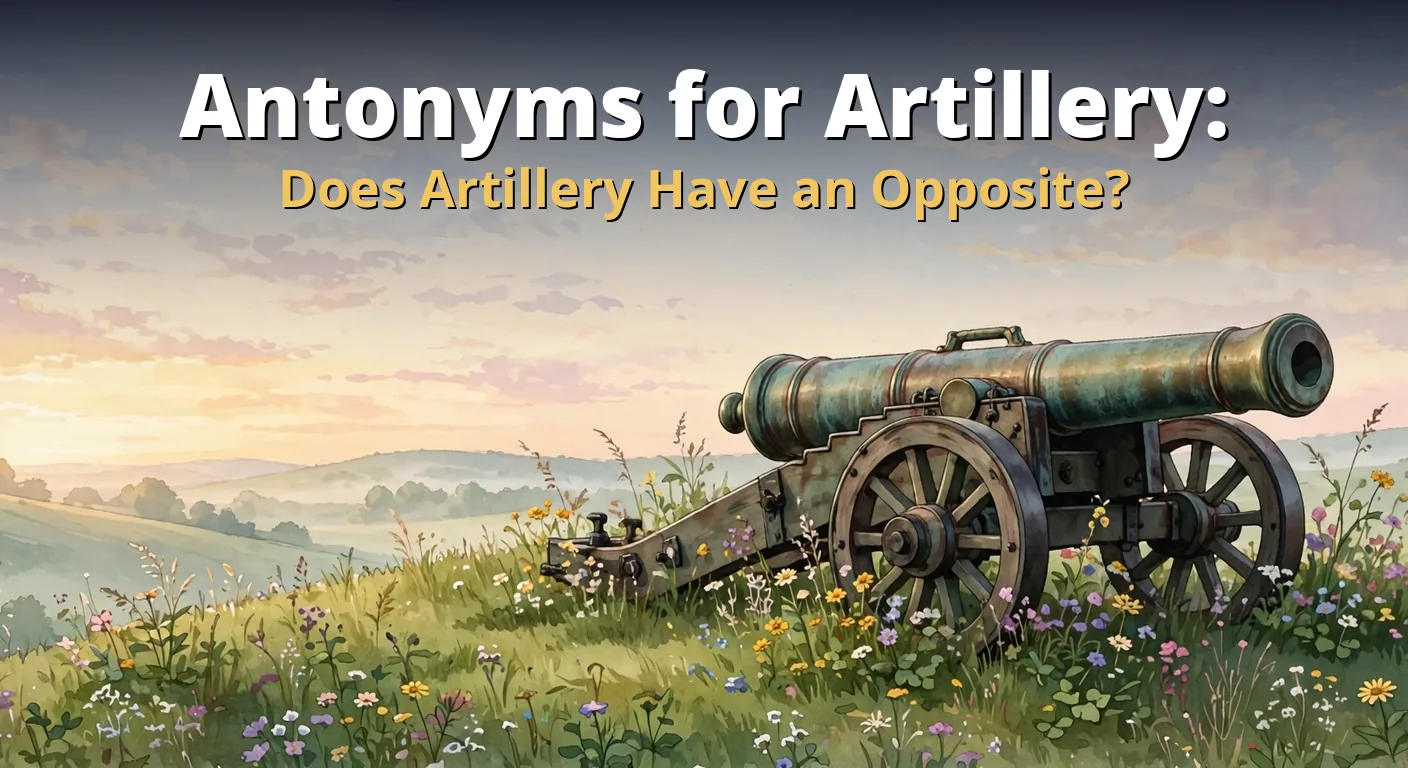
Artillery has two connected senses. The first is the weapons themselves: a collective name for large-calibre guns: cannon, howitzers and mortars: together with missile and rocket launchers. These are heavy pieces of equipment, served by a crew rather than carried and used by a single soldier, and they fire shells or projectiles over long distances. Artillery in this sense is a collective noun: you speak of “the artillery” or of individual “pieces of artillery”.
The second sense is the branch of an army responsible for those weapons: the artillery arm, such as the Royal Artillery in the British Army. A class of equipment, or one branch in an organisation, can have neighbours in the same scheme: which is exactly what the contrasts below are.
The Genuine Contrasts
1. Small arms: the neighbouring category
Military and arms-control vocabulary divides weapons by size and by how they are served. At one end stand small arms: weapons designed for use by one person, such as rifles, pistols and light machine guns. (The companion term light weapons covers somewhat larger portable systems.) At the other end stands artillery: heavy, crew-served ordnance.
This is a real and standard contrast: usually the one searchers are looking for: but it is a contrast within one category system. A rifle is not the “opposite” of a howitzer; both are weapons, and small arms is artillery’s neighbour on the scale, not its reverse.
2. Infantry and armour: sister branches
In an army’s organisation, artillery is one arm among several. Infantry are the soldiers who fight on foot. Armour is the arm whose units operate tanks and other armoured fighting vehicles. Artillery stands beside them as the arm of the big guns and launchers.
These words are alternatives in a classification: parts of one whole, like chapters in a single book. That is why word lists and strategy games so often pair artillery with infantry: they are sorting units by branch. A classification pairing is useful vocabulary, but it is not an antonym pair.
3. Unarmed and disarmament: the absence of weapons
If the intended contrast is “weapons against no weapons at all”, English expresses it differently: with the adjective unarmed: having no weapons, said of people, vehicles or ships: and with the policy noun disarmament, the removal or reduction of weapons. A related policy term, demilitarisation, means removing military forces and equipment from an area.
Label this honestly: these words name an absence or an ending, not a reversed category. Unarmed removes artillery along with every other weapon; it does not pick out any special opposite of artillery.
How the Arms Are Classified
Much of the confusion around this word comes from the classification itself. Land forces are traditionally organised into arms, each with its own job:
- Artillery: operates the large-calibre guns and missile launchers.
- Infantry: soldiers who fight on foot.
- Armour: units operating tanks and other armoured vehicles.
- Engineers: the military engineering arm: building, demolition, bridges and obstacles.
- Signals: provides the army’s communications: radio and networks.
Real armies arrange these arms in different ways and add many supporting services: medical, logistics and others. The point for vocabulary is simple: these are boxes in one classification. Words in different boxes are neighbours, not opposites.
Words That Are Not Antonyms
- Peace: this opposes war, not a class of weapon. Artillery can fall silent in peacetime, but the word itself names equipment, not conflict.
- Peaceful means and nonviolence: these describe methods of settling disputes without force. They contrast with the use of weapons, in any category, not with artillery as a word.
- Light artillery: still artillery. “Light” marks a sub-category within the class; it no more reverses the word than “light furniture” reverses furniture.
- Non-artillery: not a standard English word, just a makeshift label meaning “everything else”.
Example Sentences
- The museum gallery traces artillery from bronze cannon to modern rocket launchers.
- In the army’s classification, artillery, infantry and armour are separate arms.
- Small arms are issued to individual soldiers; artillery is served by crews.
- The observers travelled unarmed throughout the inspection.
- Under the treaty, heavy artillery was withdrawn from the border region.
Common Mistakes
Mistake 1: Calling infantry the antonym of artillery
Infantry and artillery are two arms of the same army: soldiers on foot beside the crews of the big guns. Listing one as the other’s antonym confuses a classification with an opposition.
Mistake 2: Presenting policies as antonyms
Disarmament and demilitarisation are decisions and processes: things governments do. They can express the absence of artillery, but a policy cannot be the opposite of a piece of equipment, any more than “recycling” is the antonym of plastic.
Mistake 3: Assuming every noun has an opposite
Many concrete category nouns: artillery, furniture, machinery: simply have none. Forcing a word into the antonym slot produces the familiar padded lists this page is written to replace.
Mini Quiz
1. Which term names a neighbouring weapon category, not an opposite?
A. Small arms
B. Unarmed
C. Peace
Answer: A. Small arms are individual weapons: the small end of the same scale as crew-served artillery.
2. In an army’s organisation, artillery, infantry and armour are…
A. Antonyms of each other
B. Synonyms for soldiers
C. Separate arms within one classification
Answer: C. They are sister branches: different parts of one whole, not opposites.
3. Does artillery have a standard dictionary antonym?
A. Yes: infantry
B. No: it names a category, and categories do not reverse
C. Yes: peace
Answer: B. Infantry is a sister branch, and peace opposes war. Neither reverses the word artillery.
Short Q&A
Q: What is the antonym of artillery?
A: Strictly, there isn’t one. Artillery names a category of heavy, crew-served weapons (and the branch that operates them). The genuine contrasts are small arms (a smaller weapon category), infantry and armour (sister branches), and unarmed / disarmament (the absence of weapons).
Q: Is “small arms” the opposite of artillery?
A: It is the standard contrasting category: individual weapons against crew-served heavy ordnance: and usually the word searchers actually need. But it is a neighbour on the size scale, not a true antonym.
Q: Is infantry the opposite of artillery?
A: No. Infantry (soldiers on foot) and artillery (the gun arm) are two branches of the same army. They are paired in classifications and games because they belong to the same scheme, not because their meanings oppose each other.
Q: What word means having no weapons at all?
A: Unarmed. The process of removing weapons is disarmament: the absence contrast, covering artillery and every other weapon together.
Q: Why do word lists pair artillery with infantry so often?
A: Because both belong to the short list of an army’s traditional arms: artillery, infantry, armour, engineers, signals. Lists borrow the classification and mislabel it as opposites; the pairing is real, the “antonym” label is not.
Key Takeaways
- Artillery has no true dictionary antonym: it names a category: large-calibre, crew-served guns and launchers, and the branch that operates them: and categories do not reverse.
- The closest category contrast is small arms: individual weapons at the small end of the same scale.
- Infantry and armour are sister branches in the same classification: neighbours, never opposites.
- The absence of weapons is expressed by unarmed and disarmament; peace, nonviolence and peaceful means belong to a different discussion, about how disputes are settled.

I’m Leo Jackson, an English writer with a soft spot for the peculiarities of language and vocabulary. He specializes in exploring the nuances of English synonyms, antonyms, helping students, writers, and professionals choose the right word with confidence. My guides combine careful research with clear, practical explanations.