The Opposite of Monotonous at a Glance
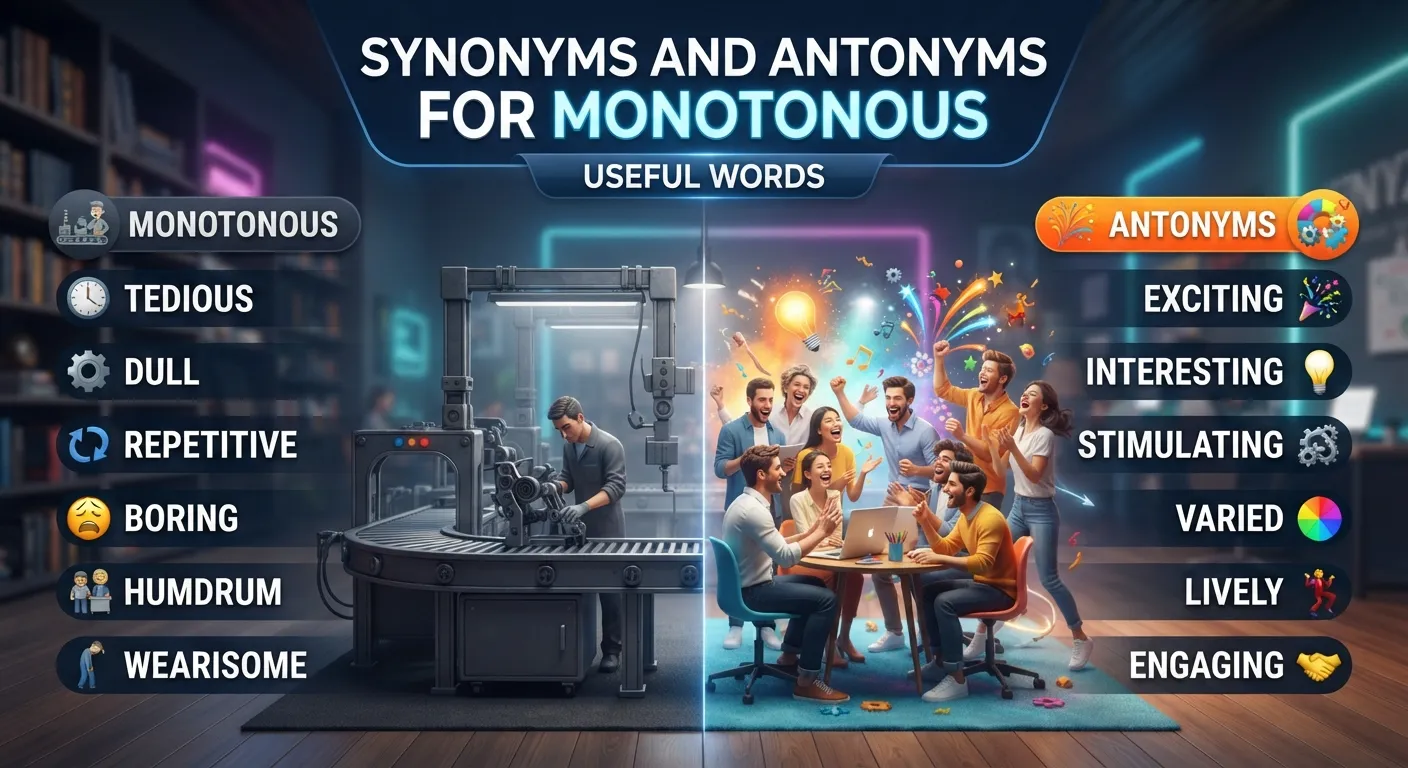
The most common antonym of monotonous is varied, meaning having enough differences or changes to avoid repetition. Other strong opposites include interesting, stimulating, lively, engaging, and diverse. The best choice depends on whether you are describing an activity, conversation, routine, voice, or experience.
Answer in Brief
Monotonous describes something that is repetitive, unchanging, and often dull because it lacks variety.
Its strongest opposites include:
- Varied: containing different things or experiences rather than repeating the same pattern.
- Interesting: holding attention because it is engaging or unusual.
- Stimulating: encouraging interest, thought, or mental activity.
- Engaging: keeping someone’s attention or involvement.
- Lively: energetic, active, or full of interest.
- Diverse: showing considerable variety.
For synonyms, words such as repetitive, tedious, boring, dull, routine, unvarying, and humdrum are useful, but they differ slightly in tone and meaning.
Monotonous and Its Opposite
| Word | Meaning | Example |
|---|---|---|
| Monotonous | Repetitive and lacking variety | The monotonous routine became tiring. |
| Varied | Including different types or experiences | The course offers a varied range of activities. |
| Stimulating | Encouraging interest or thought | The discussion was stimulating and informative. |
| Lively | Energetic and interesting | The meeting became lively after the discussion began. |
Definition
Monotonous: Repetitive and unchanging in a way that can become boring.
Main antonym: Varied: containing different elements, activities, or experiences instead of repeating the same thing.
What You’ll Learn
After reading this guide, you will know:
- The main synonyms of monotonous
- The most useful antonyms of monotonous
- How synonyms differ in strength and tone
- Which opposite fits different contexts
- How to use these words naturally in sentences
Common Opposites of Monotonous
Not every antonym of monotonous has exactly the same meaning. Some oppose its lack of variety, while others oppose its boring or uninteresting quality.
1. Varied
Meaning: Containing different types, activities, or experiences.
Example:
Her work is varied, so she rarely feels stuck doing the same task.
Why it works: Varied is the most direct opposite when monotonous means repetitive or lacking variety.
2. Interesting
Meaning: Able to attract or hold attention.
Example:
The teacher turned a potentially monotonous lesson into an interesting discussion.
Best for: Things that are engaging rather than boring.
3. Stimulating
Meaning: Encouraging interest, thought, or mental activity.
Example:
The students had a stimulating conversation about climate change.
Best for: Discussions, classes, books, ideas, and experiences that make you think.
4. Engaging
Meaning: Interesting enough to keep someone’s attention or involvement.
Example:
The speaker gave an engaging presentation.
Best for: Presentations, stories, lessons, conversations, and activities.
5. Lively
Meaning: Full of energy, activity, or excitement.
Example:
What started as a monotonous meeting became lively after the team began sharing ideas.
Best for: Conversations, meetings, events, environments, and social situations.
6. Diverse
Meaning: Including many different kinds of people, things, or experiences.
Example:
The museum has a diverse collection of artwork.
Best for: Collections, groups, experiences, cultures, and subjects.
7. Dynamic
Meaning: Characterized by continuous change, activity, or development.
Example:
She works in a dynamic environment where every day brings new challenges.
Best for: Workplaces, situations, industries, teams, and changing environments.
8. Exciting
Meaning: Causing enthusiasm or strong interest.
Example:
The new project gave the team an exciting challenge.
Best for: Events, experiences, opportunities, activities, and developments.
Choosing the Right Antonym
The best opposite depends on what aspect of monotonous you want to contrast.
| If monotonous means… | Try these opposites |
|---|---|
| Repetitive | Varied, diverse, dynamic |
| Boring | Interesting, engaging, exciting |
| Lacking mental stimulation | Stimulating, thought-provoking |
| Lacking energy | Lively, energetic, vibrant |
| Unchanging | Dynamic, changing, varied |
For example, varied is better than exciting when you are talking about a work schedule:
The job has a varied schedule.
You would normally use exciting when emphasizing enthusiasm:
The new assignment was exciting.
So, although both can contrast with monotonous in some contexts, they do not mean the same thing.
Useful Synonyms to Know
Here are the most natural synonyms for monotonous:
| Synonym | Meaning | Example |
|---|---|---|
| Repetitive | Happening again and again | The repetitive task took several hours. |
| Tedious | Long, boring, and tiring | Filing hundreds of documents was tedious. |
| Boring | Not interesting or enjoyable | The lecture became boring after an hour. |
| Dull | Lacking excitement or interest | It was a dull afternoon. |
| Routine | Done regularly in the same way | He became tired of his routine duties. |
| Unvarying | Remaining the same without change | The landscape was unvarying for miles. |
| Humdrum | Ordinary, predictable, and lacking excitement | She wanted a break from her humdrum routine. |
| Tedious | Requiring prolonged effort and causing boredom | The tedious process tested everyone’s patience. |
Synonyms Are Not Always Interchangeable
Repetitive focuses on repetition.
The work is repetitive because I perform the same action all day.
Tedious focuses on something being boring and tiring.
Completing the paperwork was tedious.
Dull focuses on a lack of interest or excitement.
The presentation was dull.
Humdrum suggests an ordinary, predictable lifestyle or routine.
He was tired of his humdrum existence.
This distinction matters because monotonous often combines the ideas of repetition and boredom, while its synonyms may emphasize only one of them.
How These Antonyms Differ
Some opposites are close in meaning but have different uses.
Varied vs. Diverse
Both words express variety, but varied is especially natural for activities, routines, content, or experiences.
The teacher uses varied activities in class.
Diverse often emphasizes different types, groups, backgrounds, or categories.
The university has a diverse student population.
Interesting vs. Stimulating
Interesting simply means something attracts your attention.
It was an interesting article.
Stimulating suggests that something actively encourages thought, discussion, or mental engagement.
It was a stimulating article about artificial intelligence.
Lively vs. Dynamic
Lively usually describes energy or activity.
We had a lively debate.
Dynamic emphasizes change, movement, or continuous development.
The company operates in a dynamic market.
Engaging vs. Exciting
Engaging means something successfully holds your attention.
The book was engaging.
Exciting suggests enthusiasm, anticipation, or strong emotional interest.
The final match was exciting.
Examples in Context
Work
The job became monotonous because she performed the same task every day.
His new position is more varied, with different responsibilities each week.
School
Students may lose concentration during a monotonous lecture.
An engaging lesson encourages students to participate.
Conversation
Their conversation became monotonous because they kept discussing the same topic.
The discussion was lively and covered several interesting subjects.
Daily Routine
Working the same hours and following the same routine made his life feel monotonous.
She created a more varied routine by trying different activities.
Sound or Voice
The speaker’s monotonous voice made it difficult to maintain attention.
The narrator used a lively and expressive voice.
Writing
The article became monotonous because every paragraph followed the same pattern.
The revised article uses varied sentence structures.
Grammar and Word Forms
Monotonous is an adjective.
It commonly appears before a noun:
a monotonous routine
a monotonous voice
a monotonous job
a monotonous lifestyle
It can also follow a linking verb:
The work became monotonous.
Its common adverbial form is monotonously:
The machine ran monotonously throughout the night.
Useful antonyms are also mainly adjectives:
- varied
- interesting
- stimulating
- engaging
- lively
- diverse
- dynamic
- exciting
A Useful Language Tip
Monotonous does not always mean simply “boring.” It often suggests that repetition or a lack of variation is the reason something feels boring.
Compare:
The movie was boring.
This tells us the movie failed to interest the viewer.
The movie was monotonous.
This suggests that the movie felt repetitive, uniform, or lacking variation.
That distinction can help you choose a more precise word.
Commonly Confused Opposites
“Interesting” is not always the direct opposite
If the problem is repetition, varied is usually more precise.
❌ The opposite of a monotonous schedule is necessarily an interesting schedule.
✅ The opposite of a monotonous schedule is a varied schedule.
An interesting schedule could still contain repetitive tasks.
“Exciting” can be too strong
Not everything that is non-monotonous is exciting.
The teacher planned a varied lesson.
This does not necessarily mean the lesson was thrilling. It simply means it included different activities or approaches.
Quick Practice
Choose the best word to complete each sentence.
1. The office routine was so ______ that employees rarely encountered anything new.
A. varied
B. monotonous
C. lively
Answer: B. monotonous
2. The workshop was ______, with group discussions, practical tasks, and demonstrations.
A. varied
B. repetitive
C. monotonous
Answer: A. varied
3. The professor led a ______ discussion that encouraged students to think deeply.
A. tedious
B. stimulating
C. unvarying
Answer: B. stimulating
Frequently Asked Questions
Q: What is the most common antonym of monotonous?
A: Varied is one of the most direct antonyms of monotonous because it describes something that contains differences or changes rather than repeating the same pattern. Depending on context, interesting, stimulating, engaging, lively, and dynamic can also work as opposites.
Q: What are the best synonyms for monotonous?
A: Common synonyms include repetitive, tedious, boring, dull, routine, unvarying, and humdrum. The best choice depends on the exact meaning. Repetitive emphasizes repetition, while tedious and boring emphasize a lack of interest.
Q: Is interesting the opposite of monotonous?
A: Interesting can be an opposite when monotonous means boring or lacking interest, but it is not always the most direct antonym. When the focus is on repetition or lack of variety, varied is more precise.
Q: What is a stronger opposite of monotonous?
A: There is no single “strongest” antonym in every context. Exciting, stimulating, vibrant, or dynamic may express a stronger contrast when you want to emphasize energy, interest, or change rather than simply variety.
Q: Is monotonous the same as boring?
A: Not exactly. Monotonous often describes something that becomes dull because it is repetitive, uniform, or lacking variation. Boring is broader and simply describes something that does not hold interest.
What to Remember
Monotonous describes something repetitive, uniform, and often dull. Its most direct opposite is varied, while words such as interesting, stimulating, engaging, lively, diverse, and dynamic provide different kinds of contrast.
For synonyms, choose according to the specific shade of meaning: repetitive for repetition, tedious for tiring boredom, dull for lack of interest, and humdrum for an ordinary, predictable routine.
Antonyms for Assurance: Clear Opposites & Examples

I’m Leo Jackson, an English writer with a soft spot for the peculiarities of language and vocabulary. Specializes in exploring the nuances of English synonyms, antonyms, helping students, writers, and professionals choose the right word with confidence. My guides combine careful research with clear, practical explanations.