Quick Answer
Ghetto has no true dictionary antonym, and understanding why starts with what the word means. A ghetto is a quarter of a city where a minority group is concentrated: historically by law and compulsion, and in modern use often by discrimination, poverty and lack of choice. The word names a place defined by several features at once, and places do not come in reverse.
What ghetto does have is a set of genuine contrasts: one for each defining feature:
- Segregation: one group kept separate from the rest of the city. The contrast is integration: groups living, learning and working together.
- Exclusion: residents shut out of equal participation. The contrast is inclusion: being welcomed in, with the same access and opportunities.
- Deprivation: typically poor and under-resourced. The contrast is affluence (or prosperity): wealth and well-funded services.
Note what this page does not do: earlier versions reached six entries by counting integration three times: “integration”, “social integration” and “integrated community”: and inclusion twice: “inclusion” and “inclusive neighborhood”. Those are the same ideas in different dress. Counted honestly, there are three contrasts, each attached to a different feature, and none is a dictionary antonym of the whole word.
Quick Comparison
| Feature | A ghetto is… | The contrasting side | Example |
|---|---|---|---|
| Segregation | An area where one group is kept separate from the rest of the city | Integration: groups sharing the same schools, housing and public life | Housing policy aimed at integration placed families from different backgrounds in the same districts. |
| Exclusion | A place whose residents are shut out of equal participation | Inclusion: residents welcomed and able to take part on equal terms | The council’s inclusion programme opened the community centre’s services to every district. |
| Deprivation | Typically poor, with underfunded services and limited resources | Affluence / prosperity: residents comparatively wealthy, services well funded | Researchers compared school funding in affluent neighbourhoods with funding in deprived districts. |
What a Ghetto Is
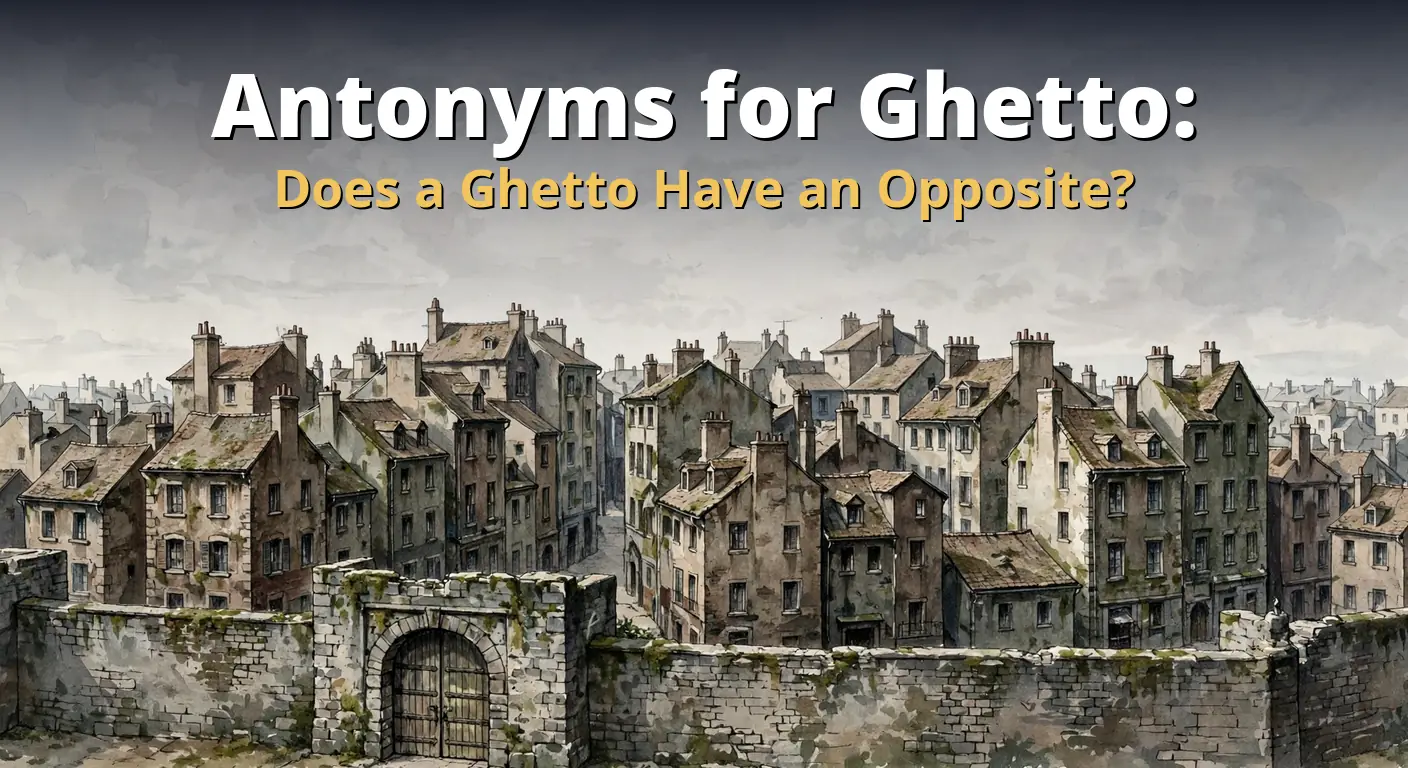
A ghetto is a part of a city where members of a particular minority group live, separated from the wider population. In its original historical sense the separation was compulsory: residents were required by law to live there, and often locked in at night.
The word comes from Venice. In 1516 the Venetian Republic ordered the city’s Jewish residents to move to a quarter near a foundry: geto in Venetian dialect: and the name ghetto travelled from there to similar compulsory Jewish quarters across Europe. In the twentieth century, the Jewish ghettos established under Nazi rule became instruments of persecution, and many residents were later deported to camps. The word therefore carries heavy historical weight.
In modern use the meaning has widened: ghetto can describe any segregated, deprived urban area whose residents are concentrated there by poverty, discrimination or limited housing choice rather than by law. Because of its history, writers often choose plainer terms: segregated district, deprived neighbourhood, low-income area: when those are more precise.
Three features run through every sense, and they are what the contrasts below attach to: segregation (one group kept apart), exclusion (residents denied equal participation) and deprivation (poverty and under-resourcing).
If You Mean the Segregation: Integration
The oldest and most central feature of a ghetto is separation: one group set apart from everyone else. The genuine contrast is integration: different groups living together and taking part in the same institutions: the same schools, workplaces, housing and public services.
Two honesty notes. First, integration opposes the feature: it is the standard antonym of segregation, not of ghetto as a whole. Second, the familiar variants: social integration and integrated community: are this one idea restated: the first names integration by its domain, the second a community where it has happened. One idea, one entry.
If You Mean the Exclusion: Inclusion
Segregation describes where people live; exclusion describes how they are treated. Residents of a ghetto are excluded from the full life of the city: equal access to services, jobs and political voice. The contrasting idea is inclusion: everyone welcomed, respected and able to participate on equal terms, whatever their background.
The distinction from integration is real: integration is about groups mixing; inclusion is about people belonging and taking part. A city can mix its housing without making every resident feel included. The two are close cousins, not duplicates: and the same doubling warning applies: inclusive neighborhood is inclusion applied to an area, the same idea in a second costume, not a separate opposite.
If You Mean the Deprivation: Affluence and Prosperity
The third feature is economic. Ghettos are characteristically poor areas: low incomes, poor housing, underfunded schools and healthcare. The contrasting condition is affluence: also called prosperity: comparatively high incomes and well-resourced services.
Be clear about the form of this answer. Affluence is a genuine word opposing deprivation, the feature. But no single word names “an affluent area” as the mirror image of ghetto; writers reach instead for the descriptive phrase affluent neighbourhood: honest and useful, as long as it is labelled a description of a contrasting kind of area, not a word-antonym.
And the contrast is partial: an affluent neighbourhood reverses only the poverty. Wealth alone says nothing about separation: an affluent area can still be homogeneous and closed, and a poor area closely woven into its city’s life.
Words and Phrases That Are Not Antonyms
Diverse community
A diverse community is one whose residents come from many backgrounds. It is a real and relevant idea: a mixed population is part of what integration looks like: but diversity alone is not the opposite of a ghetto. Diversity describes who lives somewhere; it says nothing by itself about whether those groups mix, participate equally or share resources. Communities can sit side by side, diverse on the map and segregated in daily life, and a diverse area can still be deprived. The earlier version of this page was right, in its own FAQ, to call a diverse community “not necessarily” an opposite: it belongs in this discussion, not the contrast list.
The restated variants
Social integration, integrated community and inclusive neighborhood are the contrasts above with an adjective or a place-word attached. Listing them as separate entries inflates a three-item answer into a six-item one without adding any meaning.
Invented and stretched words
There is no dictionary word “non-ghetto”, and suburb is not an opposite either: a suburb is defined by its position at a city’s edge, and suburbs can be rich or poor, mixed or segregated.
Example Sentences
- Historians use ghetto for the compulsory Jewish quarters of early modern Europe, beginning with Venice in 1516.
- The report contrasted the segregated district with the city’s policy of integration in housing and schools.
- An inclusion programme gave residents of every district equal access to the new library and health centre.
- Funding per pupil was markedly higher in affluent neighbourhoods than in the deprived areas the study surveyed.
Common Mistakes
Mistake 1: Counting one idea three times
Listing integration, social integration and integrated community as three separate opposites is padding: the second names the first with its domain attached, the third a place where it has happened. The same applies to inclusion and inclusive neighborhood. Honest counting gives one entry per idea.
Mistake 2: Treating “affluent neighbourhood” as the whole answer
The phrase contrasts with a ghetto on one feature only: money. It does not touch the historical sense, nor the segregation: a wealthy district can be just as separate as a poor one.
Mistake 3: Assuming diverse means integrated
A neighbourhood can house many backgrounds while its residents live parallel lives: different schools, shops and social worlds, and unequal resources. Diversity is about who is present; integration and inclusion are about participation.
Mistake 4: Using “ghetto” as a casual insult
Given the word’s history: compulsory confinement and persecution: using it loosely for any run-down place is imprecise and can stigmatise the people who live there. Deprived, low-income or segregated say exactly which feature is meant.
Mini Quiz
1. How many genuine feature-contrasts does ghetto have on this page?
A. Six
B. Three: one each for segregation, exclusion and deprivation
C. One: “affluent neighbourhood”
Answer: B. Integration answers segregation, inclusion exclusion, affluence deprivation. Six-entry lists reach six by restating the first two ideas.
2. A district’s residents come from many backgrounds, but the groups attend separate schools, rarely mix, and services remain unequal. Which description fits?
A. Diverse but not integrated
B. Integrated
C. Affluent
Answer: A. The population is diverse, but diversity alone does not reverse segregation or exclusion: participation is what integration names.
3. Which statement about “affluent neighbourhood” is accurate?
A. The dictionary antonym of ghetto
B. It is a descriptive phrase contrasting with the deprivation feature only
C. It also reverses the segregation feature
Answer: B. The phrase describes a contrasting kind of area on the economic feature only; wealth alone says nothing about separation.
Short Q&A
Q: What is the antonym of ghetto?
A: Strictly, there isn’t one. Ghetto names a place defined by segregation, exclusion and deprivation together, and no single word reverses all three. The genuine contrasts are feature by feature: integration, inclusion and affluence.
Q: Is “integration” the antonym of ghetto?
A: It is the antonym of the word’s central feature, segregation: the contrast most often meant. But it answers only that feature, and its variants (“social integration”, “integrated community”) are the same idea, not extra opposites.
Q: Is a “diverse community” the opposite of a ghetto?
A: Not necessarily. Diversity describes the mix of people present; it does not by itself guarantee mixing, equal participation or shared resources.
Q: Where does the word “ghetto” come from?
A: From Venice, where in 1516 Jewish residents were ordered to live in a quarter by a foundry: geto in the local dialect. Its later history under Nazi rule is why the word carries such weight.
Q: What should I write when I need “the opposite of a ghetto” in a sentence?
A: Name the feature you mean: “an integrated, mixed district” for segregation, “an inclusive community” for exclusion, “an affluent, well-resourced neighbourhood” for deprivation.
Key Takeaways
- Ghetto has no true dictionary antonym: it names a place defined by several features at once: segregation, exclusion and deprivation: and no one word reverses them all.
- The genuine contrasts attach to the features, one entry each: integration against segregation, inclusion against exclusion, affluence/prosperity against deprivation.
- “Social integration”, “integrated community” and “inclusive neighborhood” are those same ideas restated: counting them separately is how a three-contrast answer was padded to six.
- Diverse community describes who lives in an area; diversity alone does not reverse segregation or deprivation.
- The word’s history: from Venice in 1516 to the ghettos of Nazi-occupied Europe: is why it should be used precisely and with care.

Hi, I’m Amna Akhtar. I write about word meanings, opposites, and the small distinctions that make English tricky. I don’t come at language purely from instinct, either. I have a peer-reviewed academic paper “Determinants of Jobs Satisfaction of Female Teachers: An Evidence from District Hafizabad, Pakistan,” published in education economics, and that research background shapes how I think about language content, I want it to actually help people learn, not just look correct on a page. Whether you’re a student, a writer, or just someone who wants to use the right word at the right moment, my goal is to make that easier for you.