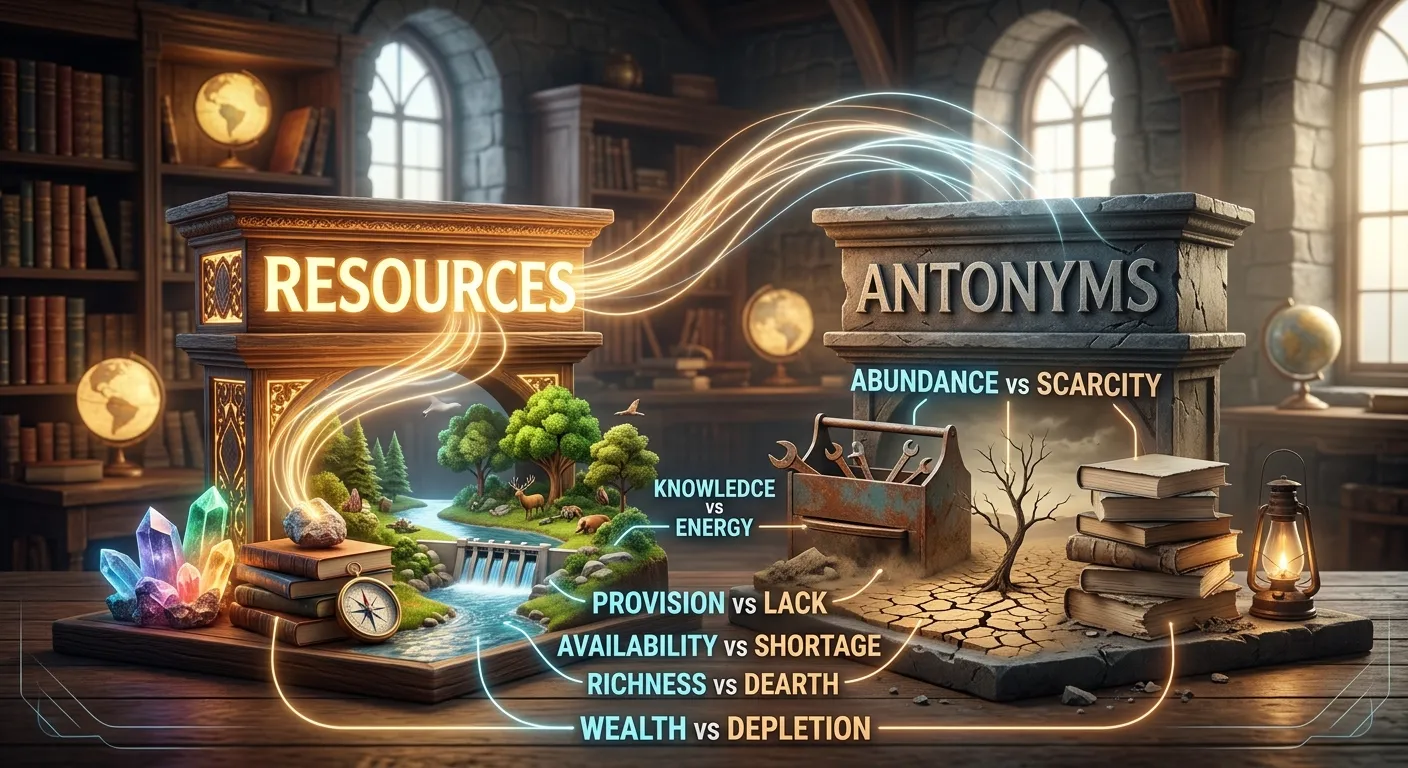
Resources: Supplies, money, skills, materials, or other useful things available for a particular purpose.
Main antonym: Lack the absence or insufficient availability of something needed.
Pronunciation:
Resources: /rɪˈzɔːr.sɪz/ or /rɪˈzɔː.sɪz/
Featured Snippet
The most natural antonym for resources is lack, especially when resources means available supplies, money, support, or useful assets. Other contextual opposites include scarcity, shortage, deficiency, insufficiency, absence, and unavailability, depending on whether the emphasis is on limited quantity, shortage, or complete absence.
Quick Answer
The strongest general opposite of resources is lack.
For example:
- Resources: The school has enough resources to support the students.
- Lack: The school struggles because of a lack of resources.
Other useful antonyms include scarcity, shortage, deficiency, insufficiency, absence, unavailability, depletion, and poverty. These are not interchangeable in every sentence because each emphasizes a slightly different kind of shortage.
Quick Comparison Table
| Word | Meaning | Example |
| Resources | Useful supplies, money, support, or assets available for use | The project has enough resources. |
| Lack | Absence or insufficient amount of something needed | The project failed because of a lack of resources. |
| Scarcity | A situation in which something is difficult to obtain because there is not enough | Water scarcity affects many regions. |
| Shortage | An insufficient supply of something | The hospital is facing a shortage of staff. |
| Deficiency | A shortage or inadequacy of something required | The program has a deficiency of trained workers. |
What You’ll Learn
After reading this guide, you will know:
- The strongest antonym of resources
- Other useful opposites and their differences
- Which antonyms work best in different contexts
- How to use these words naturally in sentences
- Why lack is usually more natural than some other alternatives
Core Antonyms for Resources
1. Lack
Meaning: The absence or insufficient amount of something needed.
Example:
The organization suffers from a lack of resources.
Usage: Lack is the most natural general opposite when you want to say that resources are unavailable or insufficient.
2. Scarcity
Meaning: A situation in which something is not available in sufficient quantity and is difficult to obtain.
Example:
The region is experiencing a scarcity of natural resources.
Usage: This is especially useful in economics, environmental studies, and academic writing. Oxford defines scarcity as a situation in which there is not enough of something and it is difficult to obtain.
3. Shortage
Meaning: A situation in which there is not enough of something that is needed.
Example:
The company is facing a shortage of financial resources.
Usage: Shortage is common in everyday, business, and news writing.
4. Deficiency
Meaning: A lack or shortage of something necessary or desirable.
Example:
The project suffered from a deficiency of human resources.
Usage: More formal and academic than lack.
5. Insufficiency
Meaning: The condition of being inadequate or not enough.
Example:
The program was delayed because of the insufficiency of available resources.
Usage: Formal and suitable for academic or professional writing.
6. Absence
Meaning: The state of something not being present.
Example:
The absence of financial resources made the project impossible.
Usage: Use absence when the focus is on something not being present, rather than simply being limited.
7. Unavailability
Meaning: The condition of not being available for use.
Example:
The unavailability of resources forced the team to postpone the project.
Usage: Useful when resources exist somewhere but cannot currently be accessed or used.
8. Depletion
Meaning: The reduction of something because it has been used up or greatly reduced.
Example:
The depletion of natural resources threatens future generations.
Usage: Best for resources that are being consumed or exhausted, especially natural resources.
9. Deprivation
Meaning: The condition of being without something necessary or beneficial.
Example:
The community experienced severe deprivation of essential resources.
Usage: Stronger and more serious than ordinary lack.
10. Paucity
Meaning: A very small amount or number of something.
Example:
The paucity of resources limited the researchers’ ability to continue the study.
Usage: Formal and relatively uncommon in everyday conversation.
11. Scantiness
Meaning: The condition of being very small in amount or insufficient.
Example:
The scantiness of resources made it difficult to complete the work.
Usage: Less common than lack, shortage, or scarcity.
12. Deficit
Meaning: An amount by which something is less than what is needed, expected, or required.
Example:
The organization faced a significant budget deficit.
Usage: Especially common with money, budgets, supplies, and quantities.
13. Poverty
Meaning: A severe lack of money or material resources.
Example:
The region continues to struggle with extreme poverty.
Usage: This is not a general antonym of resources. It works when resources refers specifically to wealth or financial means.
14. Need
Meaning: A condition in which something necessary is lacking.
Example:
The community is in need of essential resources.
Usage: Need is related to the absence of resources, but it is not a direct antonym in every context.
15. Want
Meaning: A lack or absence of something needed or desired.
Example:
The project failed for want of adequate resources.
Usage: This is formal or literary in this sense. In everyday English, lack is usually more natural.
Contextual Antonyms
The best opposite changes slightly depending on what resources means.
When resources means supplies or useful materials
Use:
- lack
- shortage
- scarcity
- deficiency
- insufficiency
- paucity
Example:
The hospital has limited resources.
Opposite idea:
The hospital has a shortage of resources.
When resources means money or financial means
Use:
- lack of funds
- financial deficiency
- poverty
- financial insufficiency
- budget deficit
Example:
The organization does not have enough financial resources.
Natural opposite expression:
The organization suffers from a lack of funds.
When resources means natural supplies
Use:
- scarcity
- depletion
- shortage
- deprivation
- exhaustion
Example:
The country is concerned about the depletion of natural resources.
Here, depletion is more precise than simply saying lack, because it describes resources being reduced through use.
When resources means support, skills, or capabilities
Use:
- lack
- absence
- insufficiency
- inability
- incapacity
Example:
The team has the resources to complete the project.
Opposite:
The team lacks the resources to complete the project.
Meaning & Usage: Which Antonym Should You Choose?
Not every word on an antonym list can replace resources directly.
Lack vs. Scarcity
Lack focuses on not having enough of something.
The school has a lack of resources.
Scarcity emphasizes limited availability and difficulty obtaining something.
Water scarcity is a major environmental problem.
Lack vs. Shortage
Lack is broader and very common.
We have a lack of resources.
Shortage usually suggests that supply is below demand or what is needed.
The hospital has a shortage of medical supplies.
Lack vs. Deficiency
Deficiency is more formal and often suggests that something is below an expected or required level.
The program has a deficiency in resources.
For ordinary communication, lack of resources is usually more natural.
Scarcity vs. Depletion
Scarcity describes limited availability.
The region faces water scarcity.
Depletion describes resources becoming reduced because they have been consumed or exhausted.
The depletion of groundwater is a serious concern.
Example Sentences
Here are natural examples showing how the antonyms work:
- The project was delayed because of a lack of resources.
- The region is experiencing a scarcity of clean water.
- The hospital is facing a shortage of medical supplies.
- The department has a deficiency of trained personnel.
- The company struggled because of insufficient financial resources.
- The absence of adequate resources affected the quality of education.
- The unavailability of equipment prevented the researchers from continuing.
- The depletion of natural resources is an important environmental concern.
- The community suffers from deprivation of essential resources.
- The paucity of resources made the research difficult to complete.
Grammar & Word Class
Resources is a plural noun.
The singular form is resource.
- resource → singular noun
- resources → plural noun
- lack → noun or verb
- scarcity → noun
- shortage → noun
- deficiency → noun
- insufficiency → noun
- absence → noun
- depletion → noun
A particularly common structure is:
lack of + noun
Examples:
- a lack of resources
- a lack of money
- a lack of time
- a lack of support
You can also use lack as a verb:
The organization lacks resources.
This structure does not require of.
Common Mistakes
Mistake 1: Treating “scarcity” as a direct replacement for “lack”
❌ The company scarcity resources.
✅ The company lacks resources.
✅ The company is experiencing a scarcity of resources.
Why?
Scarcity is a noun describing limited availability. It cannot normally be used as a verb.
Mistake 2: Using “poverty” for every type of resource
❌ The school has poverty of computers.
✅ The school has a lack of computers.
Poverty mainly refers to severe financial or material hardship. It is not the general opposite of every meaning of resources.
Mistake 3: Assuming “depletion” means simple absence
Depletion specifically suggests that a resource has been reduced or used up.
The depletion of oil reserves is a long-term concern.
For a simple absence, lack or absence is usually better.
Expert Tip
When you need one safe, natural opposite for resources, choose lack.
The phrase “lack of resources” works across education, business, healthcare, government, and everyday English. Use more specific words such as scarcity, shortage, or depletion when you want to emphasize why resources are insufficient.
Short Questions & Answers
Q: What is the opposite of resources?
A: The most natural general opposite of resources is lack, especially when resources means money, supplies, support, or useful assets that are available for use.
Q: What is a stronger opposite of resources?
A: Scarcity can express a stronger idea of limited availability, while deprivation can emphasize being seriously without something necessary. The best choice depends on context.
Q: Is “lack” a direct antonym of resources?
A: Lack is the most practical contextual antonym of resources, particularly in phrases such as “lack of resources.” Strictly speaking, resources and lack belong to different semantic roles: resources describe what is available, while lack describes its absence or insufficiency.
Q: What is the opposite of natural resources?
A: There is no single universal antonym for natural resources. Depending on the intended meaning, useful contrasting terms include scarcity, depletion, exhaustion, or absence of natural resources.
Q: What is the difference between scarcity and shortage?
A: Scarcity emphasizes limited availability and difficulty obtaining something, while shortage usually refers to a supply that is insufficient for current needs or demand.
Final Verdict
- Lack is the most natural general antonym associated with resources.
- Scarcity emphasizes limited availability.
- Shortage emphasizes insufficient supply.
- Deficiency and insufficiency are more formal choices.
- Absence emphasizes that resources are not present.
- Depletion is best when resources have been reduced through use.
- Poverty applies mainly when resources means financial or material wealth.
- The best antonym depends on the exact meaning and context.
Dictionary Note
Major dictionaries define resource/resources as useful or valuable supplies, possessions, qualities, or means available to a person, organization, or country. Cambridge also gives examples involving limited resources, while Oxford describes resources as a supply that a person, organization, or country has and can use.
Antonyms for Compound: Simple Opposites Explained

Hi, I’m Amna Akhtar. I write about word their meanings, opposites, and the small distinctions that make English tricky. I don’t come at language purely from instinct, either. I have a peer-reviewed academic paper “Determinants of Jobs Satisfaction of Female Teachers: An Evidence from District Hafizabad, Pakistan,” published in education economics, and that research background shapes how I think about language content, I want it to actually help people learn, not just look correct on a page. Whether you’re a student, a writer, or just someone who wants to use the right word at the right moment, my goal is to make that easier for you.