Quick Answer
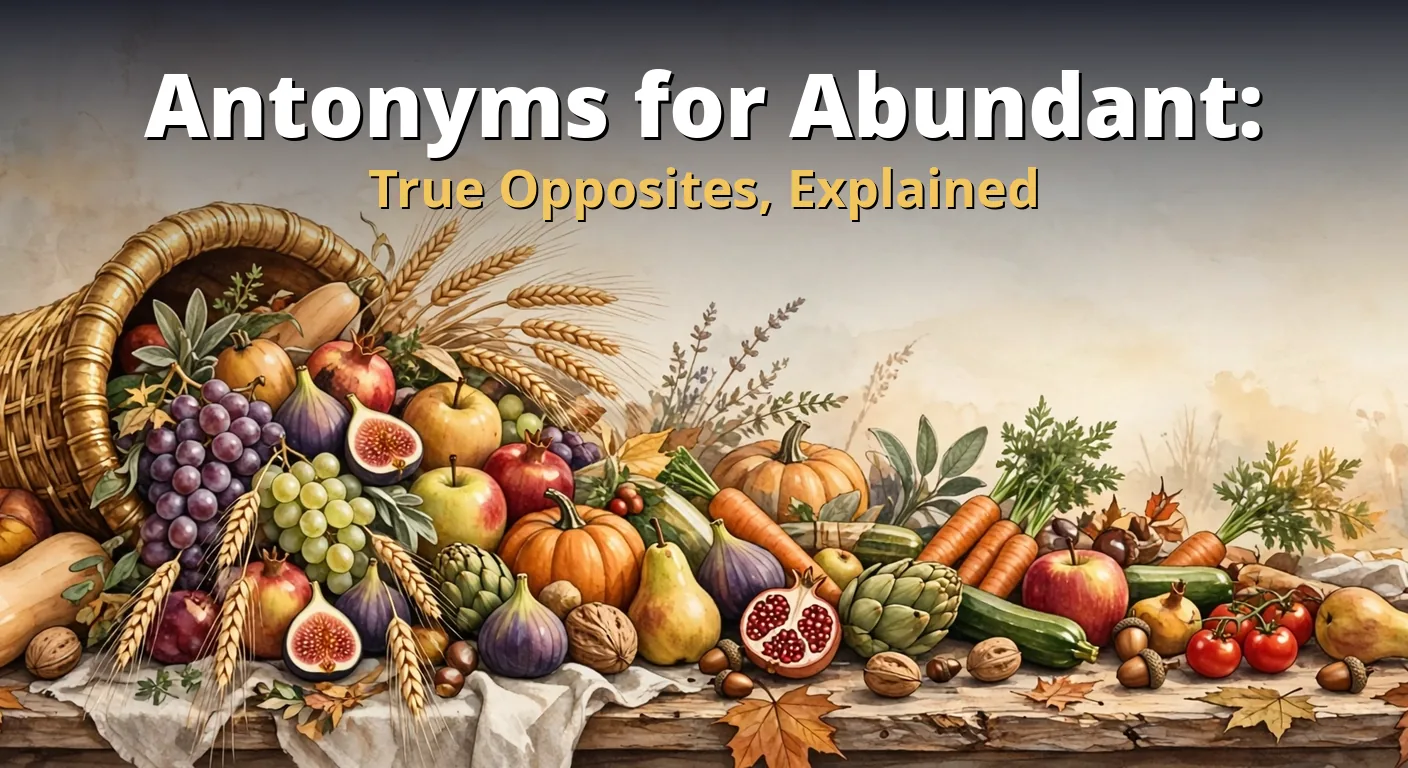
The direct opposite of abundant is scarce. Abundant means existing in large quantities: more than enough. Its genuine opposites all sit at the low end of the quantity scale, but they are not interchangeable: each measures “not much” in a different way.
- Scarce: the total supply is small.
- Sparse: what exists is thinly spread out.
- Meagre: the amount is too small to satisfy.
- Insufficient: the amount falls short of what a task needs.
- Lacking: something needed is missing.
- Deficient: the amount is below a required standard.
Two more words, rare and minimal, work only in particular contexts, so they are kept separate below. Two honesty notes: limited is not an opposite at all (restricted is not the same as small), and scant is a variant of meagre, counted inside that entry rather than as a separate opposite.
Quick Comparison
| Opposite | Meaning | Example |
|---|---|---|
| Scarce | Existing only in small supply; hard to get | Clean water grew scarce during the drought. |
| Sparse | Thinly spread over an area; low in density | Trees are sparse on the dry hillside. |
| Meagre | Small and unsatisfying; barely enough or less | They survived on a meagre wage. |
| Insufficient | Less than a particular purpose requires | The evidence was insufficient to charge him. |
| Lacking | Missing; not having enough of something needed | The report is clear but lacking in detail. |
| Deficient | Below the level or standard required (formal) | His diet was deficient in iron. |
| Rare | Not often found or seen (contextual) | These orchids, once abundant here, are now rare. |
| Minimal | The smallest amount possible (contextual) | The fire caused minimal damage. |
Core Antonyms for Abundant
1. Scarce
Meaning: Existing only in small amounts, so that it is hard to obtain.
Example: After two dry summers, fodder became scarce and prices doubled.
Best context: Resources and supplies people compete for: water, food, jobs, housing, materials.
Nuance: This is the dictionary opposite of abundant: where abundant says “plenty of it,” scarce says “not much of it, and people want it.” Something can be scarce without being absent: a little exists, just not enough to go round.
2. Sparse
Meaning: Thinly spread out; present in small numbers across a wide area.
Example: Vegetation is sparse on the plateau, with wide gaps of bare rock.
Best context: Distribution and coverage: population, trees, hair, rainfall across a region, data points on a chart.
Nuance: Sparse answers a different question from scarce. Scarce is about how much exists in total; sparse is about density: how thickly it is spread. A region can hold thousands of trees and still look sparse if they stand far apart.
3. Meagre
Meaning: Small in amount and disappointing: barely enough, or less than is wanted. (American spelling: meager.)
Example: The harvest was so meagre that the village had to buy in grain.
Best context: Amounts judged against people’s needs or hopes: wages, portions, rations, results, evidence.
Nuance: Meagre carries a judgement the plainer words do not: it says not just “little” but “unsatisfyingly little.” Its close variant scant (scant evidence, a scant tablespoon) expresses exactly this idea, so it belongs inside this entry: listing both is how padded lists inflate their count.
4. Insufficient
Meaning: Not enough for a particular purpose or requirement.
Example: The grant was generous but insufficient to finish the repairs.
Best context: Functional and formal writing where a defined need exists: funds, time, evidence, data, staff.
Nuance: Insufficient is measured against a need, not against zero. Rainfall can be abundant for the season and still insufficient for the crop; the word always asks “enough for what?”
5. Lacking
Meaning: Missing, or not having enough of something that is needed.
Example: Her argument was lively but lacking in proof.
Best context: Qualities and contents of a particular thing: a report lacking detail, a diet lacking variety, a speech lacking evidence. It usually appears in the pattern lacking in + noun.
Nuance: Where scarce describes a supply in the world, lacking points to a gap inside one thing. The water supply may be abundant while a single well is lacking a pump.
6. Deficient
Meaning: Below the level or standard required; not containing enough of a necessary element.
Example: Blood tests showed she was deficient in vitamin D.
Best context: Formal, medical and technical writing: nutrients, minerals, skills, performance measured against a set standard.
Nuance: The technical member of the family: deficient implies measurement against a norm. Doctors and inspectors use it where everyday speech would use lacking.
Contextual Opposites
These two words oppose abundant only in some sentences. Used carelessly, they mislead.
Rare
Meaning: Not often found, seen or happening.
Rare primarily opposes common and frequent: it is about how often something occurs, not how much of it there is. It genuinely opposes abundant only where abundance means “found everywhere”: “These birds were abundant a century ago; today they are rare.” For a small total amount, scarce is the accurate word: water in a desert is scarce, not rare.
Minimal
Meaning: The smallest amount that is possible or allowed.
Minimal names the floor of the scale: abundant is as much as anyone could want; minimal is as little as there can be: “The storm did minimal damage.” Note that minimal is often neutral or welcome (minimal fuss, minimal waste), so it lacks the “disappointingly little” force of meagre.
Example Sentences
- Rice was abundant after the good harvest, but cooking oil stayed scarce.
- The crowd on the first night was sparse; by Friday the hall was full.
- They shared a meagre meal of bread and thin soup.
- The samples were insufficient to support the claim.
- A diet deficient in calcium can weaken bones over time.
Common Mistakes
Mistake 1: Treating “limited” as an antonym
❌ Tickets are limited, so they are the opposite of abundant.
✅ Limited means restricted or kept within a boundary: it says nothing about size. A limited stock can still be abundant. Limited sits in the middle of the scale; the opposite end is scarce.
Mistake 2: Counting “scant” and “meagre” as two opposites
❌ Listing scant and meagre as separate entries to reach a bigger number.
✅ They are one idea: a small, unsatisfying amount: in two forms. Count it once, as this article does.
Mistake 3: Using “rare” for a small amount
❌ Water is rare in the desert.
✅ Water is scarce in the desert.
Rare is about frequency of occurrence; scarce is about quantity of supply. A rare event may involve huge amounts (a flood), and an everyday substance can be scarce.
Mistake 4: Using “sparse” where there is no spread or area
❌ The soup was sparse.
✅ The soup was meagre: mostly water.
Sparse needs something distributed across space: trees on a hillside, hair on a head, houses in a valley. A single amount that is simply small is meagre or scant.
Mini Quiz
1. Which word is the most direct opposite of abundant?
A. Limited
B. Scarce
C. Occasional
Answer: B. Scarce reverses the quantity claim directly. Limited means restricted, and occasional is about timing, not amount.
2. “The pines stood far apart across the slope, with bare ground between them.” Which word fits best?
A. Meagre
B. Insufficient
C. Sparse
Answer: C. The sentence is about density and spread, which is sparse. Meagre judges an amount as unsatisfying; insufficient measures it against a need.
3. A hospital report says a patient is “__ in vitamin B12.” Which word fits best?
A. Deficient
B. Rare
C. Minimal
Answer: A. A measured shortfall against a medical standard is deficient: the formal, technical choice.
Short Q&A
Q: What is the main antonym of abundant?
A: Scarce. It reverses the core claim: large supply becomes small supply: and works in most contexts where abundant does.
Q: What is the difference between scarce and sparse?
A: Scarce is about total supply (there is not much of it); sparse is about density (what exists is thinly spread). A forest can be sparse without its trees being scarce worldwide.
Q: What is the difference between meagre and insufficient?
A: Meagre is a judgement: the amount feels disappointingly small. Insufficient is a measurement: the amount falls short of a stated need. A wage can be meagre; evidence is insufficient.
Q: Is “rare” an antonym of abundant?
A: Only in context. Rare opposes common; it works against abundant when something once found everywhere is now seldom seen.
Q: Which opposite is best in formal or technical writing?
A: Insufficient when something falls short of a purpose, and deficient when it falls short of a standard: the word of lab reports, inspections and medical notes.
Key Takeaways
- The direct opposite of abundant is scarce; the other core opposites are sparse, meagre, insufficient, lacking and deficient.
- Each answers a different question: supply (scarce), spread (sparse), satisfaction (meagre), need (insufficient), absence (lacking), standard (deficient).
- Rare and minimal are genuine opposites only in context: frequency and the floor of the scale.
- That makes eight honest entries. Scant is a variant of meagre, not a ninth, and limited is not an opposite at all.

I’m Leo Jackson, an English writer with a soft spot for the peculiarities of language and vocabulary. He specializes in exploring the nuances of English synonyms, antonyms, helping students, writers, and professionals choose the right word with confidence. My guides combine careful research with clear, practical explanations.