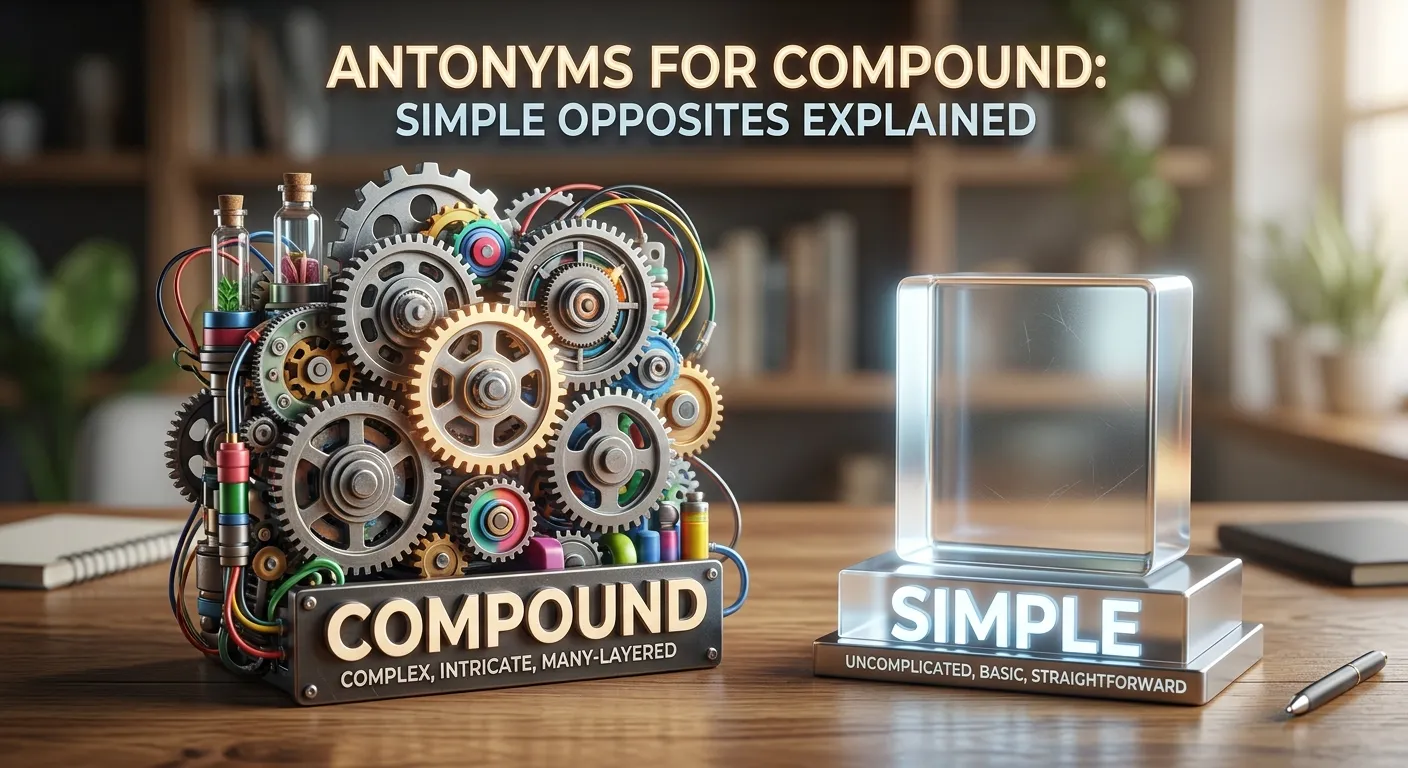
Compound: Made up of two or more parts, elements, or things combined together.
Main antonym: Simple Made up of one basic or uncomplicated part rather than several combined parts.
Featured Snippet:
The most common antonym for compound is simple when compound means consisting of two or more parts. Depending on context, other opposites may include single, uncombined, basic, or individual. For the verb compound, the opposite can be separate, reduce, or alleviate, depending on its meaning.
Quick Answer
The best antonym for compound is usually simple when you mean something made up of multiple parts.
However, compound has several meanings, so its opposite changes with context:
- Compound → simple when something has multiple parts versus one straightforward part.
- Compound → single when referring to a word or structure made from multiple elements.
- Compound → uncombined when referring to substances or materials.
- Compound → alleviate/reduce when compound means “make a problem worse.”
So, there is no single antonym that works in every situation.
Quick Comparison Table
| Word | Meaning | Example |
| Compound | Made of two or more parts | “This is a compound sentence.” |
| Simple | Consisting of one basic part or structure | “This is a simple sentence.” |
| Single | One rather than several | “Use a single word instead.” |
| Uncombined | Not joined or mixed with another substance | “The elements remain uncombined.” |
| Alleviate | Make a problem less severe | “The treatment helped alleviate the pain.” |
What You’ll Learn
After reading this guide, you will know:
- The main antonyms of compound
- Which opposite fits each meaning
- Why simple is often the best general antonym
- How compound changes meaning as a noun, adjective, and verb
- How to use the opposites naturally in sentences
Core Antonyms for Compound
Because compound has several meanings, the most useful antonyms depend on the context.
1. Simple
Meaning: Consisting of one basic structure or not made from multiple combined parts.
Example:
The teacher asked students to change the compound sentence into a simple sentence.
Why it works:
In grammar, compound and simple are established contrasting categories. A compound sentence contains two or more independent clauses, while a simple sentence has one independent clause.
2. Single
Meaning: One rather than two or more.
Example:
The compound term contains two words, while the other example is a single word.
Best context:
Use single when you want to emphasize the number of components rather than the complexity of something.
3. Uncombined
Meaning: Not joined, mixed, or combined with something else.
Example:
The chemicals were stored separately in their uncombined forms.
Best context:
This is especially useful when compound refers to a chemical substance created by combining elements.
4. Separate
Meaning: Existing apart rather than being joined together.
Example:
The two ingredients were kept separate until the final stage.
Best context:
Separate is a natural opposite when compound describes things that have been joined or combined.
5. Individual
Meaning: Existing as a single, distinct unit rather than as part of a combination.
Example:
The researchers examined the individual components rather than the compound mixture.
Best context:
This works particularly well when discussing components, elements, or parts of a larger combination.
6. Basic
Meaning: Simple and fundamental rather than made up of several complicated elements.
Example:
We started with the basic concept before studying more complex structures.
Best context:
Basic can contrast with compound in educational or technical explanations, but it is not a universal antonym.
7. Unmixed
Meaning: Not combined or blended with another substance.
Example:
The laboratory sample remained unmixed until the experiment began.
Best context:
Use this when the focus is on physical substances or mixtures.
8. Alleviate
Meaning: To make a problem, difficulty, or unpleasant situation less severe.
Example:
The new policy helped alleviate the financial pressure on families.
Best context:
This is an antonym of compound only when compound is used as a verb meaning to make a problem worse.
9. Reduce
Meaning: To make something smaller, weaker, or less severe.
Example:
The intervention reduced the effects of the problem.
Best context:
Reduce contrasts with compound when compound means to increase or worsen a difficulty.
10. Improve
Meaning: To make something better.
Example:
The new strategy improved the situation instead of compounding the problem.
Best context:
This is a contextual opposite, especially in sentences such as “compound a problem.”
Contextual Antonyms of Compound
The word compound has several distinct meanings, so choosing its antonym requires looking at the sentence.
When compound means “made of two or more parts”
Best opposites:
- Simple
- Single
- Basic
- Individual
Example:
A compound structure contains multiple parts, while a simple structure has a basic structure.
This is one of the clearest antonym relationships.
When compound means “combined or mixed”
Best opposites:
- Separate
- Uncombined
- Unmixed
- Individual
Example:
The ingredients were kept separate rather than combined.
In chemistry, however, be careful: compound and mixture are not exact opposites. A chemical compound is formed when elements combine chemically, while a mixture contains substances that are physically combined.
When compound means “a word made from two or more words”
Best opposites:
- Simple
- Single
- Non-compound
Example:
“Toothbrush” is a compound word, while “book” is a simple word.
Cambridge describes compound words as words formed by linking two or more words to produce a new meaning.
Important: Non-compound is useful for classification, but simple or single is generally more natural in ordinary explanations.
When compound means “make a problem worse”
Here, the word is a verb, and its opposites change completely.
Useful contextual opposites:
- Alleviate
- Reduce
- Relieve
- Improve
- Ease
- Resolve
Example:
The delay compounded the problem.
Possible opposite:
Quick action alleviated the problem.
Cambridge defines this verb sense of compound as making a problem or difficult situation worse.
Compound vs. Simple: The Most Important Contrast
If you’re looking for one general antonym, simple is the strongest choice when compound means consisting of two or more parts.
Consider these examples:
- compound sentence → simple sentence
- compound word → simple word
- compound structure → simple structure
- compound system → simple system
But don’t automatically replace compound with simple in every sentence.
For example:
The scientist studied a chemical compound.
Here, simple is not necessarily the correct opposite. The relevant contrast may be uncombined elements or separate substances, depending on what you mean.
Example Sentences
Compound → Simple
The teacher explained the difference between compound and simple sentences.
Compound → Single
The phrase contains several words rather than a single word.
Compound → Separate
The chemicals were kept separate before the experiment.
Compound → Uncombined
The elements remained uncombined until the reaction began.
Compound → Alleviate
The new treatment alleviated the symptoms instead of compounding the problem.
Compound → Reduce
Better planning can reduce the difficulties that poor preparation might compound.
Compound → Relieve
The medication helped relieve the discomfort.
Compound → Improve
The new policy improved the situation rather than making it worse.
Grammar and Word Class
Compound can function as several parts of speech, and this is one reason its antonyms vary.
| Use | Meaning | Example | Possible Opposite |
| Adjective | Made of two or more parts | “a compound structure” | simple |
| Noun | A combination or chemical substance | “a chemical compound” | separate substance / element, depending on context |
| Noun | A word made from multiple words | “a compound word” | simple word |
| Verb | Make something worse | “compound a problem” | alleviate / reduce |
| Verb | Mix or combine | “compound chemicals” | separate / unmix |
Cambridge identifies compound as a noun, adjective, and verb, with distinct meanings including combination, chemical substance, word formation, worsening a problem, and mixing substances.
Compound in Grammar: A Useful Distinction
In English grammar, compound is not simply the opposite of simple in every grammatical structure.
For example:
- Simple sentence: one independent clause
- Compound sentence: two or more independent clauses joined together
Similarly:
- Simple word: one basic lexical unit
- Compound word: two or more words or bases combined to form a new word
Cambridge notes that compounds occur across different word classes, including nouns, adjectives, verbs, adverbs, and other grammatical categories.
Common Mistakes
Mistake 1: Using “simple” as the opposite in every context
❌ The opposite of every compound is simple.
✅ Simple is a common antonym of compound when compound means “made of two or more parts,” but the appropriate opposite depends on context.
Mistake 2: Treating “mixture” as the exact opposite
❌ Compound means chemically combined, so mixture is always its antonym.
✅ Compound and mixture describe different types of combinations; they are not straightforward antonyms.
Mistake 3: Using “alleviate” with the adjective compound
❌ The adjective compound is opposite to alleviate.
✅ Alleviate is an opposite of the verb compound when compound means “to make a problem worse.”
Mistake 4: Confusing “compound” with “complex”
In grammar, compound and complex are not interchangeable.
A compound sentence has two or more independent clauses, while a complex sentence contains an independent clause and at least one dependent clause.
So simple is the relevant structural contrast to compound in a simple-versus-compound sentence comparison.
Expert Tip
Always identify the meaning of compound before choosing its antonym. If it means “made of multiple parts,” use simple or single. If it means “make a problem worse,” use alleviate, reduce, or relieve instead.
Short Questions & Answers
What is the main antonym of compound?
The main antonym of compound is simple when compound means consisting of two or more parts. For example, a compound sentence contrasts with a simple sentence.
What is the opposite of compound in chemistry?
There is no single universal antonym. Depending on the intended contrast, element, uncombined, or separate substance may be appropriate. A chemical compound consists of elements that are chemically combined.
What is the opposite of compound when it means “make worse”?
When compound means “make a problem worse,” useful opposites include alleviate, reduce, relieve, ease, and improve.
Is simple always the opposite of compound?
No. Simple is the clearest opposite when compound means “consisting of two or more parts.” Other meanings require different contextual opposites, such as separate for “combined” or alleviate for “make worse.”
What is the opposite of a compound word?
A simple word is the most useful contrast when discussing word structure. A compound word combines two or more words or bases to create a new word or meaning.
Key Takeaways
- Simple is the strongest general antonym of compound when it means “made of two or more parts.”
- Single emphasizes one unit rather than multiple components.
- Separate, uncombined, and unmixed work when the meaning involves joining or mixing.
- When compound means “make a problem worse,” its opposites include alleviate, reduce, relieve, and ease.
- Always choose the antonym according to the specific meaning and grammatical use of compound.
Dictionary Reference
Cambridge Dictionary identifies several meanings of compound, including something consisting of two or more parts, a chemical substance formed from elements, a word formed from multiple words, and the verb meaning to make a problem worse.
Antonyms for Resources: Opposite Words Explained

I am Clara Stephen, passionate about making English simple and easy to understand through clear synonym, antonyms, word comparisons, vocabulary guides, and language tips. Through thoughtful, reliable content, I aim to be a trusted guide for anyone looking to expand their English vocabulary.