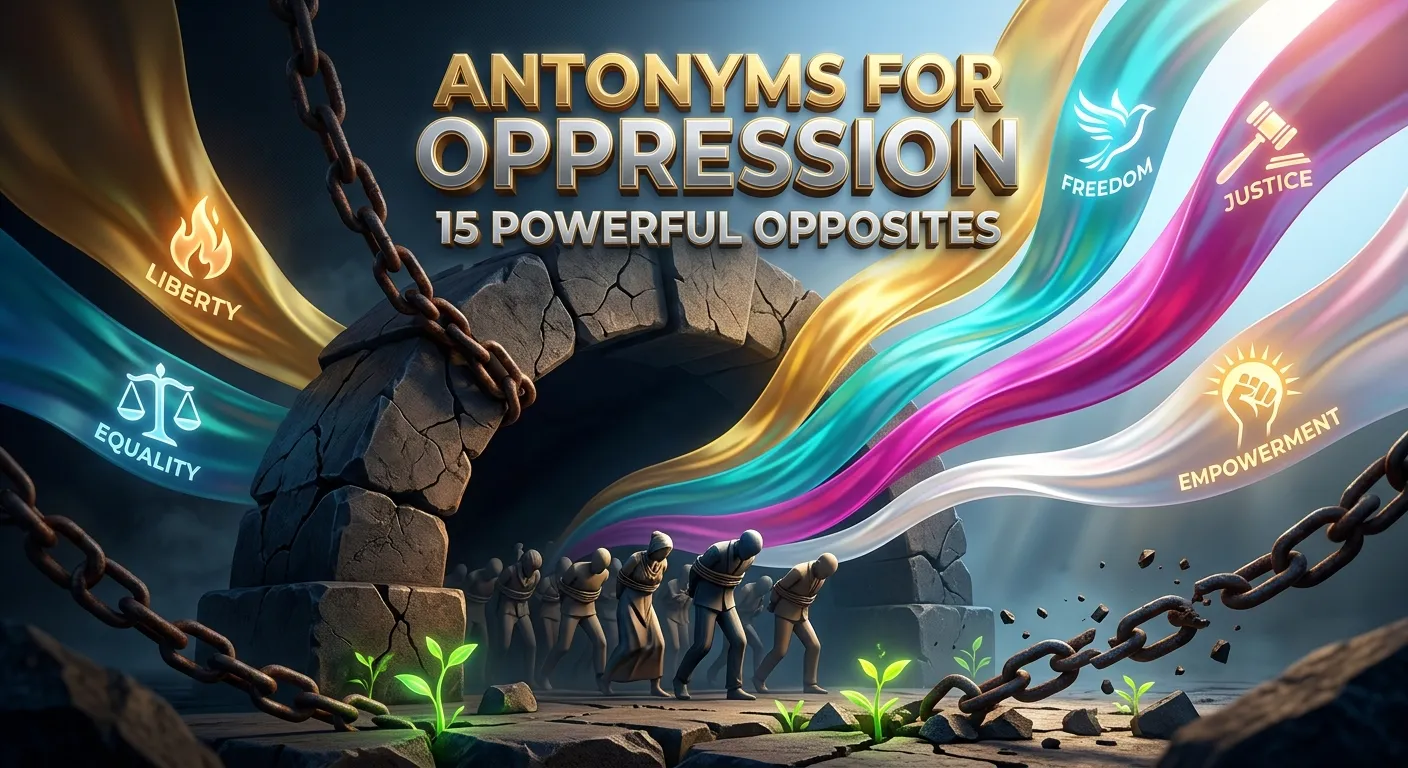
Oppression: The unjust or cruel use of power or authority to control or mistreat people.
Main antonym Freedom: The state of being free from unjust control, restrictions, or domination.
Featured Snippet:
The strongest antonym for oppression is freedom, meaning the state of being free from unjust control, cruelty, or domination. Other useful opposites include liberty, equality, justice, empowerment, autonomy, and liberation, depending on whether the context focuses on political control, social inequality, or personal freedom.
Quick Answer
The most natural antonym of oppression is freedom. However, because oppression describes unjust or cruel control over people, several words can express different aspects of its opposite:
- Freedom: absence of oppressive control
- Liberty: freedom from unreasonable restrictions
- Equality: equal rights and status
- Justice: fair treatment according to rights and law
- Empowerment: giving people greater power and control
- Autonomy: ability to govern oneself
- Liberation: release from oppression or captivity
Quick Comparison
| Word | Meaning | Example |
| Oppression | Unjust or cruel control over people | The community suffered under years of oppression. |
| Freedom | The state of being free from control | Everyone deserves freedom of expression. |
| Equality | Equal rights, opportunities, and status | The movement called for equality. |
| Justice | Fair and morally right treatment | The victims demanded justice. |
| Empowerment | Greater power or ability to control one’s life | Education can promote empowerment. |
| Liberation | Release from oppressive control | The people celebrated their liberation. |
Pronunciation of “Oppression”
Oppression is pronounced:
oppression (uh-PRESH-un)
Word stress: The stress falls on the second syllable: op-PRESS-ion.
Etymology of “Oppression”
The word oppression comes from the Latin opprimere, meaning “to press down” or “to crush.” It is formed from ob- (“against”) and premere (“to press”). Over time, the word developed its modern sense of unjust or cruel control over people.
What You’ll Learn
After reading this guide, you will know:
- The strongest opposites of oppression
- How freedom, liberty, equality, and justice differ
- Which antonyms work best in different contexts
- How to use these words naturally in sentences
Core Antonyms of Oppression
1. Freedom
Meaning: The condition of being free from oppressive control or restrictions.
Example:
The people fought for their freedom after years of oppression.
Why it works: Freedom is the broadest and most natural opposite of oppression.
2. Liberty
Meaning: The right or ability to live freely without unjust restrictions.
Example:
The constitution protects the liberty of its citizens.
Usage: Liberty is especially common in political, legal, and formal contexts.
3. Liberation
Meaning: The act or process of being freed from oppression or control.
Example:
The movement sought the liberation of communities facing discrimination.
Usage: Unlike freedom, which describes a condition, liberation often emphasizes the process of becoming free.
4. Equality
Meaning: The condition in which people have equal rights, status, opportunities, or treatment.
Example:
The campaign promoted equality for all members of society.
Usage: Equality is a particularly useful opposite when oppression involves discrimination or unequal treatment.
5. Justice
Meaning: Fair and morally right treatment according to rights, laws, or principles.
Example:
The victims sought justice after years of mistreatment.
Usage: Justice is not a direct antonym in every sentence, but it contrasts strongly with oppressive systems based on unfairness.
6. Empowerment
Meaning: The process of giving people greater power, confidence, or control over their lives.
Example:
Education can contribute to the empowerment of marginalized communities.
Usage: Particularly useful in social, educational, and workplace contexts.
7. Autonomy
Meaning: The ability or right to make decisions independently and govern oneself.
Example:
The agreement gave the region greater political autonomy.
Usage: Best for contexts involving self-government or personal independence.
8. Independence
Meaning: Freedom from dependence, control, or outside authority.
Example:
The country gained independence after years of foreign rule.
Usage: Especially appropriate for political or national contexts.
9. Self-determination
Meaning: The right or ability of people to decide their own political or social future.
Example:
The movement demanded self-determination for the region.
Usage: This is a formal term commonly associated with political and national issues.
10. Dignity
Meaning: The quality of being worthy of respect and decent treatment.
Example:
Every person deserves to live with dignity.
Usage: Dignity is not a strict dictionary antonym of oppression, but it represents an important contrasting condition when oppression involves humiliation or degrading treatment.
11. Tolerance
Meaning: Acceptance or respectful treatment of people whose beliefs, backgrounds, or opinions differ from one’s own.
Example:
The school encourages tolerance and respect among students.
Usage: Useful when oppression results from prejudice or intolerance.
12. Acceptance
Meaning: Willingness to recognize and respect someone or something without hostility or rejection.
Example:
Greater acceptance can help reduce discrimination within a community.
Usage: A contextual opposite when oppression is connected to social exclusion.
13. Democracy
Meaning: A system of government in which people participate in choosing their leaders and influencing government.
Example:
A functioning democracy can provide citizens with greater political participation.
Usage: Democracy is a contextual opposite, not a direct lexical antonym. Some democratic systems can still contain oppressive practices.
14. Fairness
Meaning: Treatment that is reasonable, impartial, and free from unjust discrimination.
Example:
The new policy was designed to promote fairness in the workplace.
Usage: Best in everyday, educational, and workplace contexts.
15. Human Rights
Meaning: Basic rights and freedoms that belong to all people.
Example:
The organization works to protect human rights around the world.
Usage: This is a contextual opposite, rather than a single-word antonym. It is particularly relevant when oppression refers to systematic denial of people’s basic rights.
Contextual Antonyms of Oppression
There isn’t one perfect antonym for oppression in every situation. The best choice depends on what kind of oppression is being discussed.
When oppression means unjust control
Use:
- Freedom
- Liberty
- Autonomy
- Independence
Example:
The people demanded freedom from oppressive government control.
When oppression means unequal treatment
Use:
- Equality
- Fairness
- Justice
Example:
The reform aimed to replace discrimination with equality.
When oppression means being kept under oppressive conditions
Use:
- Liberation
- Empowerment
- Self-determination
Example:
The movement became a symbol of liberation from decades of oppression.
When oppression involves discrimination or exclusion
Use:
- Acceptance
- Tolerance
- Equality
- Human rights
Example:
The organization promotes tolerance and equality in diverse communities.
Antonym Meaning & Usage
Freedom vs. Liberty
These two words are very close, but freedom is more general and common in everyday English.
- Freedom: broad absence of control or restriction
- Liberty: freedom, especially as a legal or political right
Example:
They fought for freedom from oppression.
The law protects individual liberty.
Freedom vs. Liberation
Freedom describes a state or condition, while liberation often describes the process of achieving that freedom.
The country enjoys freedom today.
The struggle led to its liberation.
Equality vs. Justice
Equality focuses on equal status, rights, or opportunities. Justice focuses more broadly on fairness and what is morally or legally right.
The movement demanded equality for all citizens.
The victims demanded justice for the wrongs committed against them.
Empowerment vs. Autonomy
Empowerment means gaining power, confidence, or ability. Autonomy specifically means having the ability or right to make decisions independently.
Education can lead to empowerment.
The agreement gave the region greater autonomy.
Example Sentences
Here are some natural examples showing different opposites of oppression:
- The people eventually gained freedom from authoritarian rule.
- The constitution guarantees individual liberty.
- The movement called for equality and equal opportunities.
- The victims continued to seek justice.
- Education can promote empowerment among disadvantaged groups.
- The region was granted greater autonomy.
- The country’s independence marked the end of foreign rule.
- The celebration marked the community’s liberation.
- Everyone deserves to be treated with dignity.
- The organization works to protect human rights.
Grammar & Word Class
Oppression is a noun.
It usually refers to a condition, practice, or system of unjust control or treatment.
Common patterns include:
- oppression of + person/group
the oppression of workers - oppression by + person/group
oppression by an authoritarian regime - under oppression
The community lived under oppression.
Most of the strongest opposites are also nouns:
| Noun | Related adjective |
| Oppression | Oppressive |
| Freedom | Free |
| Liberty | — |
| Equality | Equal |
| Justice | Just |
| Empowerment | Empowered |
| Autonomy | Autonomous |
| Independence | Independent |
| Liberation | Liberated |
Common Mistake: Treating Every Opposite as a Perfect Replacement
Not every contextual antonym can simply replace oppression.
For example:
❌ The opposite of oppression is always democracy.
This is too broad. Democracy is a political system, while oppression is a condition or practice of unjust control. A democracy can still have oppressive laws or practices.
A better statement is:
✅ Freedom is the broadest and most direct opposite of oppression, while equality, justice, liberty, and empowerment describe different aspects of an oppressive situation’s opposite.
Expert Tip
The best antonym depends on the aspect of oppression you are describing. If you mean freedom from control, use freedom or liberty and equal treatment, use equality. For fair treatment, use justice. For the process of becoming free from oppression, use liberation.
Short Questions & Answers
Q: What is the opposite of oppression?
A: The most common opposite of oppression is freedom. Other contextual opposites include liberty, equality, justice, empowerment, autonomy, and liberation.
Q: What is a stronger opposite of oppression?
A: Liberation can be especially strong when the context focuses on the process of escaping or ending oppression. Freedom remains the broadest and most natural opposite.
Q: Is freedom the same as liberation?
A: No. Freedom generally describes a state of being free, while liberation usually emphasizes the process of being freed from control, captivity, or oppression.
Q: Is equality an antonym of oppression?
A: Equality is a contextual antonym rather than a perfect opposite. It works particularly well when oppression involves discrimination, unequal rights, or unequal treatment.
Q: Can democracy be an antonym of oppression?
A: Not exactly. Democracy is a form of government, whereas oppression describes unjust control or treatment. Democracy may help protect people from oppression, but the two words are not direct antonyms.
Key Takeaways
- Freedom is the strongest general antonym of oppression.
- Liberty emphasizes freedom as a right, especially in legal or political contexts.
- Liberation emphasizes the process of becoming free from oppression.
- Equality contrasts with oppression involving discrimination or unequal treatment.
- Justice contrasts with oppression involving unfairness or wrongdoing.
- Empowerment and autonomy emphasize gaining power and control over one’s own life.
Antonyms for Colonialism: 15 Words to Know

Hi, I’m Amna Akhtar. I write about word their meanings, opposites, and the small distinctions that make English tricky. I don’t come at language purely from instinct, either. I have a peer-reviewed academic paper “Determinants of Jobs Satisfaction of Female Teachers: An Evidence from District Hafizabad, Pakistan,” published in education economics, and that research background shapes how I think about language content, I want it to actually help people learn, not just look correct on a page. Whether you’re a student, a writer, or just someone who wants to use the right word at the right moment, my goal is to make that easier for you.