Featured Snippet:
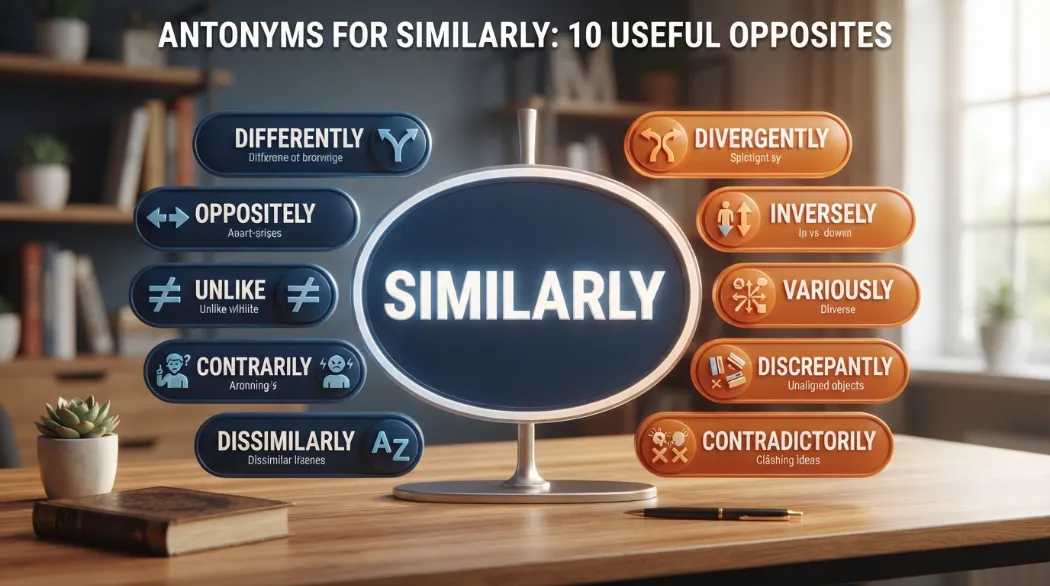
The main antonyms for similarly are differently, dissimilarly, and unlike in appropriate sentence structures. Similarly means “in a similar way” or “in a comparable manner,” while its opposite describes actions, qualities, or situations that are different rather than alike.
Quick Answer
The strongest and most natural antonym of similarly is “differently.”
Depending on the sentence, other useful opposites include:
- Differently: in a different way.
- Dissimilarly: in a way that is not similar; more formal.
- Distinctly: in a clearly different or separate way.
- Contrarily: in an opposite or contrary way.
- Unlike: different from, although it usually requires a noun or pronoun rather than functioning as a direct adverbial replacement.
For everyday English, differently is usually the best choice.
Quick Comparison Table
| Word | Meaning | Example |
| Similarly | In a similar way | The two students answered similarly. |
| Differently | In a different way | The two students answered differently. |
| Dissimilarly | In a dissimilar way | The cultures developed dissimilarly. |
| Contrarily | In an opposite way | The evidence points contrarily to that claim. |
Definition
Similarly: In a way that is similar to something else.
Main antonym: Differently in a way that is not the same or similar.
Learning Outcomes
After reading this guide, you will know:
- The most natural antonym of similarly
- When to use differently and dissimilarly
- Why unlike is related but not always a grammatical substitute
- How to use these words naturally in sentences
Core Antonyms for Similarly
1. Differently
Meaning: In a way that is different from another person, thing, or situation.
Example:
The two researchers interpreted the results differently.
Best for: Everyday English, academic writing, conversation, and general comparisons.
Why it is the best antonym:
Similarly and differently are natural opposites when describing how something is done.
She responded similarly to her colleague.
She responded differently from her colleague.
2. Dissimilarly
Meaning: In a way that is not similar.
Example:
The two species behave dissimilarly under changing conditions.
Best for: Formal, academic, or technical writing.
Usage note:
Although dissimilarly is a genuine antonym, it is much less common in everyday English than differently. In most situations, differently sounds more natural.
3. Contrarily
Meaning: In a contrary or opposing way.
Example:
The two witnesses described the event contrarily.
Best for: Situations where the difference is not merely noticeable but opposes or contradicts another view, action, or result.
Important distinction:
Contrarily is stronger than differently. Things can be different without being opposite.
4. Distinctly
Meaning: In a clearly different or separate manner.
Example:
The two groups responded distinctly to the new policy.
Usage note:
Distinctly is a contextual opposite, not a perfect dictionary-style antonym of similarly. It emphasizes clear separation or difference.
5. Separately
Meaning: In a separate or independent way.
Example:
The two issues should be considered separately.
This can contrast with similarly when two things are being treated together because they share characteristics.
However, separately is not a universal antonym of similarly. It works only in contexts involving separation or independent treatment.
Contextual Antonyms
Because similarly is an adverb, its opposite usually describes a different manner or relationship.
When similarly means “in the same way”
The natural opposite is:
Differently
The children learned similarly.
The children learned differently.
When similarly means “in a comparable way”
Use:
Differently or dissimilarly
The two companies operate similarly.
The two companies operate differently.
When similarly introduces a comparison
Sometimes the natural contrast is expressed with:
Unlike or in contrast
Similarly, both countries experienced economic growth.
In contrast, the two countries followed different policies.
Here, in contrast is often more natural than trying to force an adverbial antonym.
Antonym Meaning & Usage
Differently vs. Dissimilarly
These two words are the closest lexical opposites of similarly, but they have different levels of naturalness.
Differently is common and versatile:
The twins think differently.
Dissimilarly is more formal and specifically emphasizes a lack of similarity:
The two materials react dissimilarly to heat.
For most readers, differently is the better choice.
Differently vs. Contrarily
These words should not be treated as exact equivalents.
Differently simply means “in another way.”
Contrarily suggests opposition or contradiction.
Compare:
The students solved the problem differently.
They used different methods.
The two witnesses described the event contrarily.
Their accounts conflicted with each other.
Differently vs. Unlike
Differently is an adverb:
They behave differently.
Unlike is normally a preposition or conjunction-like comparative marker:
Unlike her sister, she prefers working alone.
So unlike can express the opposite idea but cannot simply replace similarly in every sentence.
Example Sentences
- The two machines work similarly.
- The two machines work differently.
- The sisters reacted differently to the news.
- The two cultures developed dissimilarly.
- The witnesses described the incident contrarily.
- Unlike his brother, Ali prefers working alone.
- The two companies have similar goals but operate differently.
- The students approached the assignment similarly.
- Their teachers, however, explained the concept differently.
- The two cases should be examined separately rather than treated as identical.
Grammar & Word Class
Similarly is an adverb.
It commonly modifies a verb or introduces a comparison:
Both students similarly approached the problem.
It is also frequently used at the beginning of a sentence:
Similarly, the second study produced positive results.
Its main antonym: differently
Differently is also an adverb, making it a particularly clean grammatical counterpart.
The two researchers worked similarly.
The two researchers worked differently.
Dissimilarly and contrarily are also adverbs.
By contrast, unlike belongs to a different grammatical category, so its sentence structure is different.
Common Mistakes
Mistake 1: Assuming “unlike” can always replace “similarly”
❌ The two students studied unlike.
This is unnatural.
✅ The two students studied differently.
But:
✅ Unlike her classmates, Sara studied at home.
Unlike normally introduces the person, thing, or group being contrasted.
Mistake 2: Using “contrarily” for every difference
❌ The two shops are contrarily decorated.
If the shops simply have different designs, differently is more appropriate.
✅ The two shops are decorated differently.
Use contrarily when there is genuine opposition or contradiction.
Mistake 3: Choosing “dissimilarly” just because it looks like the exact opposite
Dissimilarly is grammatically valid, but it is relatively formal and less common.
In ordinary conversation:
They dress differently.
is much more natural than:
They dress dissimilarly.
Expert Tip
When you need the opposite of similarly, start with differently. Choose a more specific alternative only when the context requires it:
differently = not in the same way
dissimilarly = lacking similarity
contrarily = in an opposing way
unlike = different from someone or something
This keeps your word choice both accurate and natural.
Mini Practice
Choose the best word
1. The two students approached the problem ________.
A. differently
B. similarly
C. alike
2. ________ her sister, Maria prefers working alone.
A. Differently
B. Unlike
C. Dissimilarly
Answers:
1. A — differently. The sentence needs an adverb describing how the students approached the problem.
2. B — Unlike. Unlike correctly introduces the person being contrasted with Maria.
Short Questions & Answers
Q: What is the opposite of similarly?
The most natural opposite of similarly is differently, meaning “in a different way.” Other contextual alternatives include dissimilarly, contrarily, and in contrast.
Q: What is a stronger opposite of similarly?
Contrarily can express a stronger contrast because it suggests opposition rather than simple difference. However, it should not be used when two things are merely different.
Q: Is differently the best antonym for similarly?
Yes. Differently is generally the most natural and useful antonym of similarly, especially in everyday, academic, and professional English.
Q: Can unlike replace similarly?
No, not in every sentence. Unlike has a different grammatical function and usually introduces the person or thing being contrasted, as in “Unlike her brother, she works remotely.
Final Verdict
Differently is the clearest and most useful antonym of similarly.
Use:
- Differently for ordinary contrasts.
- Dissimilarly for a more formal expression of lack of similarity.
- Contrarily when the difference involves opposition.
- Unlike when directly comparing one person or thing with another.
- In contrast when contrasting ideas, results, or situations.
The key lesson is that not every word expressing difference is a direct grammatical replacement for “similarly.”
Antonyms for Setting: Opposites by Context

Hi, I’m Amna Akhtar. I write about word their meanings, opposites, and the small distinctions that make English tricky. I don’t come at language purely from instinct, either. I have a peer-reviewed academic paper “Determinants of Jobs Satisfaction of Female Teachers: An Evidence from District Hafizabad, Pakistan,” published in education economics, and that research background shapes how I think about language content, I want it to actually help people learn, not just look correct on a page. Whether you’re a student, a writer, or just someone who wants to use the right word at the right moment, my goal is to make that easier for you.