Quick Answer
Textile has no true opposite word, and it is better to say that plainly than to invent one. A textile is cloth made by weaving or knitting fibre. Words like soft, rough, thick and thin describe cloth. They do not stand opposite to it. The honest answers are the things cloth is made from, and the materials that never pass through a loom: raw fibre, unwoven material and nonwoven fabric.
Quick Comparison
| Word | Type | Meaning | Example |
|---|---|---|---|
| Raw fibre | Opposite (before stage) | The natural or synthetic thread material before any weaving or knitting | The mill buys raw fibre by the bale and turns it into cloth. |
| Unwoven | Opposite (process) | Material that has not been woven or knitted at all | Felt is the famous unwoven material in every craft shop. |
| Nonwoven | Opposite (industry class) | Fabric bonded by heat, glue or pressure instead of weaving | Hospital masks are made of nonwoven fabric, not textile. |
| Yarn | Related stage, not opposite | Fibre spun into thread, ready for the loom | Yarn sits between raw fibre and finished textile. |
What Textile Means
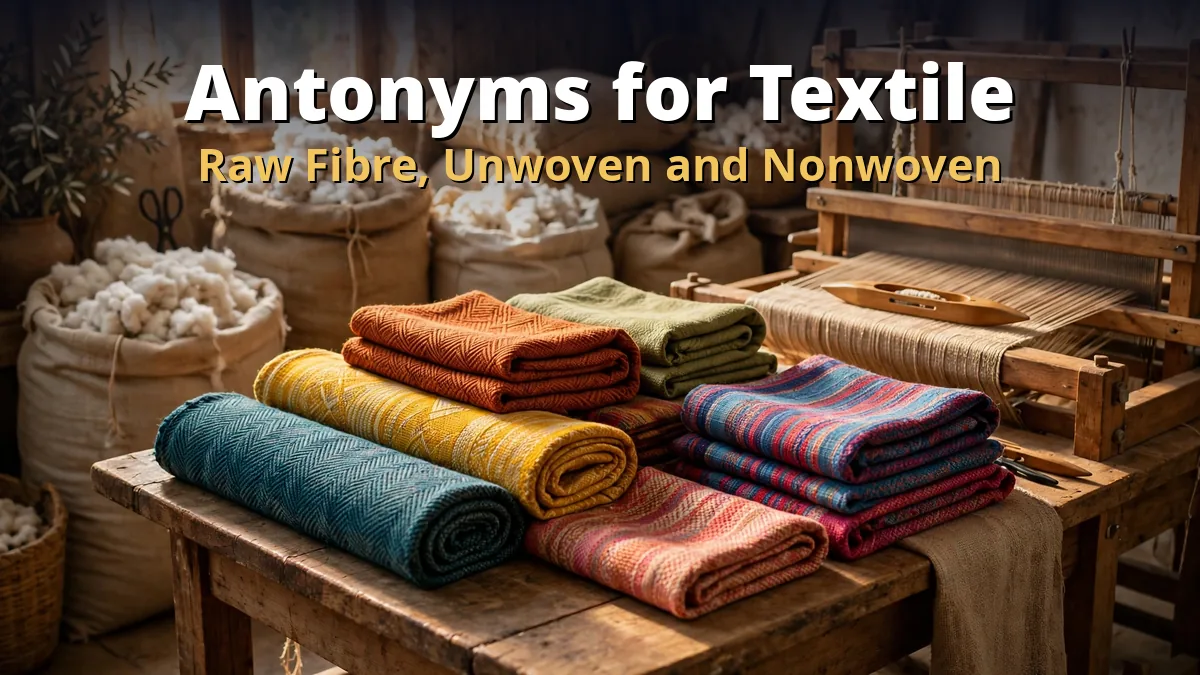
A textile is any cloth made by weaving or knitting. The word comes from a Latin verb that means to weave, and weaving still sits at the heart of it. Cotton shirts, wool blankets, silk scarves and nylon ropes are all textiles. So are carpets and curtains. If thread has been crossed over thread to make a sheet of material, you are looking at a textile.
Now think about what an opposite would have to do. Hot has cold. Rough has smooth. But textile names a thing, not a quality. A thing can have a source, a rival or a stage before it. It cannot have a simple reverse. That is why honest word lists struggle with this keyword, and why padded lists fill the gap with words like hard or solid that mean nothing here. This page takes the honest road. It gives you the real contrasts that tailors, traders and students actually use.
Core Antonyms
1. Raw Fibre
Meaning: The basic material, such as cotton, wool, flax or synthetic filament, before it is spun or woven into anything.
Example: At the start of the line you see raw fibre in bales. At the end you see textile on rolls.
Best context: Mills, trade, farming and lessons about how cloth is made.
Nuance: Raw fibre is the before stage of every textile. It is the closest thing to an opposite that the making process offers. One is the ingredient. The other is the meal.
2. Unwoven
Meaning: Not woven and not knitted. The fibres are pressed, matted or tangled together instead.
Example: Her hat was made of unwoven felt, so it had no threads to pull loose.
Best context: Craft, felt, leather work and simple descriptions of material.
Nuance: Unwoven is a plain English word that anyone can understand at once. Felt is its best example. Leather also belongs here, since skin is never woven at all.
3. Nonwoven
Meaning: The industry name for fabric made by bonding fibres with heat, chemicals or pressure, with no weaving or knitting involved.
Example: The factory makes both lines side by side: woven textile for shirts, and nonwoven rolls for hospitals.
Best context: Industry, medicine, trade exams and product labels.
Nuance: In the cloth trade, goods are sorted into woven, knitted and nonwoven. Textile in its strict trade sense covers the first two. Nonwoven is the third box, and that makes it the working opposite inside the industry.
Opposites by Context
In a clothing lesson: the contrast children learn is between cloth and the fibre it came from. Wool on the sheep, yarn on the spool, textile on the table.
In home furnishing: hard surfaces answer soft furnishings. A room of wood, glass and steel has no textiles in it, and writers use bare or hard where a single opposite word is needed.
As an adjective: textile most often appears in phrases like textile mill, textile waste and textile trade. These phrases have no opposite forms. Nobody says a non textile mill and means the reverse. The phrases are labels, not scales.
Words That Are Not Antonyms
- Hard, solid, stiff: these describe how a material feels. A textile can be stiff, as any starched collar proves. A word that can describe the thing itself cannot be its opposite.
- Natural, synthetic: these sort fibres by origin. Both kinds become textiles the moment they are woven, so neither stands against the word.
- Garment, clothing: a garment is something made out of textile. A product is not the opposite of its material.
Example Sentences
- Textile: The textile on this roll will become school uniforms.
- Raw fibre: Raw fibre arrives at the mill in heavy bales.
- Unwoven: The unwoven felt kept its shape without a single stitch.
- Nonwoven: Nonwoven fabric is cheap, light and made to be thrown away.
- Yarn: Good yarn makes honest work for the weaver.
Common Mistakes
1. Textile and fabric treated as different worlds
Incorrect: The shop sells fabrics, not textiles.
Correct: The shop sells textiles of every kind, from cotton fabric to wool.
Why? In daily speech the two words cover the same ground. Textile is the wider and more formal word. Fabric leans toward cloth for clothes and homes. Setting them against each other as opposites is an error.
2. “A textile” used for one thread or one fibre
Incorrect: She pulled a textile out of the sweater.
Correct: She pulled a thread out of the sweater.
Why? A textile is the whole woven sheet. Its parts are threads, yarns and fibres. Naming the part with the word for the whole confuses every reader who works with cloth.
Mini Quiz
1. A bale of cotton that has not been spun or woven is best called what?
Answer: Raw fibre.
2. True or false: synthetic is an antonym of textile.
Answer: False. Synthetic fibres are woven into textiles every day.
3. Which class of fabric is made without weaving or knitting?
Answer: Nonwoven fabric.
Short Q&A
Does textile have a real antonym?
No single word. Textile names a material, and materials do not come in opposite pairs. The useful contrasts are raw fibre before it, and unwoven or nonwoven material beside it.
What is the difference between unwoven and nonwoven?
Almost none in meaning. Unwoven is the plain word for daily use. Nonwoven is the trade term you will meet on labels, in factories and in exams.
Is leather a textile?
No. Leather is animal skin, prepared by tanning. It is never woven, so it stands outside the textile family, with felt beside it.
Why do some sites list hard as the opposite of textile?
Because lists get padded. Hard describes a feel, not a class of material, and plenty of textiles are hard. Honest answers serve the reader better than long ones.
Key Takeaways
- Textile has no true single opposite, because it names a thing and not a quality.
- The real contrasts are raw fibre before weaving, unwoven material such as felt and leather, and nonwoven fabric in the trade sense.
- Words like hard, natural and synthetic describe textiles. They cannot oppose them.

I’m Leo Jackson, an English writer with a soft spot for the peculiarities of language and vocabulary. He specializes in exploring the nuances of English synonyms, antonyms, helping students, writers, and professionals choose the right word with confidence. My guides combine careful research with clear, practical explanations.