Quick Answer
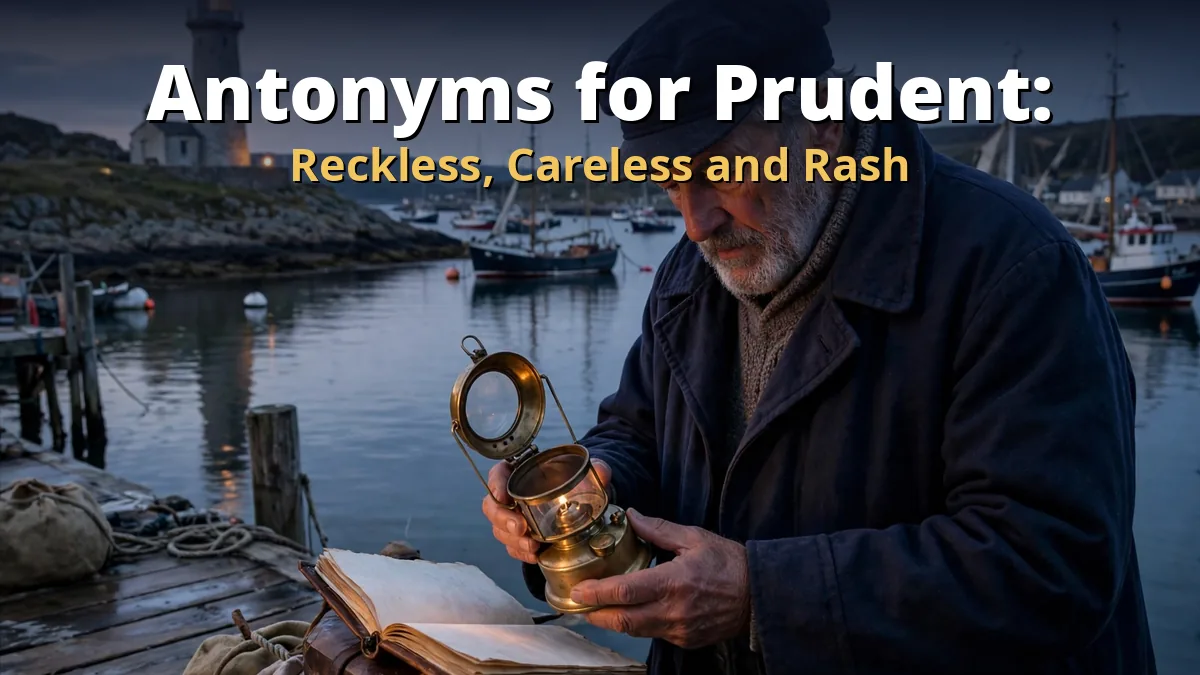
A prudent person thinks ahead, weighs the risk and acts with care. The opposites attack each part of that habit. Reckless ignores danger altogether, careless forgets the attention the moment needs, and rash acts before thinking. In formal writing, imprudent is the direct built opposite and covers all three failings at once.
Quick Comparison
| Word | Type | Meaning | Example |
|---|---|---|---|
| Reckless | True opposite | Taking no care about danger or consequences | Reckless driving on the wet road ended the trip early. |
| Careless | True opposite | Not giving the attention or thought that a task requires | A careless signature cost him the house deposit. |
| Rash | True opposite | Acting suddenly and without enough thought | It was a rash promise, made in a minute and regretted for a year. |
| Imprudent | True opposite (formal) | Not showing care for the future; unwise | The court called the loan imprudent from the first day. |
What Prudent Means
Prudent comes from the Latin word for foreseeing, and the idea of seeing ahead still sits at its centre. A prudent driver slows down before the bend she cannot see around. A prudent family keeps savings for the month when work stops and a prudent ruler asks what a decision will cost in ten years, not what it wins this week. Care, foresight and restraint travel together in this word, and an opposite has to break at least one of the three.
That is why this keyword has several true answers rather than one. Reckless breaks the care for safety. Careless breaks the attention. Rash breaks the timing, by acting now and thinking later. Imprudent, the formal twin, breaks the whole pattern and is therefore the safest choice in reports, law and finance. A close cousin of prudence in speech is discretion, and readers who want that side of the family can see our guide to antonyms for discreet.
Core Antonyms
1. Reckless
Meaning: Showing no care about danger to oneself or others, or about the results of an action.
Example: It was reckless to cross the flooded bridge with children in the car, and everyone in the village said so.
Best context: Driving, safety, adventure, law and any scene where real harm is possible.
Nuance: Reckless is the strongest of the group because danger is inside its meaning. A prudent act protects the future; a reckless act gambles it. Where no harm is possible, reckless is too heavy, and one of the next two words will fit better.
2. Careless
Meaning: Not giving enough attention or thought; done through neglect rather than daring.
Example: One careless entry in the ledger undid a year of prudent bookkeeping.
Best context: Work, writing, records, driving at the everyday level, and habits rather than adventures.
Nuance: Careless fails quietly. The reckless man sees the cliff and drives on; the careless man never looks up from his phone. Both oppose prudence, but the first opposes its courage control while the second opposes its attention. Choose by asking which failure the sentence is really about.
3. Rash
Meaning: Done or decided too quickly, without enough thought about what follows.
Example: Resigning in anger was a rash act that a prudent night of sleep would have prevented.
Best context: Decisions, promises, words spoken in heat, purchases and resignations.
Nuance: Rash is the opposite of prudence in timing. The rash person may be kind, brave and even careful later; the fault is that the action came first and the thinking second. It is the natural word for decisions, where reckless would wrongly suggest danger.
4. Imprudent
Meaning: Not prudent; failing to show care and foresight, especially in formal or financial matters.
Example: Lending the whole fund to one borrower was imprudent, whatever the borrower’s promises.
Best context: Finance, law, official reports, policy and formal criticism.
Nuance: Imprudent is the exact negative of the word itself, which makes it precise but a little stiff for everyday writing. It carries judgement without drama: no cliff, no anger, just a failure of foresight recorded in a level tone. Committees and courts prefer it for exactly that reason.
Opposites by Context
With money: wasteful and extravagant join imprudent. A prudent household saves against a hard season; a wasteful one spends the reserve on display. Where the spending is showy rather than merely unwise, extravagant is the sharper word.
In speech: indiscreet and tactless. The prudent speaker weighs words before they leave; the indiscreet one publishes every thought. This is the bridge sense between prudence and discretion.
In judgement and planning: foolish and short sighted. A prudent plan survives contact with next year; a short sighted one wins the month and loses the decade. Foolish is the plain everyday word and carries a stronger personal judgement, so use it where the writer means to judge.
Words That Are Not Antonyms
- Brave, bold, daring: courage is not the opposite of prudence. A prudent soldier can be brave with a plan; a reckless one is brave without one. The two scales cross often, which is why bold does not belong on this page as an opposite.
- Generous: a prudent person can give freely within a budget. Generosity opposes stinginess, and stinginess is a corruption of prudence, not prudence itself.
- Strict, stern: these describe manner toward others. Prudence describes how a person handles risk and the future, and a gentle person can be perfectly prudent.
Example Sentences
- Prudent: The prudent captain turned back before the storm reached the harbour.
- Reckless: The reckless captain sailed into it for the sake of one day saved.
- Careless: A careless worker left the gate open and the goats did the rest.
- Rash: Do not make a rash offer on the house before the survey returns.
- Imprudent: The report called the purchase imprudent and the timing worse.
Common Mistakes
1. Reckless and careless used as if they were twins
Incorrect: He was reckless to forget his umbrella on a cloudy day.
Correct: He was careless to forget his umbrella on a cloudy day.
Why? Reckless needs danger. Forgetting an umbrella risks wet shoes, not harm, so the heavy word makes the sentence ridiculous. Save reckless for cliffs, brakes and loaded risks; careless covers the small neglects of a day.
2. Prudent confused with stingy
Incorrect: She is too prudent to tip the waiter.
Correct: She is too stingy to tip the waiter.
Why? Prudence is care about real risk and the future. Refusing a fair tip risks nothing and protects nothing; it is meanness, and English has a word for it. Calling it prudence flatters the fault and insults the virtue.
Mini Quiz
- A driver speeds through fog with his lights off. Prudent, careless or reckless?
- Which formal opposite would a bank report choose for a prudent lending policy?
- True or false: a brave act cannot be prudent.
Answer: Reckless. Real danger is being ignored, which is recklessness rather than mere inattention.
Answer: Imprudent.
Answer: False. Bravery and prudence work on different scales, and a brave act with a sound plan is both.
Short Q&A
What is the single most accurate opposite of prudent?
Imprudent, since it negates the word itself. In everyday writing, reckless and careless are used far more often, each for its own kind of failure.
Is foolish an antonym of prudent?
In effect, yes, though it judges the person more than the act. Foolish is the plain word; prudent writers reach for rash, careless or imprudent when they want precision instead of blame.
Prudent or thrifty: do they share opposites?
Partly. Wasteful and extravagant oppose both in money matters. But prudence is wider than thrift, covering safety, speech and timing, where its opposites are reckless, indiscreet and rash.
Can a decision be rash and still turn out well?
Yes. Rash describes how the decision was made, not how it ended. A lucky outcome does not repair a thoughtless process, which is why the word survives the happy ending.
Key Takeaways
- Reckless opposes prudence where danger is ignored, careless where attention fails, and rash where action outruns thought.
- Imprudent is the exact formal opposite and the safe choice in finance, law and reports.
- Brave and generous are not opposites of prudent; courage and giving sit on different scales from foresight and care.

Hi, I’m Amna Akhtar. I write about word meanings, opposites, and the small distinctions that make English tricky. I don’t come at language purely from instinct, either. I have a peer-reviewed academic paper “Determinants of Jobs Satisfaction of Female Teachers: An Evidence from District Hafizabad, Pakistan,” published in education economics, and that research background shapes how I think about language content, I want it to actually help people learn, not just look correct on a page. Whether you’re a student, a writer, or just someone who wants to use the right word at the right moment, my goal is to make that easier for you.