Quick Answer
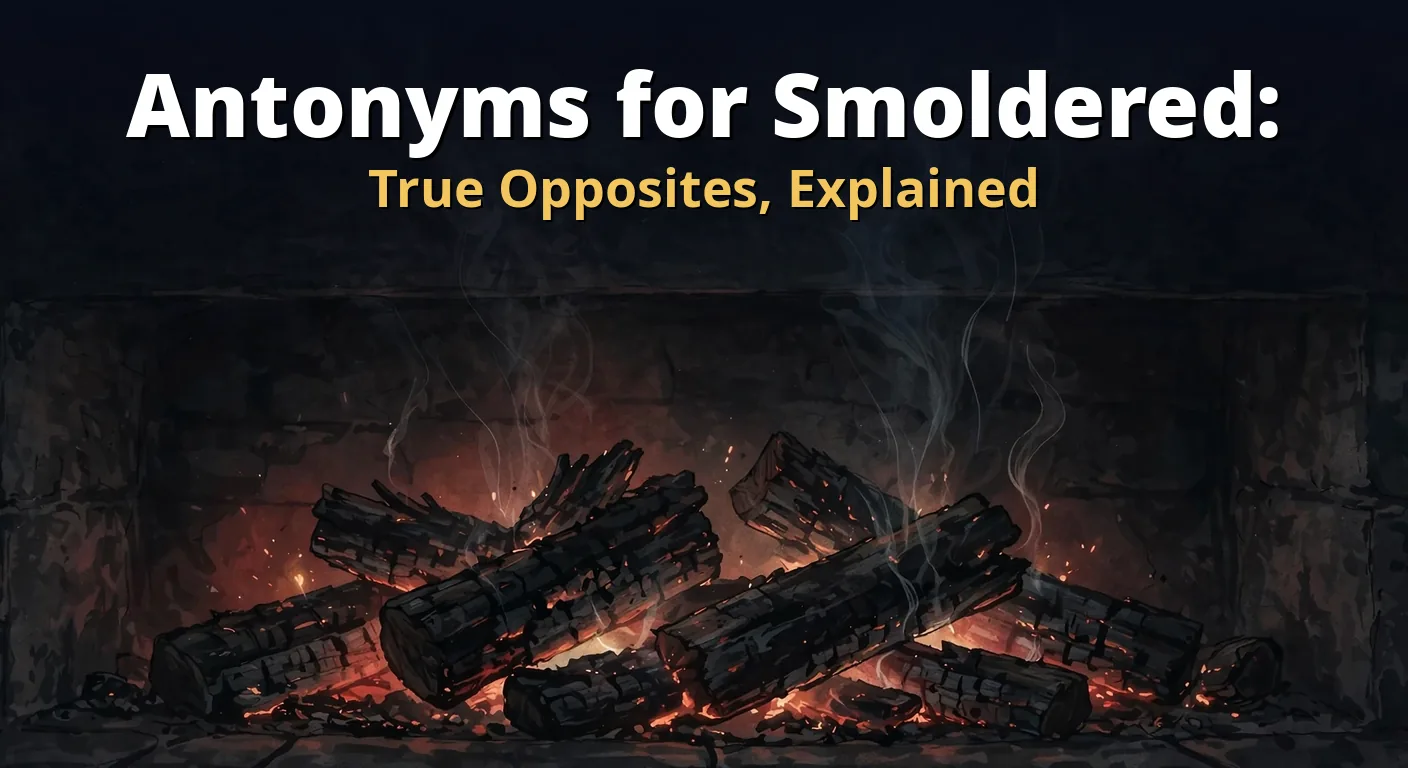
Smoldered is the past tense of smolder: to burn slowly, with smoke but little or no flame. In British English the verb is spelled smoulder, so the British past tense is smouldered; smoldered is the American spelling. Its opposites split by the verb’s two senses:
- Literal (something burning): the burning ended entirely: went out or was extinguished: or weakened towards ending: died down.
- Figurative (a feeling held beneath the surface): the anger, resentment or tension faded: subsided, calmed down or eased.
Because the headword is a past-tense verb form, most of its opposites are phrasal verbs or phrases rather than single words. One warning: flared up is not an opposite of the burning itself: it reverses only the intensity, as explained below.
Quick Comparison
| Opposite | Sense | Example |
|---|---|---|
| Went out | Literal: the burning stopped on its own | The embers smoldered all night and went out before dawn. |
| Was extinguished | Literal: the burning was deliberately put out | The smoldering rubbish was extinguished by firefighters. |
| Died down | Literal: the burning weakened towards ending | The fire died down, though the logs still smoldered faintly. |
| Flared up | Literal: intensity contrast only | A gust of wind made the embers flare up into flame. |
| Subsided | Figurative: a feeling gradually weakened | The resentment that had smoldered for months finally subsided. |
| Calmed down | Figurative: a person became less angry | He smoldered through the meeting, then calmed down. |
| Eased | Figurative: tension gradually relaxed | The tension eased once both sides had talked. |
About the Word: Smoldered or Smouldered?
Smoldered is the simple past tense and past participle of the American spelling smolder. British English adds a u: smoulder, past tense smouldered. So the British spelling is smouldered: any source that gives “smoldered” as the British form is wrong. Pick one spelling system and use it consistently throughout a piece of writing.
The past-tense headword also explains the shape of the lists below: English rarely reverses “burned slowly” with a single verb, so every opposite here is given in the past tense, to match smoldered, and labelled as a word, phrase or phrasal verb.
Core Opposites of Smoldered
Literal Sense: Burning Slowly Without Flame
1. Went Out (phrasal verb)
Meaning: Stopped burning completely, by itself.
Example: The last coal smoldered for hours before it finally went out.
Nuance: The most natural everyday opposite. Went out implies nobody put the fire out: it simply stopped. Use it for fires, embers, candles and cigarettes that end on their own.
2. Was Extinguished (phrase: past passive)
Meaning: Was deliberately put out by someone or something.
Example: The mattress had smoldered undetected for an hour before it was extinguished.
Nuance: Formal and safety-related in tone. The passive keeps the burning thing as the subject, matching smoldered: the fire was extinguished by the crew, just as it had smoldered in the wall.
3. Died Down (phrasal verb)
Meaning: Gradually became weaker, heading towards stopping, without necessarily ending completely.
Example: By midnight the flames had died down, and the logs merely smoldered.
Nuance: The opposite of degree. Where went out and was extinguished end the burning entirely, died down describes it fading: the fire may still smolder faintly afterwards.
Flared Up (phrasal verb): an intensity contrast, not a true opposite
Meaning: Suddenly burst into open flame, or became much stronger.
Example: The embers had smoldered quietly until a draught made them flare up.
Nuance: Handle with care. Smoldering is burning at its lowest level; flaring up is the sudden move in the opposite direction, from faint glow to open flame: a genuine contrast of intensity. But the fire does not stop; it gets worse. Flared up therefore reverses the intensity of smoldering, not its existence.
Figurative Sense: A Feeling Held Beneath the Surface
Smoldered also describes anger, resentment, desire or tension that exists quietly and restrained, sometimes for a long time. Its opposites describe that feeling fading.
4. Subsided (word)
Meaning: Gradually became less intense until it faded.
Example: The anger that had smoldered between them since the argument slowly subsided.
Nuance: The closest figurative opposite. The subject is the feeling itself, and the fading is gradual and happens on its own.
5. Calmed Down (phrasal verb)
Meaning: Became less angry, upset or agitated.
Example: She smoldered through the whole discussion, but she calmed down once she had said her piece.
Nuance: The subject is the person, not the feeling, and the register is conversational. Never use it for an actual fire.
6. Eased (word)
Meaning: Became less severe or tense; relaxed gradually.
Example: Hostility between the two departments smoldered all winter and eased only after the reorganisation.
Nuance: Best for tension, pressure and difficult situations rather than one person’s temper. It is also the gentlest of the three: something that eased may still be present, only weaker.
Example Sentences
- The campfire smoldered in the damp leaves but never quite went out.
- Firefighters extinguished the sofa, which had smoldered inside the wall for hours.
- His resentment smoldered for years before it finally subsided.
- She calmed down after a short walk, though her frustration had smoldered all morning.
- The dispute smoldered on for months and eased only when new managers arrived.
Common Mistakes
Mistake 1: Calling “flared up” the direct opposite
Flared up reverses the direction of intensity, not the fact of burning. A fire that flares up has not stopped smoldering and ended: it has started burning more. It is a contrast of intensity, and listing it among opposites that mean “the burning stopped” misleads the reader.
Mistake 2: Using “calmed down” for a fire
People calm down; fires do not. For a real fire, choose went out, was extinguished or died down.
Mistake 3: Getting the British spelling wrong
The British past tense is smouldered, with a u, from smoulder. “Smoldered” is the American form. Mixing the two: or stating that British English uses smoldered: is a plain factual error.
Mistake 4: Dropping back into the present tense
Because the headword is a past-tense form, its opposites should match it: went out, died down, calmed down: not go out, die down, calm down: whenever the sentence is about the same past event.
Mini Quiz
1. The embers smoldered under the ash and _ by morning, without anyone touching them.
A. were extinguished
B. went out
C. flared up
Answer: B. Nothing and nobody put them out, so they went out. Were extinguished needs someone to do the extinguishing, and flared up would mean they burst into flame.
2. Which is the correct British past tense of the verb?
A. smoldered
B. smouldered
C. smolderd
Answer: B. British English spells the verb smoulder, so its past tense is smouldered. Smoldered is American.
3. His anger had smoldered all week, but after the apology it gradually _.
A. was extinguished
B. went out
C. subsided
Answer: C. Feelings subside as they weaken gradually. Was extinguished and went out belong to the literal, burning sense.
Short Q&A
Q: What is the main opposite of smoldered?
A: For a fire or embers, went out. For anger, resentment or tension, subsided.
Q: Is “flared up” an antonym of smoldered?
A: Not of the burning itself. It is a contrast of intensity: smoldering is burning at the lowest level, flaring up is the sudden jump to open flame. The burning continues: indeed, it gets stronger: so flared up does not mean the smoldering ended.
Q: What is the British spelling?
A: Smouldered: the past tense of smoulder, with a u. Smoldered is the American spelling of the same word.
Q: Why are so many of the opposites phrases instead of single words?
A: Because the headword is an inflected past-tense form. English usually reverses it with phrasal verbs (went out, died down, calmed down) or a passive phrase (was extinguished) rather than with one-word verbs.
Q: Can a feeling be “extinguished”?
A: Only in special figurative uses, such as her hopes were extinguished. For anger or resentment, native speakers normally choose subsided, eased or calmed down.
Key Takeaways
- Smoldered is the past tense of smolder (American); the British form is smouldered, from smoulder.
- Literal opposites: went out and was extinguished (the burning ended entirely) and died down (it weakened towards ending).
- Figurative opposites: subsided, calmed down and eased: for feelings and tension that fade.
- Flared up is an intensity contrast only: the burning or feeling continues, just stronger.

I’m Leo Jackson, an English writer with a soft spot for the peculiarities of language and vocabulary. He specializes in exploring the nuances of English synonyms, antonyms, helping students, writers, and professionals choose the right word with confidence. My guides combine careful research with clear, practical explanations.