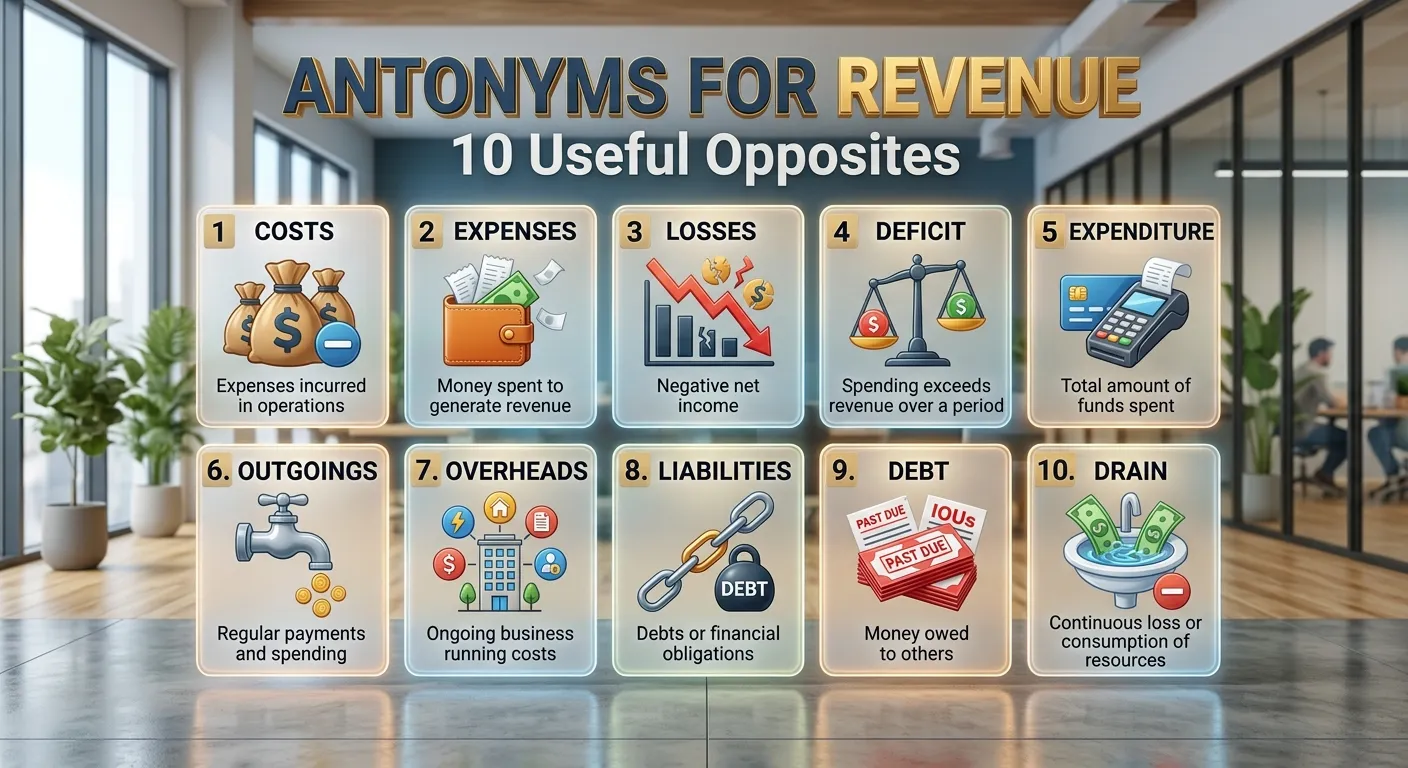
The main Antonym Explained
The most useful antonym for revenue is expense, especially in accounting and business contexts. Revenue is money earned by a business from its activities, while an expense is money spent to operate it. Depending on context, cost, expenditure, outflow, or loss may also provide a meaningful contrast.
At a Glance
There is no single perfect dictionary antonym for revenue. In business and accounting, the clearest contrasting term is expense.
- Revenue = money a business earns.
- Expense = money a business spends.
- Expenditure = money spent, often referring to a specific spending activity.
- Cost = the amount required to obtain or produce something.
- Outflow = money leaving a business or account.
- Loss = a financial result in which expenses or other costs exceed revenue.
So, if you need an opposite for revenue in financial writing, expense is usually the most useful choice.
Side by Side Comparison
| Word | Meaning | Example |
| Revenue | Money earned from business activities | The company’s revenue increased this year. |
| Expense | Money spent to operate a business | Rent is a major business expense. |
| Expenditure | Money spent on something | The project required significant expenditure. |
| Cost | Amount needed to produce or obtain something | Labor is a major production cost. |
| Outflow | Money leaving a business or account | The company experienced a large cash outflow. |
| Loss | A negative financial result | The company reported a loss for the quarter. |
The Meaning of Revenue
Revenue: Money earned by a business, organization, or individual from selling goods, providing services, or other income-generating activities.
Main contrasting term: Expense money spent to operate a business or carry out an activity.
What Are the Main Antonyms of Revenue?
Because revenue describes money coming in from earning activities, its opposites are usually contextual contrasts rather than strict lexical antonyms.
1. Expense
Expense is the clearest business contrast to revenue.
It refers to money a business spends while operating, such as rent, salaries, utilities, or advertising.
The company generated $2 million in revenue but had $1.5 million in expenses.
Best context: accounting, finance, business, financial reports.
2. Expenditure
Expenditure means money that is spent, particularly on a particular activity, project, or purchase.
Government expenditure increased during the fiscal year.
It overlaps with expense, but the words are not always interchangeable. Expenditure often emphasizes the act or amount of spending, while expense commonly refers to a cost incurred in running an operation.
Best context: finance, government, business, formal writing.
3. Cost
Cost refers to the amount of money required to produce, purchase, or obtain something.
The cost of raw materials reduced the company’s margins.
Cost is related to revenue but is not its exact opposite. Revenue is money earned, whereas cost is money required or spent.
Best context: pricing, production, business, purchasing.
4. Outflow
Outflow describes money moving out of a business, account, or financial system.
The company experienced a significant cash outflow after purchasing new equipment.
This creates a particularly clear directional contrast:
Revenue → money coming in
Outflow → money going out
However, not every outflow is an expense. For example, purchasing an asset can create a cash outflow without being treated as an immediate operating expense.
Best context: cash flow and financial analysis.
5. Loss
Loss describes a negative financial result rather than simply money leaving a business.
The company reported a net loss despite generating substantial revenue.
This distinction matters. A company can have high revenue and still make a loss if its total expenses and other costs are greater than its revenue.
Therefore, loss is better understood as a financial-result contrast, not a direct antonym of revenue.
6. Deficit
Deficit refers to a situation in which available income or resources are less than what is required or spent.
The organization faced a budget deficit after expenses exceeded available income.
It is useful when discussing governments, organizations, budgets, or financial shortfalls.
Best context: budgets, government finance, organizational finance.
7. Spending
Spending refers to the act of using money to pay for goods, services, or other needs.
Consumer spending rose while business revenue declined.
It provides a simple everyday contrast to revenue, although it is less precise than expense in accounting language.
Best context: everyday English, economics, business discussions.
8. Payment
Payment is money given to another person or organization in exchange for something.
The company made a large payment to its supplier.
Payment can contrast with revenue from the perspective of money leaving the business, but it is not a strict antonym. A payment made by one business can become revenue for another.
Best context: transactions, purchases, invoices.
9. Disbursement
Disbursement means money paid out or distributed by an organization.
The agency recorded several large disbursements during the project.
It is more formal and is particularly useful when discussing organizations, funds, loans, or official payments.
Best context: formal finance, accounting, institutions.
10. Financial Shortfall
Financial shortfall describes a situation in which available money or income is insufficient to meet financial needs.
The nonprofit faced a financial shortfall after donations declined.
Unlike expense, this phrase describes a financial deficiency, so it should be used when the intended meaning is insufficient income rather than simply spending.
Context Matters: Revenue Does Not Have One Exact Antonym
This is the most important point for learners.
Revenue and expense are commonly contrasted because they represent two different sides of business finances:
Revenue − Expenses = Profit or Loss
But they are not perfect lexical opposites in the same way that hot and cold are.
Different contexts call for different contrasting words:
| Context | Useful contrast |
| Business accounting | Expense |
| Money spent | Expenditure |
| Production or purchasing | Cost |
| Cash movement | Outflow |
| Negative financial result | Loss |
| Budget imbalance | Deficit |
| Everyday spending | Spending |
| Money formally paid out | Disbursement |
Revenue vs. Expense
This is the most important comparison.
Revenue represents money earned.
Expense represents money spent or costs incurred in running an operation.
The restaurant increased its revenue while reducing its operating expenses.
Revenue vs. Cost
These terms are closely related but not interchangeable.
A business can earn revenue by selling a product, while the cost represents what it takes to produce or obtain that product.
The product generated $50,000 in revenue, while its production costs were $30,000.
Revenue vs. Loss
These words describe different financial concepts.
Revenue is an income figure.
Loss is a negative financial outcome.
The company earned $5 million in revenue but still recorded a loss.
This is why calling loss the direct antonym of revenue can be misleading.
Example in Context
Here are natural examples showing how these contrasting terms work:
- The company increased its revenue while keeping its expenses under control.
- Rising costs reduced the company’s profit margin.
- Capital expenditure increased after the company opened a new facility.
- The business experienced a significant cash outflow during the expansion.
- Despite strong revenue, the company reported a loss.
- The government reduced unnecessary spending.
- The organization recorded a budget deficit.
- Several large disbursements were made during the project.
Grammar and Word Forums
Revenue is primarily an uncountable noun when it refers to income earned by a business or organization.
- The company reported strong revenue.
- Revenue has increased this year.
The main contrasting terms are also nouns:
- revenue
- expense
- expenditure
- cost
- outflow
- loss
- deficit
- spending
- payment
- disbursement
A Useful Grammar Point
Use revenue from when identifying the source of income:
The company earns revenue from online sales.
You can also use revenue generated by:
The campaign generated significant revenue.
For expenses, common structures include:
The company incurred expenses on equipment and labor.
Avoid These Usage Errors
Mistake 1: Treating profit as the antonym of revenue
❌ Revenue is the opposite of profit.
✅ Revenue and profit are different financial measures.
Revenue is the money earned. Profit is what remains after relevant expenses and costs are deducted.
Mistake 2: Assuming loss is always the opposite of revenue
❌ The opposite of revenue is always loss.
✅ Loss describes a negative financial result, not simply the absence of revenue.
A business can have substantial revenue and still make a loss.
Mistake 3: Using expense as though it means exactly the same thing as every type of outflow
❌ Every cash outflow is an expense.
✅ A cash outflow can result from an expense, asset purchase, debt repayment, or other transaction.
This distinction becomes important in accounting and cash-flow discussions.
Quick Vocabulary Tip
When you need one practical opposite of revenue, use expense in most business and accounting contexts. But when describing money movement, choose outflow; when describing a negative financial result, choose loss.
Mini Practice
Choose the best word:
The company earned $800,000 in revenue but spent $600,000 on salaries, rent, and utilities. These amounts are its ________.
A. losses
B. expenses
C. revenues
Answer: B. expenses
The salaries, rent, and utilities are costs incurred in operating the business, so they are expenses.
Short Questions & Answers
Q: What is the closest antonym of revenue?
Expense is the closest commonly used contrasting term, especially in business and accounting. Revenue is money earned, while an expense is money spent or incurred in operating a business.
Q: Is loss an antonym of revenue?
Not exactly. Loss describes a negative financial result, while revenue describes money earned. A company can generate significant revenue and still report a loss when its expenses and other costs exceed its revenue.
Q: What is the opposite of revenue in cash flow?
Cash outflow is the most useful contrast when the focus is on money entering versus leaving a business. Revenue can contribute to cash inflows, while expenses and other transactions can produce cash outflows.
Q: Are cost and expense the same as revenue’s antonym?
They are useful contrasting terms, but neither is a perfect antonym. Cost refers to what something requires financially, while expense generally refers to costs incurred in running an operation. Revenue refers to money earned.
What to Remember
- Expense is the most useful general contrast to revenue in business.
- Expenditure emphasizes money spent on an activity or purpose.
- Cost refers to the amount required to produce or obtain something.
- Outflow focuses on money moving out.
- Loss describes a negative financial result, not a direct opposite of revenue.
- Deficit is useful when income or available resources fall below requirements.
- There is no single perfect antonym for revenue in every context.
Antonyms for Salary: What Is the Opposite?

I’m Leo Jackson, an English writer with a soft spot for the peculiarities of language and vocabulary. Specializes in exploring the nuances of English synonyms, antonyms, helping students, writers, and professionals choose the right word with confidence. My guides combine careful research with clear, practical explanations.