Quick Answer
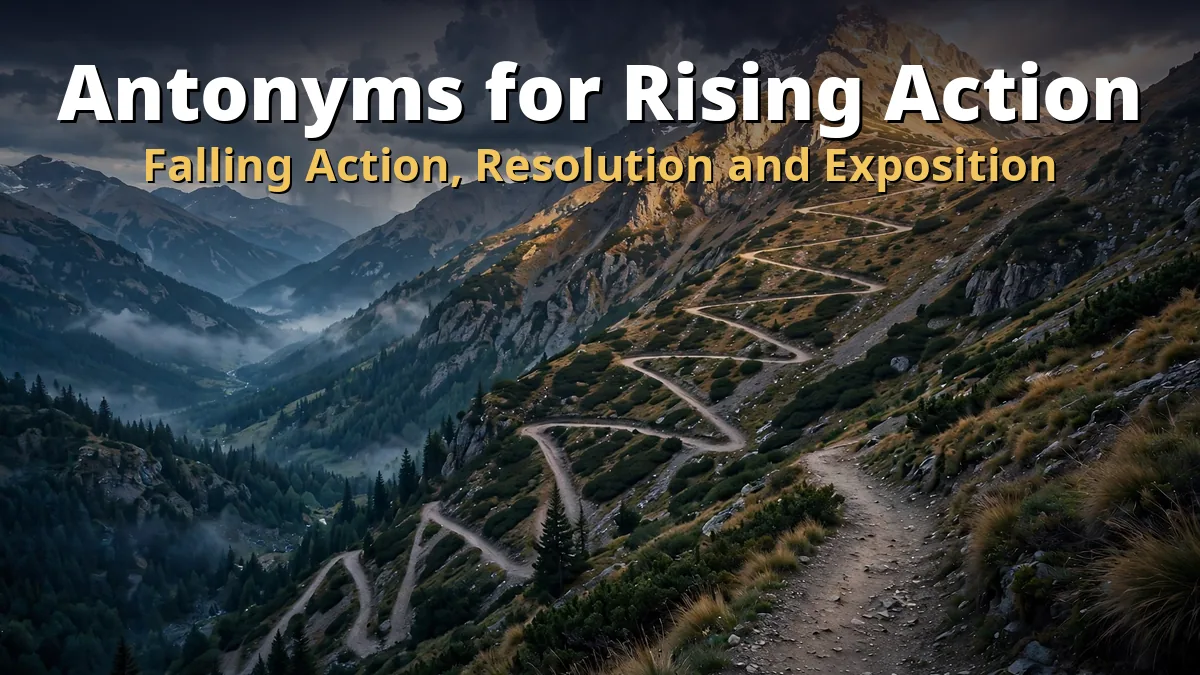
The opposite of rising action is falling action. Rising action is the part of a story where conflicts build and tension grows toward the climax. Falling action comes after the climax: tension eases, events slow down, and the story moves toward its ending.
Quick Comparison
| Phase | Type | Meaning | Example |
|---|---|---|---|
| Falling Action | True opposite | The part after the climax where tension eases and events move toward the ending | After the rescue, the falling action follows the crew as they sail home. |
| Resolution | Closing phase | The final part where the main problem is settled and loose ends are tied up | In the resolution, the missing heir returns and the quarrel ends. |
| Exposition | Opening phase | The opening part that introduces the setting, characters and background | The exposition introduces a lighthouse keeper and the storm season ahead. |
Note: Only falling action reverses rising action. Resolution and exposition are the neighbouring phases of the same plot structure, included because readers meet all of them together.
What Rising Action Means
Rising action is the series of events in a story that build tension and lead up to the climax.
Rising action is a noun phrase from the study of plot. Stories are often described in five parts, a model linked to the German writer Gustav Freytag: exposition, rising action, climax, falling action and denouement. During the rising action the main character meets complication after complication: conflicts appear, the stakes grow, and each setback makes the problem harder to escape. It grows out of the world the exposition introduces: the setting, the characters and the trouble waiting inside that world. The rising action question has a clean answer because the phases around the climax form a rising and falling pair.
Core Antonyms
Rising action has one true structural opposite: falling action. The two phases after it are included with honest labels, because plot diagrams teach the parts together and readers often pair the wrong ones.
1. Falling Action
Meaning: The part of a story after the climax in which tension decreases and events move toward the ending.
Example: Once the secret is revealed at the climax, the falling action follows the family as they deal with the consequences.
Best context: Essays, plot diagrams and story analysis, whenever you need the phase paired against rising action.
Nuance: Falling action is the mirror image of rising action: the same story, with the tension moving down instead of up. In most stories it is shorter than the rising action, because readers rarely need a long slope down.
2. Resolution (Denouement)
Meaning: The final part of a story, where the main problem is settled and loose ends are tied up.
Example: In the resolution, the two brothers meet again and the feud that divided the town is over.
Best context: When contrasting how a story closes with how it builds, or naming the very end of the structure.
Nuance: Resolution is a labelling contrast, not the exact opposite. It is the end state the falling action leads to: the falling action is the slope down, and the resolution is where the story comes to rest.
3. Exposition
Meaning: The opening part of a story, which introduces the setting, the characters and the background before the conflict develops.
Example: The exposition spends a chapter on the quiet village before the stranger arrives.
Best context: When comparing the start of the plot structure with its build and release.
Nuance: Exposition is a contrast of position, not a reversal. It stands before rising action rather than against it: beginning versus build-up.
Words That Are Not Antonyms
- Climax: the turning point and peak of tension that the rising action builds toward. It is the destination of rising action, not its opposite.
- Inciting incident: the event that sets the conflict in motion. It starts the rising action, or sits inside its first steps, rather than opposing it.
- Plot: the whole sequence of events in a story. Rising action is one part of the plot, so the whole cannot be the opposite of its part.
Example Sentences
- Rising action: In the novel’s rising action, the detective finds a new clue in every chapter, and each one raises the danger.
- Falling action: The falling action begins after the courtroom confession, as the family slowly rebuilds its life.
- Resolution: By the resolution, the lost brothers have met again and the feud is over.
- Exposition: The exposition describes the harbour town in detail before anything goes wrong.
- Rising action: In a three-act film, most of the second act is rising action: problem after problem piles onto the hero.
Common Mistakes
1. Treating the climax as the opposite of rising action
Incorrect: The climax is the opposite of the rising action.
Correct: The falling action is the opposite phase; the climax is the peak the rising action builds toward.
Why? Rising and falling describe direction: tension going up, then coming down. The climax is the top of the climb, not a direction at all.
2. Mixing up falling action and resolution
Incorrect: The falling action is where every loose end is finally tied up.
Correct: Falling action is the easing of tension after the climax; the resolution is where loose ends are tied up.
Why? The falling action is the slope; the resolution is the ground at the bottom of it. One leads into the other, but they are not the same part.
3. Calling exposition the antonym because it comes first
Incorrect: Exposition is the antonym of rising action because it comes first in the story.
Correct: Exposition comes before rising action; the paired opposite of rising action is falling action, which comes after the climax.
Why? Coming earlier is a position, not an opposite. Plot structure pairs the build-up with the release that answers it.
Mini Quiz: Test Your Knowledge
1. Which phase is the direct opposite of rising action?
A. Exposition
B. Falling action
C. Climax
Answer: B. Falling action.
Explanation: Rising and falling action are the paired phases around the climax: tension up, then tension down.
2. In which phase does tension ease after the turning point?
A. Falling action
B. Rising action
C. Exposition
Answer: A. Falling action.
Explanation: After the climax, the story’s pressure drops, and the falling action carries the characters toward the ending.
3. A story’s final scene settles every conflict and shows life back to normal. Which phase is this?
A. Rising action
B. Inciting incident
C. Resolution
Answer: C. Resolution.
Explanation: The resolution is the end state of the story, where the main problem is settled.
Frequently Asked Questions
What is the opposite of rising action?
Falling action. It is the part of the story after the climax, where the tension built during the rising action is released and events move toward the ending.
Is the climax the opposite of rising action?
No. The climax is the peak the rising action climbs toward. The opposite movement is the falling action that follows it, just as a climb up a hill is answered by the way down, not by the summit.
What comes after falling action?
The resolution, also called the denouement: the final part where the main problem is settled and the story’s loose ends are tied up.
What is the difference between falling action and resolution?
Falling action is the process of tension easing after the climax. Resolution is the result: the settled state at the very end, once the easing has finished its work.
Key Takeaways
- Falling action is the true opposite of rising action: tension falls after the climax instead of building toward it.
- The climax is the peak between the two phases, not an opposite of either.
- Resolution (denouement) is the final settling of the story; falling action is the slope that leads into it.
- Exposition stands at the start of the structure: it precedes rising action rather than reversing it.

Hi, I’m Amna Akhtar. I write about word meanings, opposites, and the small distinctions that make English tricky. I don’t come at language purely from instinct, either. I have a peer-reviewed academic paper “Determinants of Jobs Satisfaction of Female Teachers: An Evidence from District Hafizabad, Pakistan,” published in education economics, and that research background shapes how I think about language content, I want it to actually help people learn, not just look correct on a page. Whether you’re a student, a writer, or just someone who wants to use the right word at the right moment, my goal is to make that easier for you.