Quick Answer
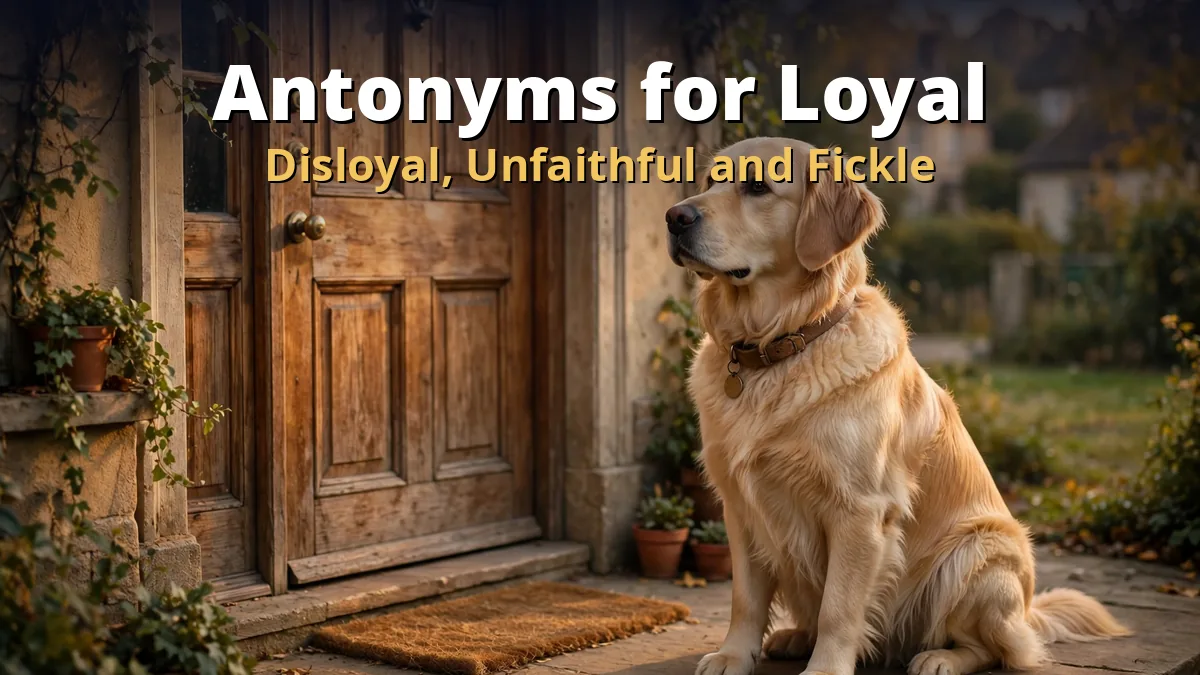
The direct opposite of loyal is disloyal. Unfaithful fits when trust is broken, above all in a marriage or a solemn promise. Fickle describes someone whose support keeps changing with mood or advantage. Treacherous is the strongest word of the group, for a betrayal that causes real harm.
Quick Comparison
| Word | Type | Meaning | Example |
|---|---|---|---|
| Disloyal | True opposite | Not standing by a person, group or cause | The disloyal officer sold secrets to the enemy. |
| Unfaithful | True opposite | Breaking trust, especially a marriage vow | She left him after he was unfaithful. |
| Fickle | Contextual opposite | Changing support often and without reason | The fickle crowd cheered a new hero each week. |
| Treacherous | Contextual opposite | Betraying trust in a way that harms | A treacherous guide led them into an ambush. |
| Faithless | Contextual opposite | Breaking a promise or a vow, literary in tone | The faithless knight abandoned his lord. |
What Loyal Means
Loyal means standing by a person, a group or a cause through good times and bad. A loyal friend stays when trouble comes. A loyal customer keeps coming back to the same shop and A loyal soldier serves one side and does not switch. Loyalty proves itself over time, in what a person does when leaving would be easier. Its opposites are therefore words about leaving, switching sides or breaking trust.
Core Antonyms
1. Disloyal
Meaning: Failing to stand by a person, group or cause you belong to.
Example: He was disloyal to his old friends and repeated their private talk in public.
Best context: General use, for friends, parties, teams and countries.
Nuance: Disloyal is the exact reverse of loyal, with no extra colour. If in doubt, this is the safe choice.
2. Unfaithful
Meaning: Breaking the trust of a close bond, most often a marriage.
Example: The novel tells of an unfaithful husband and the wife who forgives him.
Best context: Marriage, vows and solemn promises.
Nuance: Unfaithful carries a personal and moral weight that disloyal lacks. Outside marriage it sounds strong, so writers use it with care.
3. Fickle
Meaning: Changing your support, taste or affection often and for shallow reasons.
Example: Fickle fans praised the team in May and booed it in June.
Best context: Fans, voters, customers and public opinion.
Nuance: A fickle person may never betray anyone. The fault is changeableness, not treachery.
4. Treacherous
Meaning: Betraying trust in a way that brings harm to the person betrayed.
Example: The treacherous minister opened the city gates to the enemy at night.
Best context: War, politics and serious betrayal in stories.
Nuance: Treacherous is far stronger than disloyal. It adds danger and damage to the broken trust.
5. Faithless
Meaning: Breaking faith, a promise or a vow.
Example: The faithless ally signed the treaty and broke it within a year.
Best context: Literature, history and formal writing.
Nuance: Faithless overlaps with unfaithful but sounds older and more solemn. In daily speech, unfaithful is the common choice.
Opposites by Context
Friendship: disloyal fits a friend who leaves in trouble or talks against you.
Marriage and promises: unfaithful is the word for broken trust in a close bond.
Fans and voters: fickle fits support that swings with every result.
War and politics: treacherous fits a betrayal that hands an advantage to an enemy.
Words That Are Not Antonyms
Obedient means following orders. A loyal friend may refuse an order to protect you, so obedience and loyalty are different qualities.
Honest means telling the truth. A person can be honest and still disloyal, by openly walking away.
New says nothing about loyalty. A new friend can prove loyal, and an old friend can fail the test.
Example Sentences
- He was a mischievous boy, yet deeply loyal to his younger sister.
- The disloyal clerk copied the files and sold them to a rival firm.
- Their fans are fickle, loud in victory and silent in defeat.
- She stayed loyal to the small shop that had served her family for years.
- A treacherous ally is worse than an open enemy.
Common Mistakes
Incorrect: She is loyal, so she never questions the plan.
Correct: She is loyal, and she questions the plan because she wants it to succeed.
Why: Loyalty means standing by people. It does not mean silence, and a loyal friend often speaks up first.
Incorrect: The fickle guard betrayed the fort for gold.
Correct: The treacherous guard betrayed the fort for gold.
Why: Fickle means changeable in support. A deliberate betrayal for gain is treacherous.
Incorrect: The fans called him unfaithful for changing his club.
Correct: The fans called him disloyal for changing his club.
Why: Unfaithful belongs chiefly to marriage and solemn vows. For teams and parties, disloyal is the natural word.
Mini Quiz
- Which word is the direct opposite of loyal: disloyal or obedient?
Answer: Disloyal. Obedience is a separate quality. - Supporters cheer in May and boo in June. Which word fits: fickle or treacherous?
Answer: Fickle. Their support keeps changing, but no one is betrayed. - True or false: unfaithful is the best word for a soldier who changes sides.
Answer: False. Disloyal or treacherous fits; unfaithful belongs mainly to close personal bonds.
Short Q&A
What is the single best opposite of loyal?
Disloyal. It reverses the meaning exactly and fits almost every context.
What is the difference between disloyal and unfaithful?
Disloyal is general, for any person, group or cause. Unfaithful is personal, for broken trust in marriage or a solemn promise.
Is fickle as strong as treacherous?
No. Fickle means changeable. Treacherous means a betrayal that causes harm.
Can a loyal person disobey an order?
Yes. Loyalty is standing by a person or cause, not blind obedience. The two ideas often travel together but they are not the same.
Key Takeaways
- The direct opposite of loyal is disloyal.
- Unfaithful belongs to marriage and solemn promises, where trust is broken.
- Fickle means support that keeps changing; treacherous means betrayal with harm.
- Obedient, honest and new are separate ideas, not antonyms of loyal.

I’m Leo Jackson, an English writer with a soft spot for the peculiarities of language and vocabulary. He specializes in exploring the nuances of English synonyms, antonyms, helping students, writers, and professionals choose the right word with confidence. My guides combine careful research with clear, practical explanations.