Quick Answer
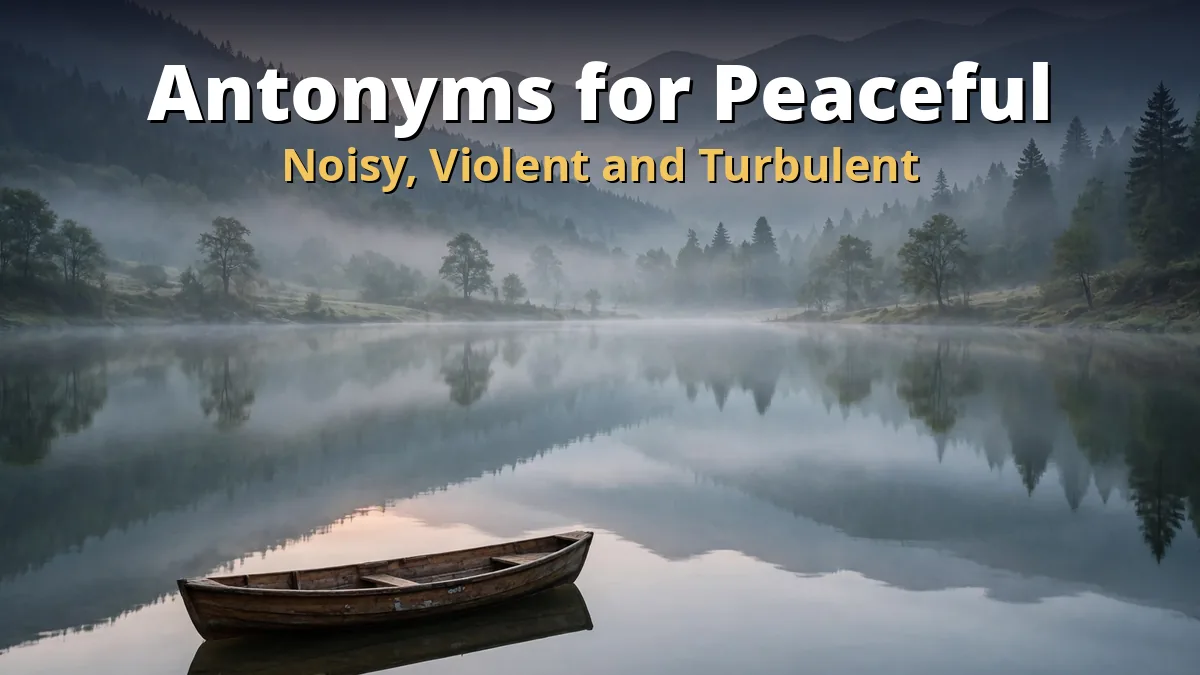
Peaceful carries two main senses, and each sense has its own opposites. For a quiet place or moment, the opposites are noisy and restless. For a gathering or a period free of fighting, the opposites are violent and turbulent. Chaotic covers disorder in either sense. Choose the word that matches the sense in your sentence.
Quick Comparison
| Word | Type | Meaning | Example |
|---|---|---|---|
| Noisy | True opposite | Full of loud or unwanted sound | The noisy street kept the guests awake. |
| Violent | True opposite | Involving force that harms people or property | Violent clashes broke out after the match. |
| Turbulent | Contextual opposite | Marked by unrest, disorder and change | The country passed through turbulent years. |
| Restless | Contextual opposite | Unable to stay calm or still | The restless crowd pushed against the gates. |
| Chaotic | Contextual opposite | In a state of complete disorder | Chaotic scenes followed the sudden storm. |
What Peaceful Means
Peaceful describes a place, a time or an event that is calm and free from disturbance. A peaceful village is a quiet one. A peaceful protest is a gathering with no fighting. A peaceful night is a night of undisturbed sleep. Two threads run through every use of the word: quietness, and the absence of conflict. The opposites divide along those same two lines, which is why no single word reverses peaceful in every sentence.
Core Antonyms
1. Noisy
Meaning: Making a lot of sound, or full of unwanted sound.
Example: The hotel room faced a noisy market, and sleep came slowly.
Best context: Places, streets, rooms, machines and gatherings.
Nuance: Noisy is the everyday opposite of peaceful in its quiet sense. It says nothing about fighting; a noisy wedding is joyful and still not peaceful.
2. Violent
Meaning: Using physical force meant to hurt or damage.
Example: The peaceful march turned violent when a small group began throwing stones.
Best context: Protests, conflicts, crimes and periods of unrest.
Nuance: Violent is the true opposite of peaceful in its conflict sense. It is a strong word, kept for real harm or the threat of it.
3. Turbulent
Meaning: Marked by disorder, unrest and sudden change.
Example: She grew up in a turbulent decade and valued quiet all her life.
Best context: Periods of history, regions, politics and relationships.
Nuance: Turbulent works on a larger scale than noisy. Years, countries and markets turn turbulent; a single room rarely does.
4. Restless
Meaning: Unable to rest or stay calm, always moving or uneasy.
Example: The baby had a restless night, and so did her parents.
Best context: Sleep, crowds, children and people waiting.
Nuance: Restless describes a state inside a person or a crowd. It opposes the calm of peaceful rather than its quiet.
5. Chaotic
Meaning: In complete disorder, with no control or pattern.
Example: The station was chaotic after all the trains were cancelled at once.
Best context: Scenes, events, traffic and organisations in disorder.
Nuance: Chaotic can be loud or silent. What it removes is order, and peaceful order is gone with it.
Opposites by Context
A place: noisy or chaotic fits a street, a market or a station.
A protest or gathering: violent or turbulent fits a crowd that turns to fighting or unrest.
Sleep and rest: restless fits a night broken by waking and turning.
A period of history: turbulent or violent fits years of war and upheaval.
Words That Are Not Antonyms
Busy means full of activity. A busy market can stay peaceful when the noise is friendly and no one is fighting.
Awake is not the opposite of peaceful. A person can sit awake by a window, perfectly peaceful.
Exciting means stirring interest or joy. A peaceful festival can still be lively, so excitement and peace are not enemies.
Example Sentences
- After a challenging week at the office, she asked for one peaceful evening at home.
- The village stayed peaceful while the noisy town celebrated all night.
- What began as a peaceful protest ended in violent scenes.
- The lake is peaceful at dawn, before the boats arrive.
- He left the turbulent city years behind him and never returned.
Common Mistakes
Incorrect: It was a peaceful war.
Correct: It was a peaceful period after the war.
Why: War is fighting by definition. Peaceful can describe the time around a war, never the war itself.
Incorrect: The crowd stayed peaceful and violent at the same time.
Correct: The crowd stayed peaceful, and only a few people turned violent.
Why: The two words describe opposite states. Use them for different groups or different moments.
Incorrect: The library was turbulent because many students were talking.
Correct: The library was noisy because many students were talking.
Why: Turbulent belongs to unrest on a larger scale. Ordinary sound in a room is noise.
Mini Quiz
- Which word opposes a peaceful street: noisy or busy?
Answer: Noisy. A busy street can still be peaceful. - A demonstration ends in fighting. Which word fits: violent or restless?
Answer: Violent. Real force and harm are involved. - True or false: turbulent can describe a single quiet room.
Answer: False. Turbulent fits periods, regions and large scale unrest.
Short Q&A
What is the single best opposite of peaceful?
There are two, one for each sense. Noisy opposes the quiet sense, and violent opposes the sense of freedom from fighting.
What is the difference between noisy and chaotic?
Noisy is about sound. Chaotic is about disorder, which may be loud or silent.
Is restless an antonym of peaceful?
Yes, for people, crowds and sleep. A restless night is the opposite of a peaceful one.
Can a place be busy and peaceful at once?
Yes. Busy means full of activity. Peaceful means calm and free of fighting, and the two often go together.
Key Takeaways
- Peaceful has two senses, quietness and freedom from conflict, and its opposites split between them.
- Noisy opposes quiet places and moments; violent opposes gatherings and times without fighting.
- Turbulent works at the scale of years and countries, and restless fits people, crowds and sleep.
- Busy, awake and exciting are not antonyms of peaceful.

I am Calara Stephen, passionate about making English simple and easy to understand through clear synonym, antonyms, word comparisons, vocabulary guides, and language tips. Through thoughtful, reliable content, I aim to be a trusted guide for anyone looking to expand their English vocabulary.