Quick Answer
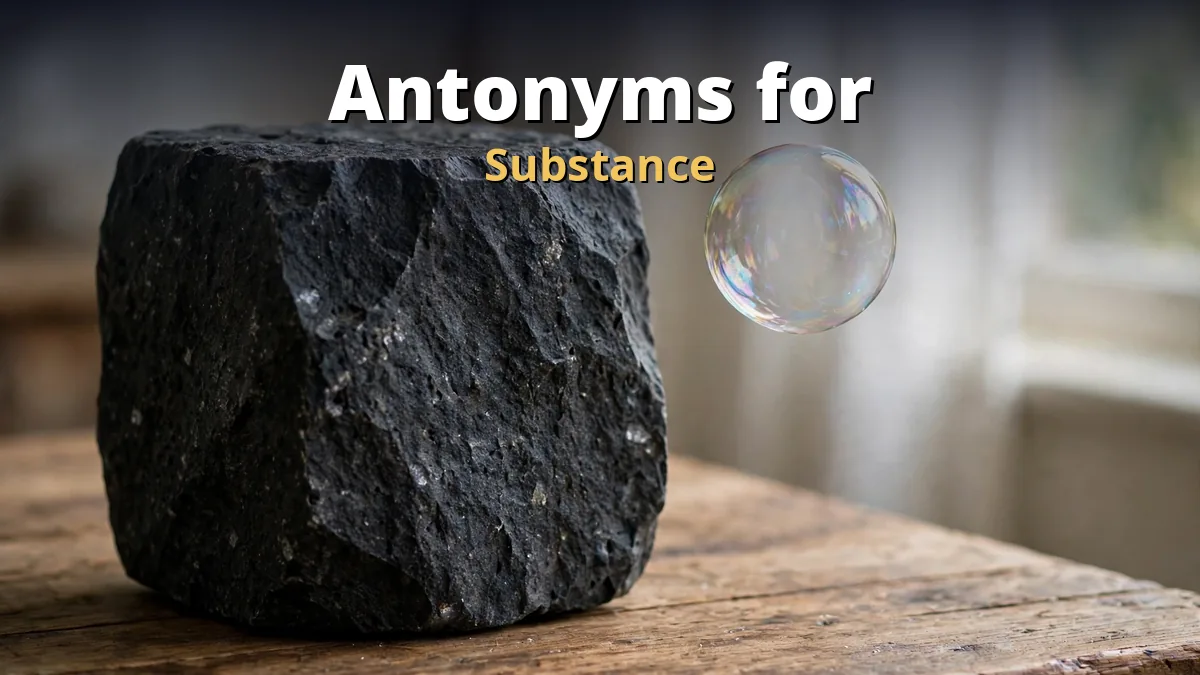
Substance has three working senses, and each has its own opposite. For physical matter, the opposite is emptiness space with nothing in it. For reality and solidity (“the substance of the claim”), the opposite is illusion or mere appearance and for importance (“a person of substance,” “an argument of substance”), the opposite is insignificance.
Quick Comparison
| Word | Type | Meaning | Example |
|---|---|---|---|
| Emptiness | True opposite (physical) | The state of containing nothing; a complete lack of material | Emptiness answered her the jar held not a crumb. |
| Illusion | True opposite (reality) | Something that seems real but is not; appearance without reality | The oasis was an illusion; there was no water at all. |
| Insignificance | True opposite (importance) | Lacking weight, value or consequence | The objection sank into insignificance beside the main charge. |
| Nothingness | Strong opposite (existence) | The state of there being nothing at all | Between the stars lies near-nothingness. |
What Substance Means
Substance starts as the physical stuff things are made of a sticky substance, a banned substance, the substance of the soil. From matter it grows two figurative branches. One is reality and essence the substance of a speech is its real content, as against its style; a shadow has appearance without substance. The other is weight and worth a person of substance has standing and means; an issue of substance matters.
Because the branches are real, no single word reverses the whole tree, and honest vocabulary work refuses to pretend otherwise. What can be done and what this article does is to match each sense with the word that truly reverses it. A hollow object is the everyday picture of the middle sense: the shape is there; the substance is not.
Core Antonyms
1. Emptiness
Meaning: The condition of a space or container holding nothing; by extension, a complete lack of content.
Example: She shook the tin and heard the emptiness not a spoonful of tea remained.
Best context: Containers, rooms, land, stomachs; also speeches and promises felt to contain nothing (“the emptiness of the excuse”).
Nuance: Emptiness reverses substance the material: matter present becomes matter absent. In its figurative use it judges content the way a hand judges a jar by finding nothing there when something was expected.
2. Illusion
Meaning: A false appearance; something taken for real that has no reality behind it.
Example: His authority was an illusion the title was real, the power was not.
Best context: Appearances, images, hopes, power, wealth anything whose show exceeds its reality.
Nuance: Illusion answers the reality sense of substance precisely: substance is what a thing truly is; illusion is what it merely seems to be. Appearance is this word’s milder cousin (the appearance of wealth), illusion its sharper one, where the seeming actually deceives.
3. Insignificance
Meaning: The quality of not mattering; having no weight, value or consequence.
Example: Set against the famine, their quarrel over seats shrank to insignificance.
Best context: Arguments, objections, sums of money, people in formal judgement (“a person of no significance” is the old, cold phrasing).
Nuance: Insignificance does not say a thing does not exist it says it does not count. That is exactly the axis of substance’s third sense, where the word measures weight in the world rather than presence in a jar.
4. Nothingness
Meaning: The state of nothing existing; complete absence, a void.
Example: He stared into the nothingness beyond the unlit road.
Best context: Philosophy, space, darkness and strong literary writing the extreme end of the physical scale.
Nuance: Nothingness is emptiness carried to its limit: not a container without contents but reality without contents. It is too strong for ordinary sentences, and this article places it honestly at the far end rather than offering it as the everyday answer.
Opposites by Context
In law and argument (“the substance of the case”): form without content technicality and mere wording. Lawyers set substance against form as a working pair: a point of substance changes outcomes; a point of form only changes paperwork.
In cooking and materials (“a substance of…”): thinness and dilution. A sauce with substance is reversed by a watery one; the working opposite in kitchens is “no body” thin, weak, watery.
Of a person (“of substance”): the social opposites are lightness and obscurity a lightweight, a nobody, in blunt speech. Careful writing prefers “of little standing.”
Words That Are Not Antonyms
- Matter, material, stuff, essence: substance’s own family essence in particular is nearly its twin in the “real content” sense.
- Shadow: a traditional contrast in poetry (“shadows and substance”), but in plain vocabulary a shadow is an image or a darkness, not the reverse of matter; illusion does that work exactly.
- Abstract: in philosophy the abstract is set against the concrete, not directly against substance; borrowing it here confuses two different contrasts.
Example Sentences
- Substance: A black, tar-like substance had spread across the shore.
- Emptiness: The hall’s emptiness echoed every footstep.
- Illusion: The calm of the market was an illusion; panic began at noon.
- Insignificance: Her early failures faded into insignificance beside the final success.
- Nothingness: Above the clouds there was only light and nothingness.
Common Mistakes
1. “Substance” where “substances” (drugs) is meant and back
Incorrect: The report found substance in the driver’s blood (meaning drugs).
Correct: The report found substances in the driver’s blood / a banned substance.
Why? The drug sense is countable substances, a substance. Bare “substance” uncounted means matter or essence, so the sentence above reads as if essence were found in the blood.
2. Insubstantial confused with unsubstantial then misused
Incorrect: His argument was very unsubstantial and thin.
Correct: His argument was insubstantial.
Why? Insubstantial is the standard modern form for “lacking substance” (unsubstantial survives but is rare). Note that it is a true adjective opposite of substantial but it answers the adjective, while this article’s nouns answer the noun.
Mini Quiz
- “The speech had style but no ___.” Which opposite, illusion or substance’s absence best named how?
Answer: substance is what it lacked; of the opposites here, emptiness (of content) is the description, the speech was empty. - A mirage is best called an ___.
Answer: illusion, appearance with no reality behind it. - True or false: insignificance means a thing does not exist.
Answer: False, it means the thing does not matter; existence is the other axis.
Short Q&A
What is the single best opposite of substance?
There is none for all senses, and that is the honest answer. For matter, emptiness; for reality, illusion; for importance, insignificance. Pick by the sense in your sentence.
Is “nothing” an antonym of substance?
In spirit, yes, nothingness is the formal noun. In a plain sentence, “there was nothing in it” does the work better than any single word.
Substance and essence opposites or synonyms?
Near-synonyms in the “real content” sense. The substance of a book and the essence of a book claim almost the same thing.
What is the opposite of “a man of substance”?
Historically, “a man of no substance” the phrase simply negates. Modern writing says “of little standing” or, bluntly, a lightweight.
Key Takeaways
- Substance’s opposites split by sense: emptiness for matter, illusion for reality, insignificance for importance, with nothingness at the extreme.
- Matter, material and essence belong to substance’s own family.
- No single word reverses all three senses matching the sense is the skill this word teaches.

Hi, I’m Amna Akhtar. I write about word meanings, opposites, and the small distinctions that make English tricky. I don’t come at language purely from instinct, either. I have a peer-reviewed academic paper “Determinants of Jobs Satisfaction of Female Teachers: An Evidence from District Hafizabad, Pakistan,” published in education economics, and that research background shapes how I think about language content, I want it to actually help people learn, not just look correct on a page. Whether you’re a student, a writer, or just someone who wants to use the right word at the right moment, my goal is to make that easier for you.