Quick Answer
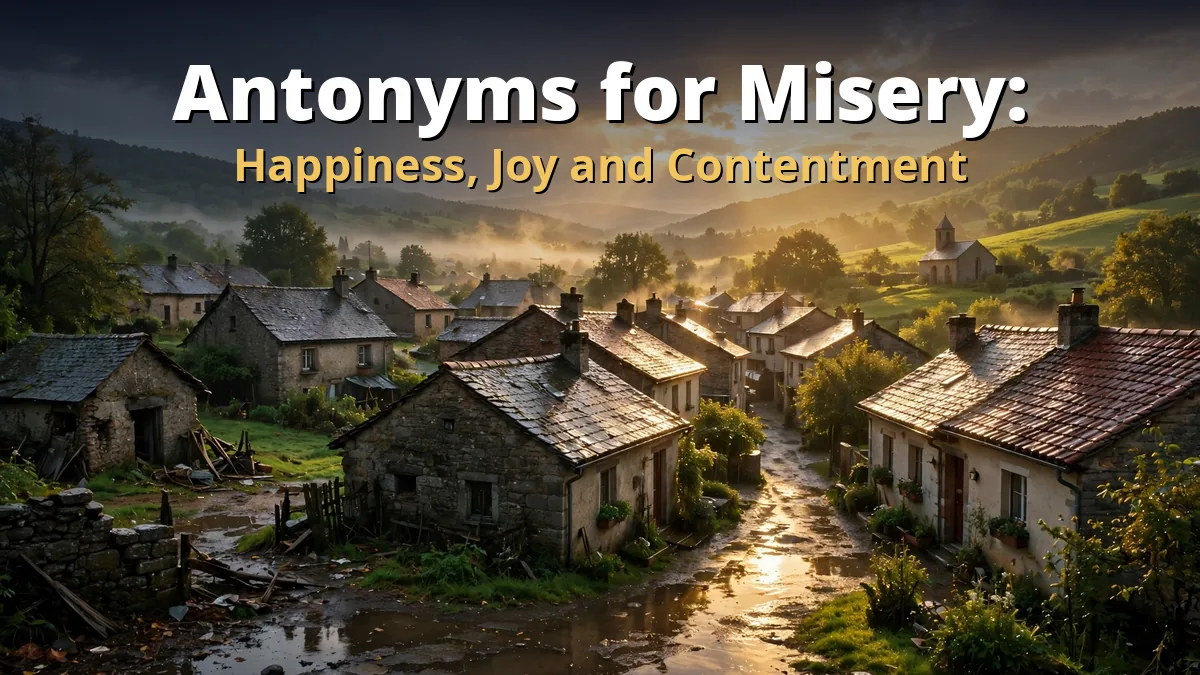
The main opposite of misery is happiness. Misery is deep and lasting unhappiness, often mixed with suffering or wretched conditions. Happiness reverses the feeling itself, joy names its brightest form, and contentment names its calm and settled form. Comfort answers the conditions sense, where misery describes a hard and painful life rather than a mood.
Quick Comparison
| Word | Type | Meaning | Example |
|---|---|---|---|
| Happiness | True opposite | A settled state of wellbeing and good feeling | After years of struggle she found real happiness in her work. |
| Joy | True opposite | Intense and bright happiness, often felt in a moment | The news of the baby filled the house with joy. |
| Contentment | True opposite | Quiet satisfaction with what one has | He lived in contentment on his small farm. |
| Comfort | True opposite (conditions) | A life free of hardship, pain and want | The pension let her spend old age in comfort. |
What Misery Means
Misery is stronger than sadness. Sadness passes; misery settles in. It names a state of great unhappiness and suffering, and it can come from inside, as grief or worry, or from outside, as poverty, illness or cruel treatment. English keeps a family of phrases for it: to live in misery, to put someone out of their misery, a life of misery. In every case the word points at pain that lasts and colours everything else.
Because misery covers both a feeling and a condition, its opposites divide the work. Happiness, joy and contentment reverse the feeling at three different brightness levels. Comfort reverses the condition: the hard bed, the empty cupboard and the untreated illness all belong to misery, and their absence belongs to comfort. A complete answer to this keyword needs both sides, which is why the table above lists four words instead of one.
Core Antonyms
1. Happiness
Meaning: The state of feeling well, glad and at peace with life over a stretch of time.
Example: The misery of the war years gave way to happiness so ordinary that nobody remarked on it, which was the best part.
Best context: Feelings and life states in general writing, essays, speeches and everyday speech.
Nuance: Happiness is the exact reverse in scale as well as direction. Misery is not a passing frown, and happiness is not a passing smile; both words describe conditions of a life, not moments in a day. When the sentence is about how someone feels in general, happiness is the word.
2. Joy
Meaning: Bright and intense happiness, usually tied to an event or a person.
Example: Her misery in the hospital ward ended the morning she held her grandchild, and joy did the rest.
Best context: Celebrations, reunions, births, victories and religious or poetic writing.
Nuance: Joy burns brighter than happiness and usually for a shorter time. It is the right opposite when the scene has a moment in it: news arriving, a door opening, a name called out. For long calm periods, happiness or contentment fits better.
3. Contentment
Meaning: Quiet satisfaction; wanting what one already has.
Example: The old fisherman knew contentment that the rich merchant, for all his gold, had traded for misery years ago.
Best context: Simple living, gratitude, enough rather than more, and writing about character.
Nuance: Contentment is misery’s opposite for people who were never chasing thrills. Misery often grows from wanting and lacking; contentment is the state where wanting stops. It is the gentlest of the three feeling words and often the most convincing in serious writing.
4. Comfort
Meaning: Freedom from pain, hardship and want; a life with enough warmth, food, rest and safety.
Example: The charity’s work was simple: to turn winter misery into comfort, one heated room at a time.
Best context: Living conditions, poverty, illness, old age and physical states.
Nuance: Comfort answers the conditions sense of misery and should not be stretched over pure emotion. A person can live in comfort and still grieve; a person can be poor and still content. Keep comfort for sentences about circumstances.
Opposites by Context
In poverty and hardship: prosperity and comfort. “The family lived in misery” reverses to “The family lived in comfort” or, where money is the point, “in prosperity.”
Under unjust power: freedom and relief. Misery imposed by cruelty lifts when the cruelty ends, and readers who want the vocabulary of that side of the topic can see our guide to antonyms for oppression, where release from unjust rule is the theme.
In illness and pain: health and ease. Misery in the body reverses to being well, and our pages on antonyms for health treat the wider wellbeing side of the contrast.
Words That Are Not Antonyms
- Sadness, grief, sorrow, gloom: misery’s own family. Grief is often a cause of misery and sorrow is a milder form of it; none of them reverses anything.
- Pleasure: a pleasant moment, too brief and too physical to reverse a state of life. A miserable man can feel a moment’s pleasure at a good meal and remain miserable.
- Luxury: comfort at the expensive end. It answers austerity or poverty more than misery, and plenty of people are miserable in luxury, which proves the words run on different tracks.
Example Sentences
- Misery: The long winter brought misery to the unheated houses on the hill.
- Happiness: Happiness returned to the house with the spring and the letters.
- Joy: There was joy in the street when the team came home.
- Contentment: She asked for little and found contentment in her garden.
- Comfort: After the pension began, he lived in comfort for the first time.
Common Mistakes
1. Misery for ordinary sadness
Incorrect: I was in complete misery because the shop had closed early.
Correct: I was annoyed because the shop had closed early.
Why? Misery is a heavy word for lasting suffering. Spending it on a closed shop makes real misery in the next sentence sound smaller than it is. Match the word to the weight of the thing.
2. “Miseries” for small troubles
Incorrect: The miseries of my day included a slow bus and cold tea.
Correct: The annoyances of my day included a slow bus and cold tea.
Why? Writers do use miseries playfully, and in humour it can work. In plain or formal writing it reads as exaggeration. Annoyances, troubles and setbacks say the same thing at the right size.
Mini Quiz
- “After the long illness, she finally lived in ___.” Which word fits: comfort or joy?
- Which opposite suits a quiet life that wants nothing more?
- True or false: grief is an antonym of misery.
Answer: Comfort. The sentence is about conditions after hardship, not a bright moment.
Answer: Contentment.
Answer: False. Grief belongs to misery’s own family and often causes it.
Short Q&A
What is the single best opposite of misery?
Happiness. It reverses the feeling at the same scale, a state of life against a state of life.
Is bliss an antonym of misery?
Yes, at the highest intensity. Bliss is perfect and complete happiness; it suits religious and poetic writing more than everyday prose, where joy usually does the work.
Can misery describe a place or a life, not just a feeling?
Yes. “A life of misery” is about conditions, and there the opposites are comfort and prosperity rather than joy.
What is the difference between joy and contentment here?
Joy is bright and brief, tied to a moment. Contentment is calm and lasting, tied to wanting nothing more. Misery can be reversed by either, in different scenes.
Key Takeaways
- Happiness is the true general opposite of misery; joy is its brightest form and contentment its calmest.
- For misery as living conditions, the opposites are comfort and prosperity.
- Sadness, grief and sorrow are misery’s family, never its opposites, and pleasure is too brief to reverse a state of life.

I’m Leo Jackson, an English writer with a soft spot for the peculiarities of language and vocabulary. He specializes in exploring the nuances of English synonyms, antonyms, helping students, writers, and professionals choose the right word with confidence. My guides combine careful research with clear, practical explanations.