Quick Answer
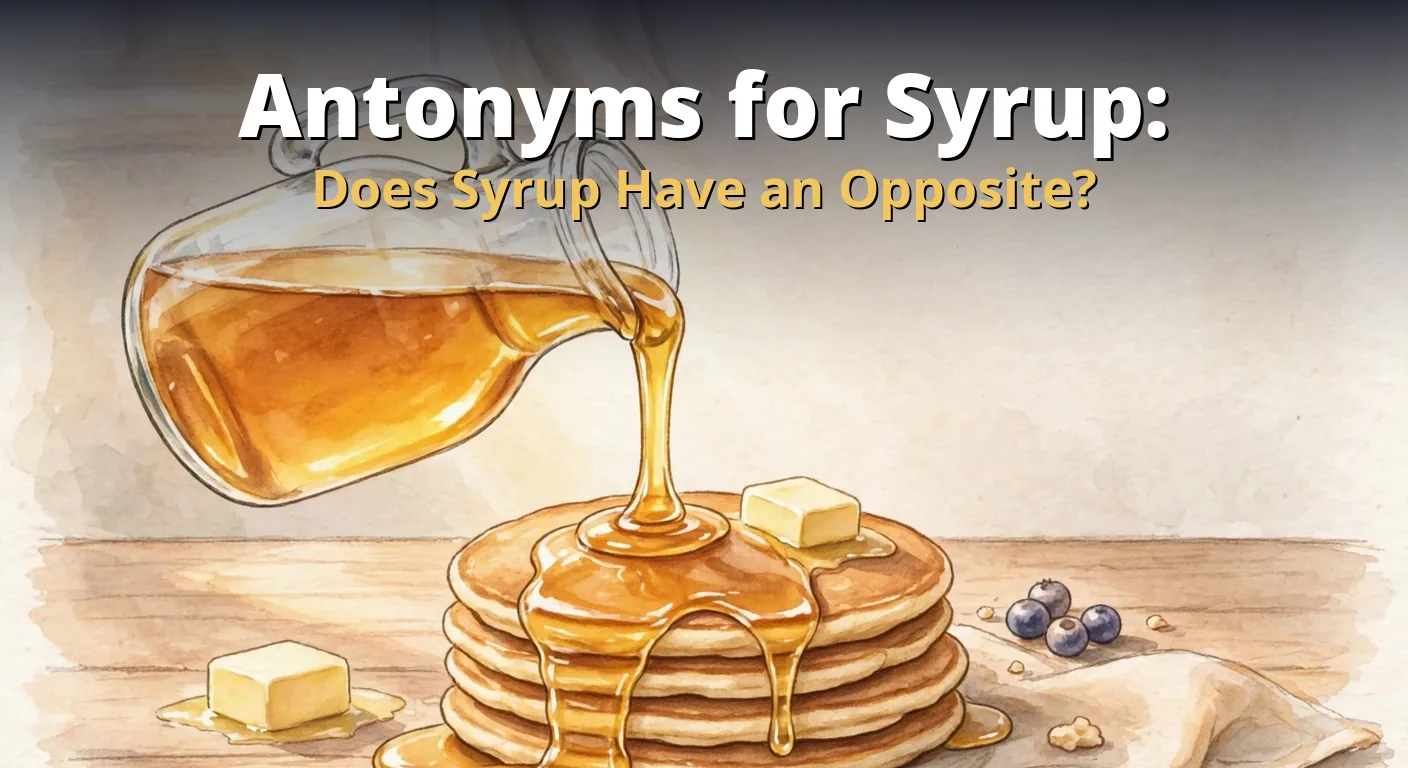
Syrup has no true dictionary antonym, and that is the honest answer rather than a gap in the language. Antonyms pair up words for qualities and states: sweet/bitter, thick/thin. Syrup names a substance: a thick, sweet liquid made by dissolving sugar in water, or drawn from a plant, like maple syrup. Substances do not sit on a scale you can run backwards: milk, honey and soup have no antonyms either.
So when people ask for the opposite of syrup, they are really asking about one of its features: and each feature has its own genuine contrast:
- Sweetness: the contrasting side is an unsweetened liquid, or a bitter one.
- Thickness: the contrasting side is a thin, watery liquid, with plain water as the everyday example.
- Flavour direction: the contrasting side is a savoury liquid such as stock or brine.
One more thing the short lists miss: the adjective syrupy does have real opposites: dry in food and wine writing, unsentimental or matter-of-fact for tone (covered below).
Quick Comparison
| Feature | Syrup is… | The contrasting side | Example |
|---|---|---|---|
| Sweetness | Sweet | Unsweetened: a liquid with no sugar added | She ordered unsweetened iced tea instead of the syrup-sweet cola. |
| Sweetness | Sweet | Bitter: the opposite end of the taste scale | The tonic water tasted bitter beside the sweet syrup. |
| Thickness | Thick and slow-pouring | Thin, watery: free-flowing, like water | The thin stock ran through the sieve; the syrup clung to it. |
| Flavour direction | A sweet-cooking liquid | Savoury: stock, broth or brine | The glaze used savoury stock where a dessert would use syrup. |
What Syrup Is
Syrup is a liquid defined by three features working together: it is sweet, it is thick, and it is liquid. Sugar syrup is made by dissolving sugar in hot water until the mixture turns viscous; maple syrup is tree sap boiled down until it thickens. Syrups appear in cooking, in drinks, and in medicine, where the sweetness makes bitter drugs easier to swallow.
All three features are qualities: and qualities are exactly the things that have opposites. That is why the honest answer to “what is the opposite of syrup?” runs feature by feature, not through a single magic word. (The same sweetness in solid form is simply sugar: a close relative, not an opposite.)
If You Mean the Sweetness: Unsweetened and Bitter
Syrup’s most obvious feature is its sweetness, so this is the contrast most searchers want.
Unsweetened is the direct contrast: a liquid with no sweetener in it: unsweetened tea, unsweetened almond milk, black coffee taken plain. Be clear about what kind of word this is: unsweetened is an adjective describing the liquid, not a substance standing opposite syrup. On this axis, the describing word is genuinely the best answer English offers.
Bitter goes one step further: unsweetened means the absence of sweetness, while bitter is a positive taste in its own right, at the far end of the flavour scale. Bitter liquids are common: tonic water, black coffee, grapefruit juice: and where a sentence sets sweet syrup against something actively tasting the other way, bitter does the work.
If You Mean the Thickness: Thin and Watery
Syrup clings, coats and pours in a slow ribbon. The contrasting quality is thinness: a thin liquid runs freely and passes through a sieve without resistance. Watery makes the same point with a hint of weakness: a watery sauce is one that failed to thicken.
Here is where water belongs, labelled honestly. Water is the everyday example of a thin, free-flowing liquid, and recipes reach for it constantly (“thin the syrup with a little water”). But water is an example of the thin side of the contrast, not “the antonym of syrup”: a different substance altogether. Presenting it as a dictionary-style opposite is what makes short syrup lists misleading: and it cannot do double duty, either: old lists let the same water stand for the unsweetened entry as well, though one substance cannot answer two different features.
If You Mean the Flavour Direction: Savoury Liquids
In the kitchen, syrup belongs to the sweet side of cooking: desserts, glazes, drinks. The opposite direction is savoury: salty, brothy, umami flavours. The liquids on that side have their own names: stock and broth (the cooking liquid from meat or vegetables) and brine (salted water for pickling and curing).
Say plainly what kind of answer this is: English has no single word meaning “a savoury liquid” in the way syrup names a sweet one. “Savoury liquid” is a description, not a word, and a list printing it as an antonym entry is dressing a phrase up as vocabulary. The flavour axis is real; its inhabitants are those specific liquids, each the savoury worker where syrup is the sweet one.
The Adjective “Syrupy” Has Real Opposites
Everything above applies to the noun. The derived adjective syrupy: thick and sweet, or excessively sweet: behaves like other adjectives and has genuine opposites:
- In food and drink writing: the contrasting word is dry. A dry wine is precisely one that is not sweet, and critics praise desserts that are “rich but not syrupy,” balanced by something sharp or tart.
- In tone: a syrupy novel, song or speech is over-sweet and sentimental. Its opposites are unsentimental, dry (a dry wit, a dry delivery) and matter-of-fact.
So if your sentence contains syrupy, real antonyms exist. Only the substance itself has none.
Words and Phrases That Are Not Antonyms
“Thin liquid” and “savoury liquid” presented as words
These are descriptions built from an adjective and a noun, not vocabulary items. The genuine words inside them: thin, savoury: are adjectives contrasting with syrup’s features, and that is how they should be presented.
Water as a standalone “opposite”
Water is a substance, like syrup, and two different substances cannot be antonyms. It earns its place here as the standard example of a thin liquid: not as a one-word answer.
Invented words: “unsyrup”, “anti-syrup”
No prefix turns a substance into its opposite: English has no “unmilk” or “unsoup” either.
Example Sentences
- The lemonade was sweetened with syrup; his glass held plain unsweetened tea.
- Bitter tonic water cut through the sweetness of the fruit syrup.
- The sauce stayed thin and watery instead of thickening into a syrup.
- She deglazed the pan with savoury stock, where the dessert recipe called for syrup.
Common Mistakes
Mistake 1: Calling water “the antonym of syrup”
Water and syrup are two different substances. Water can illustrate a contrast: thin where syrup is thick: but listing it as a word-for-word opposite claims a relationship that does not exist.
Mistake 2: Counting phrases as antonym entries
“Unsweetened liquid,” “thin liquid,” “savoury liquid”: three phrases built by swapping one adjective. Real answers name the contrasting quality (unsweetened, thin, savoury) or a specific liquid (stock, brine), and say which they are doing.
Mistake 3: Letting one example cover two features
Water is both thin and unsweetened, which tempts list-makers into using it twice: how a four-item list quietly becomes two ideas. Each feature axis gets its own contrast; no entry moonlights on a second axis.
Mistake 4: Using “dry” as the opposite of the noun syrup
Dry opposes syrupy (and sweet, of wine): it describes a quality, so it cannot answer a bottle of syrup any more than a bottle of milk. Match the word class: nouns take contrasts, adjectives take antonyms.
Mini Quiz
1. Does syrup have a true dictionary antonym?
A. Yes: water
B. No: it names a substance, so only its features have contrasts
C. Yes: “thin liquid”
Answer: B. Water is a different substance, and “thin liquid” is a phrase. Sweetness, thickness and flavour direction are the axes carrying real contrasts.
2. A wine critic writes: “Sweet and syrupy, nothing like the _ style of the region’s best bottles.” Which word is the genuine opposite?
A. Dry
B. Watery
C. Unsyrup
Answer: A. Of a wine, dry means not sweet: the established opposite of syrupy. “Unsyrup” is not an English word.
3. “The mixture should pour freely, not cling like syrup.” Which feature of syrup is being contrasted?
A. Its sweetness
B. Its flavour direction
C. Its thickness
Answer: C. Pouring and clinging are about viscosity: the thickness axis, whose contrasting words are thin and watery.
Short Q&A
Q: What is the opposite of syrup?
A: Strictly, there isn’t one: syrup is a substance, not a quality. The genuine contrasts attach to its features: unsweetened or bitter against its sweetness, thin or watery against its thickness, and savoury liquids like stock and brine against its place in sweet cooking.
Q: Is water the antonym of syrup?
A: No. Water is another substance, not an opposite: simply the most familiar example of a thin, free-flowing liquid, which is why it illustrates the thickness contrast so well.
Q: What is the opposite of “syrupy”?
A: That one exists. For food and wine, dry (with sharp or tart for balance). For tone: a syrupy song or speech: unsentimental, dry or matter-of-fact.
Q: What contrasts with syrup in savoury cooking?
A: No single word: there is no noun meaning “a savoury liquid.” The liquids doing syrup’s opposite job in the kitchen are named individually: stock, broth and brine.
Key Takeaways
- Syrup has no true dictionary antonym: it names a substance: a thick, sweet liquid: and substances do not reverse like qualities do.
- The honest contrasts run feature by feature: unsweetened and bitter for sweetness, thin and watery for thickness (with water as the example, not the answer), stock, broth and brine for the savoury direction.
- English has no single word for “a savoury liquid,” and phrases like “thin liquid” are descriptions, not antonym entries.
- The adjective syrupy does have real opposites: dry for food and wine, unsentimental and matter-of-fact for tone.

I am Calara Stephen, passionate about making English simple and easy to understand through clear synonym, antonyms, word comparisons, vocabulary guides, and language tips. Through thoughtful, reliable content, I aim to be a trusted guide for anyone looking to expand their English vocabulary.