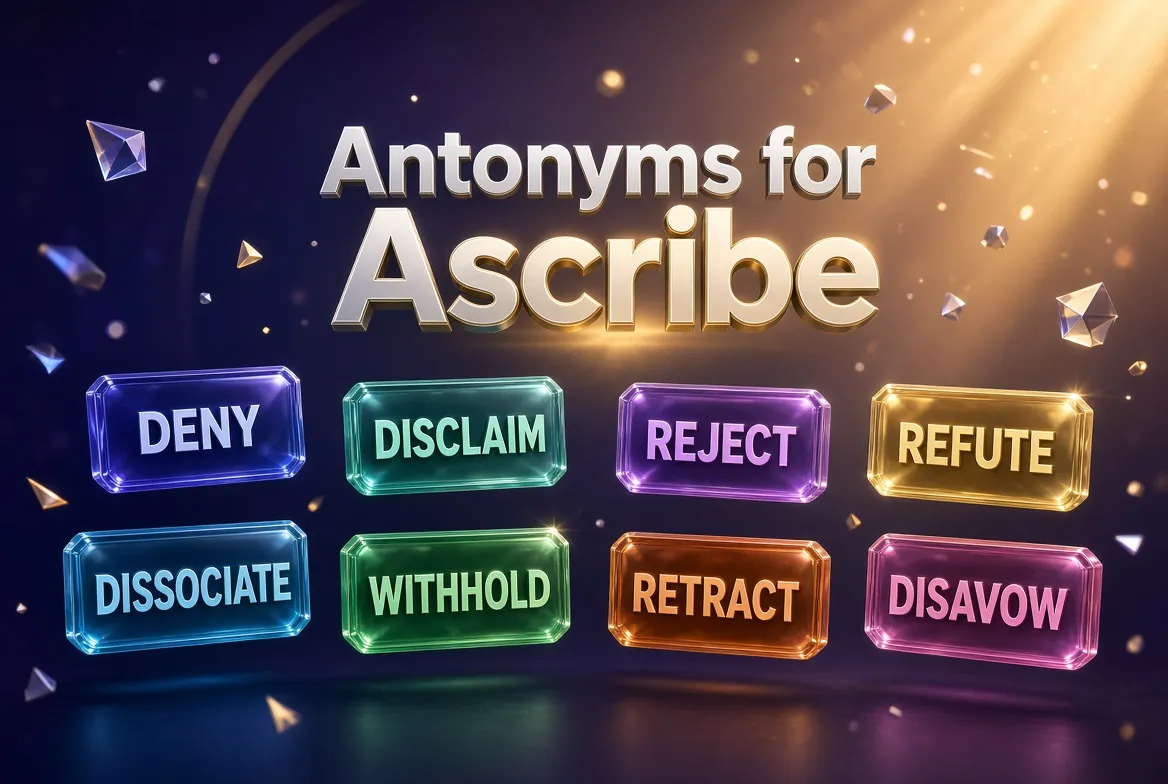
What is the opposite of “ascribe”?
The strongest opposite of ascribe is usually dissociate or disclaim, depending on context. Ascribe means to attribute something to a person, cause, or source. Its opposite may mean separating something from a source, refusing to attribute it, or assigning it elsewhere.
Quick Answer
The best antonym for ascribe depends on how the verb is being used:
- Dissociate: separate something from a person or cause.
- Disclaim: deny responsibility, authorship, or association.
- Disattribute: explicitly remove an attribution, though it is uncommon.
- Credit elsewhere: attribute something to a different person or source.
Because ascribe means “attribute,” there is no single perfect opposite in every sentence.
Ascribe vs. Its Main Opposites
| Word | Meaning | Example |
| Ascribe | Attribute something to a person, cause, or source | They ascribed the success to teamwork. |
| Dissociate | Separate something from a person, cause, or idea | The company dissociated itself from the statement. |
| Disclaim | Deny responsibility, authorship, or connection | The author disclaimed responsibility for the claim. |
| Credit elsewhere | Attribute something to another source | The discovery was credited to another researcher. |
Meaning in Brief
Ascribe: To attribute something to a particular person, cause, quality, or source.
Main antonym: Dissociate to separate a person, thing, or idea from a particular connection or attribution.
What You’ll Learn
- The main opposites of ascribe
- Why dissociate and disclaim are useful in different contexts
- How to choose the right antonym
- How these words work in natural sentences
Main Antonyms for Ascribe
1. Dissociate
Dissociate means to separate something from a person, cause, idea, or association.
Example:
The organization dissociated itself from the controversial statement.
This is often the closest contextual opposite when ascribe involves connecting something with a person or source.
2. Disclaim
Disclaim means to deny responsibility, authorship, ownership, or association.
Example:
The researcher disclaimed responsibility for the inaccurate report.
It works particularly well when ascribe means attributing responsibility or authorship.
3. Disassociate
Disassociate has essentially the same meaning as dissociate and is also used to mean separating or distancing something from an association.
Example:
The company disassociated itself from the comments.
Both dissociate and disassociate are established forms, although usage preferences can vary.
4. Deny
Deny means to say that something is untrue or that one does not accept responsibility for it.
Example:
The manager denied responsibility for the error.
It can function as an opposite when ascribe means assigning responsibility.
5. Reject
Reject means to refuse to accept something as valid, true, or applicable.
Example:
The historian rejected the claim that the invention could be ascribed to one individual.
Here, reject opposes the act of accepting an attribution rather than directly opposing the verb ascribe itself.
6. Remove
Remove can mean to take away an attribution or association.
Example:
The editor removed the attribution after discovering that the source was incorrect.
This is a practical contextual opposite rather than a dictionary-style direct antonym.
7. Reassign
Reassign means to assign something to a different person, group, or source.
Example:
The credit was reassigned to the research team after further investigation.
This is useful when the intended meaning is “attribute it to someone else.”
8. Attribute Elsewhere
Attribute elsewhere means to assign credit, responsibility, or origin to another source.
Example:
The achievement was attributed elsewhere after new evidence emerged.
This is not a single-word antonym, but it can express the intended contrast more naturally than an artificial antonym.
Choosing the Right Antonym
The opposite of ascribe changes slightly according to what is being attributed.
When ascribe means “attribute responsibility”
Use:
- disclaim
- deny
- reject responsibility
Example:
They ascribed the mistake to the new employee.
→ The new employee denied responsibility for the mistake.
When ascribe means “associate with”
Use:
- dissociate
- disassociate
- separate
Example:
The public ascribed the statement to the organization.
→ The organization dissociated itself from the statement.
When ascribe means “give credit or authorship”
Use:
- disclaim
- remove the attribution
- credit someone else
- reassign
Example:
The discovery was ascribed to Dr. Khan.
→ The discovery was credited to another researcher after new evidence appeared.
How These Antonyms Differ
Dissociate focuses on separation.
It is especially useful when a person or organization wants to distance itself from an idea, statement, action, or claim.
Disclaim focuses on denial of responsibility or ownership.
It is stronger when someone explicitly says, in effect, “This is not mine” or “I am not responsible.”
Deny is broader.
It can reject the truth of a claim or responsibility for an action, but it is not specifically an antonym of ascribe.
Reassign and credit elsewhere focus on changing the attribution rather than simply removing it.
Examples in Context
- The critic ascribed the novel’s success to its strong characters.
- The publisher disclaimed responsibility for the disputed statement.
- The organization dissociated itself from the campaign.
- The manager denied responsibility for the decision.
- The editor removed the incorrect attribution.
- New evidence caused researchers to reassign the discovery to another scientist.
- The company disassociated itself from the employee’s personal remarks.
- The historian rejected the claim that one person deserved all the credit.
Grammar and Word Class
Ascribe is a verb.
It commonly appears in the structure:
ascribe + something + to + someone/something
Researchers ascribed the improvement to better training.
Its contextual opposites are also mainly verbs:
- dissociate
- disclaim
- deny
- reject
- remove
- reassign
A useful distinction is that ascribe normally takes to when identifying the person or cause receiving the attribution.
A Closer Look at Usage
Compare:
They ascribed the success to hard work.
with:
They dissociated the company from the statement.
The prepositions change because the verbs express different relationships. Ascribe commonly uses to, while dissociate commonly uses from.
Commonly Confused Opposites
❌ “Dissociate” does not always mean “deny”
Dissociate means to separate or distance. It does not necessarily mean that something is false.
The company dissociated itself from the comment.
This says the company separated itself from the comment; it does not necessarily say the comment was false.
❌ “Deny” is not always the opposite of “ascribe”
If someone says:
The scientist ascribed the result to improved equipment.
The natural opposite is not necessarily:
The scientist denied the result.
A better contrast would be:
The scientist rejected the attribution or credited another factor.
Teacher’s Tip
Think of ascribe as “connect something to a source.”
Then choose the opposite based on what happens to that connection:
- Break the connection → dissociate
- Deny responsibility → disclaim
- Reject responsibility → deny
- Give credit to another source → reassign / credit elsewhere
Quick Antonym Quiz
Which word best completes the sentence?
The organization ______ itself from the controversial remarks.
A. ascribed
B. dissociated
C. credited
D. assigned
Answer: B. dissociated
Why? Dissociate means to separate or distance someone or something from an association.
Frequently Asked Questions
What is the opposite of ascribe?
There is no single universal antonym. Dissociate is a strong opposite when the meaning involves separating something from a person or source, while disclaim works well when denying responsibility or authorship.
Is dissociate the opposite of ascribe?
Dissociate can function as a contextual opposite of ascribe. Ascribe connects something to a source, while dissociate separates something from a source or association.
What is a stronger opposite of ascribe?
Disclaim can be a stronger contextual opposite when ascribe refers to responsibility, authorship, or ownership. Dissociate is more focused on separation or distancing.
Can deny always replace ascribe?
No. Deny means to reject the truth, validity, or responsibility for something. It does not specifically mean to reverse an attribution.
What is the difference between ascribe and dissociate?
Ascribe means to attribute something to a person, cause, or source. Dissociate means to separate something from a person, cause, idea, or association.
Key Takeaways
Ascribe means to attribute something to a particular person, cause, or source. Its opposite depends on the intended contrast. Dissociate is useful for breaking an association, disclaim for denying responsibility or authorship, and credit elsewhere for transferring attribution to another source.
Antonyms for Exploration: Meanings & Examples

I’m Leo Jackson, an English writer with a soft spot for the peculiarities of language and vocabulary. Specializes in exploring the nuances of English synonyms, antonyms, helping students, writers, and professionals choose the right word with confidence. My guides combine careful research with clear, practical explanations.